
Picture two identical used cars on a lot. Same make, same year, same mileage. One comes with a thick folder of stamped service records — every oil change, every timing belt, every inspection. The other comes with a shrug. The car with the folder sells faster and for more, and every buyer knows exactly why: a documented history is proof the thing was looked after, and a map of what has already been done. Houses cost far more than cars and last far longer — and almost nobody keeps that folder for them. A home maintenance log book is that folder, for your house.
The short answer: A home maintenance log book is one place to record the ordinary facts about your house — what the appliances are, when the systems were serviced, what color each room was painted, what has been repaired and who to call. You build it a line at a time as you learn the house. It makes daily life easier now, and it gives a buyer or the next owner a clear record the day you sell or hand the house on.
What a house's "service history" actually is
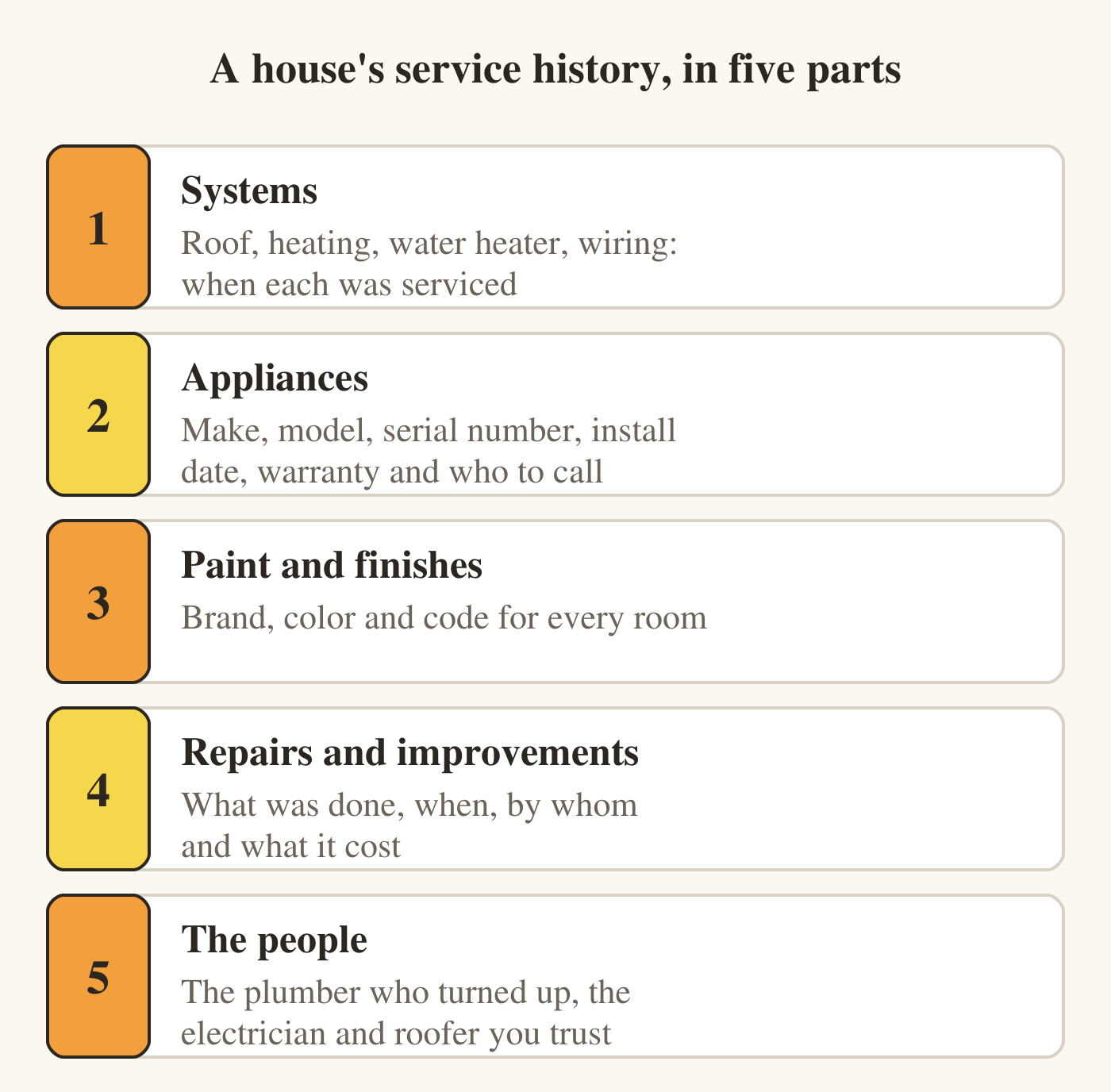
A car's service history is really just a set of answers, written down before you need them. A house has the same answers, scattered and unwritten:
- The systems and when they were touched — the roof, the heating, the water heater, the wiring. When was the boiler last serviced? When did the roof go on, and when does its warranty end?
- The appliances — make, model, serial number, install date, warranty, and who to call. The exact things you cannot find when the washing machine dies on a Sunday.
- Paint and finishes — the brand, color and code for every room, so a touch-up in three years is a five-minute job and not an afternoon of guessing.
- Repairs and improvements — what was done, when, by whom, and what it cost.
- The people — the plumber who actually turned up, the electrician you trust, the roofer who did good work.
None of it is complicated. All of it is easy to forget, and genuinely useful to have written down.
Start with where everything shuts off
If you record only one thing in a new house, record this: where the water shut-off, the gas shut-off and the electrical panel are. The stopcock — the main water shut-off — is the one people hunt for in a panic while a pipe is spraying, and it is never where you expect. Find all three on a calm afternoon, write down exactly where they are, and sketch it. It is the single most useful page in the whole book, and one day it will save your floor. The Home Maintenance Record Book includes sketch pages with places to mark the stopcock, gas shut-off and electrical panel, so their locations can be recorded alongside the written details.
The appliance trick: write it down once
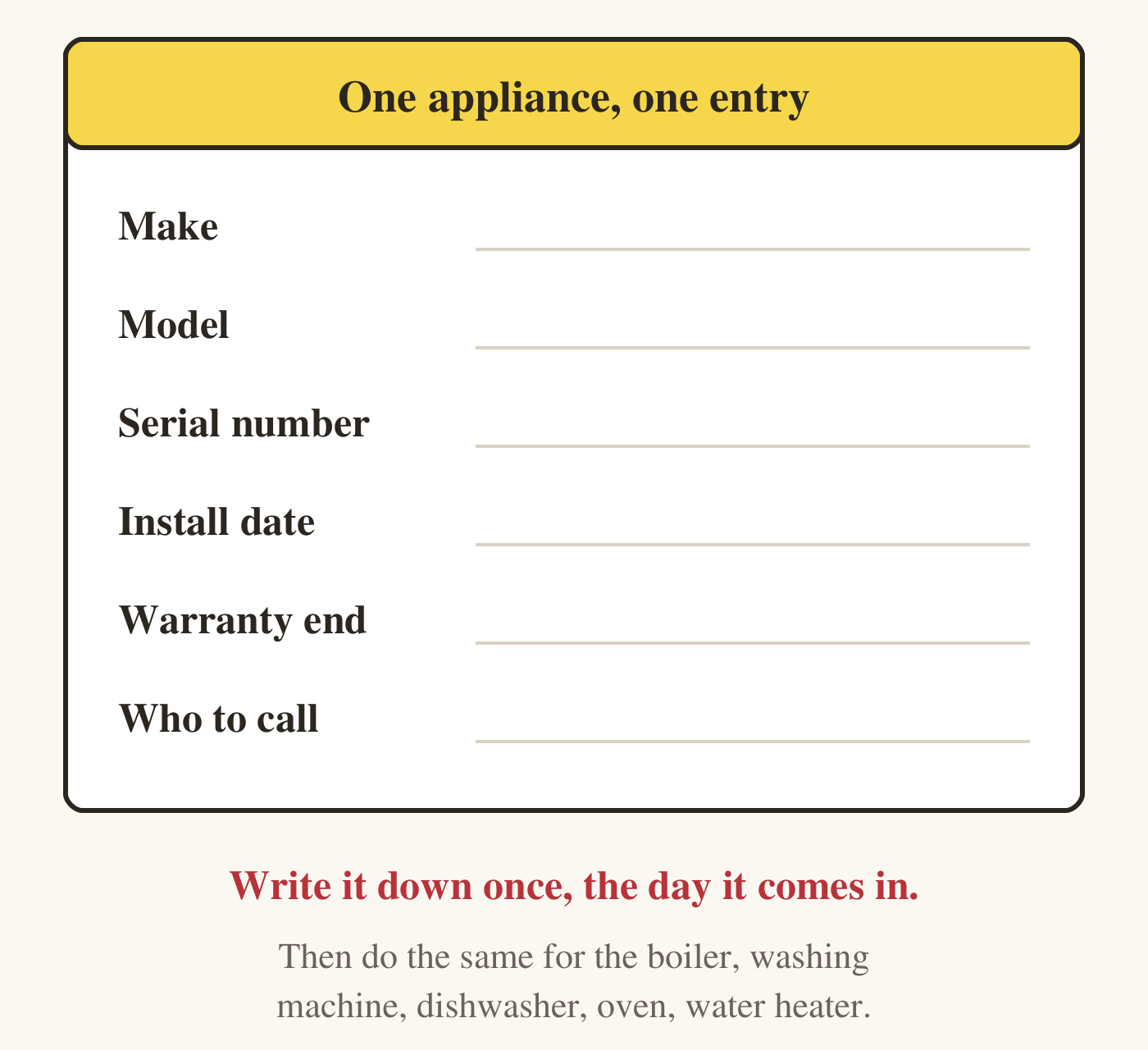
Here is the small habit that pays for the whole book. Every time an appliance comes into the house, spend two minutes recording its make, model, serial number, install date, warranty end, and who to call. Once. Then when it breaks — and it always breaks at the worst moment — you are not on your knees behind it with a flashlight, reading a smudged sticker to a call center. You open one page and you have everything.
Do that for the boiler, the washing machine, the dishwasher, the oven, the water heater, and you have removed most of the frantic-search moments from the next ten years of owning the house.
It pays you back twice
A home maintenance log earns its place two ways.
While you live there, it turns "I think we painted that about four years ago?" into a fact, and "who did the gutters last time?" into a phone number. The house stops feeling like a stranger and starts feeling like yours.
When you sell or hand it on, it gives a buyer, a surveyor or the next owner a clear record of what has been serviced, repaired and replaced, and where the supporting documents are kept. It does not prove the house was well maintained, guarantee a higher price or replace an inspection — but a clear, honest record is a real courtesy, and exactly the kind of thing that gets a housewarming or real-estate closing gift kept and used for years, instead of re-gifted.
A record, not a repair manual
One honest boundary: a log book is a record, not a how-to. It tells you what your house holds and what has been done to it — not how to rewire a socket. Anything genuinely unsafe is a job for a qualified tradesperson; the book is simply where you write down what they did, and when. Kept that way, it is useful to everyone and dangerous to no one.
How to keep one without it becoming a chore
- Add a line whenever something is fixed, replaced or discovered. You are not filling it in all at once. You are building it as you go.
- Keep it in a kitchen drawer, where you will actually reach for it — not on a high shelf with the manuals you never open.
- Adapt it to where you live. A good log is broadly country-neutral: it says "stopcock or main shut-off," and its seasonal checklists are meant to be swapped round for your own climate and hemisphere.
- Never write a full account number, password or PIN. For utilities and accounts, record only where those details are kept — so the book is safe to leave in a drawer or hand to a house-sitter.
The ready-made version
You can keep all of this in any notebook. What a designed book gives you is the structure — the pages already laid out, the appliance form already repeated, the shut-off sketch page already waiting. That is the job of The Home Maintenance Record Book: thirteen sections from "where everything shuts off" to "for whoever comes next," one clean repeated form for every appliance, a paint log, a service history, and gentle guidance opening each section — country-neutral, and made to be kept in the drawer and updated for years.
Whether you buy one or build your own, the principle is the same as the car with the folder: the house that remembers what has been done to it is easier to look after, and far easier to love.
Frequently asked questions about a home maintenance log book
What is a home maintenance log book?
It is one place to record the ordinary facts and history of your house — the appliances and their details, when the systems were serviced, what color each room was painted, what has been repaired, and who to call. You build it a line at a time, as you learn the house.
What should a home maintenance log include?
At a minimum: where everything shuts off, the appliances (make, model, serial, warranty), the major systems and their service dates, a paint and finishes log, a running repairs log, and a contractor directory. A good one also has seasonal checklists and a page for whoever comes next.
Does keeping a maintenance record actually help when you sell?
It can give a buyer or next owner a clearer record of what has been serviced, repaired or replaced and where supporting documents are kept. It does not guarantee a higher sale price or replace an inspection. It is also why a completed record book makes a housewarming or real-estate closing gift that gets kept, not re-gifted.
Is it safe to write account details in it?
Record only where account and utility details are kept — never the passwords, PINs or full account numbers themselves. That keeps the book safe to leave in a drawer or hand to a house-sitter.