
Memory is a flattering storyteller. It remembers the trade that worked and quietly forgets the three you took because you were bored, angry or chasing a move that had already gone. That is why almost every trader who sticks with it for long eventually learns how to keep a trading journal: not as a diary of feelings, and not as a spreadsheet of numbers, but as a written record that shows you, in your own handwriting, what you actually do. This guide covers what to include, when to write it, and how to review it.
This article is about record keeping. It does not tell you what to trade or how, and it is not investment advice.
Why keep a trading journal at all?
Because the same few mistakes repeat. Almost everyone has two or three: moving a stop, trading outside their hours, taking a setup that is not in their plan, doubling the size after a loss. You cannot fix a mistake you have not noticed, and you will not notice it from memory. A journal turns a vague feeling ("I think I overtrade on Fridays") into a count you can see.
How to keep a trading journal: plan before, result after
The most useful structure is to split every trade into two rows:
- The plan, written before you enter. What you intend to do, and where you will be proved wrong.
- The result, written after you exit. What actually happened, and whether you kept to the plan.
Writing the plan first changes behaviour on its own. It is surprisingly hard to take an impulsive trade when you have to write down why before you click.
What to include in a trading journal
Before the trade
- Date and time
- Market and instrument
- Long or short
- The setup you are trading, by name
- Entry, stop and target
- Size, and how much you are risking (your 1R)
- A line of notes: why this trade, why now
After the trade
- Exit price and time
- Fees, because costs are real
- Net result in money and in R
- Rules kept: yes or no
- How you felt when you clicked
- A mistake code, if there was one
- A grade for how well you followed your plan
- One lesson, or one thing you would change
Market details worth recording
Each market has its own details. For options, the strike, expiry, call or put and lots. For futures, the contract, expiry, lots and tick value. For forex, lot size, stop in pips, session and swap. For crypto, spot or perpetual, leverage, liquidation level and funding. Anything you do not track cannot be reviewed.
What is an R-multiple?
R is a simple way to measure every trade on the same scale. Your 1R is the amount you planned to risk on the trade. If you planned to risk 1,000 and lost 1,000, that trade was -1R. If you lost 2,000, it was -2R, which tells you the stop was not respected. Recording results in R lets you compare trades of different sizes and different markets, and it shows at a glance whether your losses are staying the size you planned.
Tag the emotion, not just the numbers
Next to each trade, write a one-word tag for how you felt when you entered: calm and in plan, fear of missing out, revenge, rushed, bored, overconfident, fearful, tired. At the end of the week, add up the results behind each tag. Many traders find that one tag keeps showing up on their worst trades. That tag is the leak.
Keep a mistake catalogue
Give your common mistakes codes: entered without a written plan, no stop set, moved the stop, size larger than the rule, chased the move, took a setup not in the playbook, traded outside my hours, did not log the trade the same day. Write the code on any trade where it happened. Count the codes every four weeks, and make the most frequent one your only project for the next four.
The weekly review
Once a week, sit down for about fifteen minutes and look back:
- How many trades did you plan, and how many did you take?
- How many broke a rule?
- Which emotion tags came up, and what was the result behind each?
- Which mistake codes came up?
- What is the one thing you will change next week?
The last question matters most. One change a week is manageable. Ten is a wish list.
Every four weeks: draw the picture
Numbers in rows hide patterns that a drawing shows instantly. Every four weeks, plot a simple equity curve in R, one dot per trade, joined up. Next to it, shade an R histogram: one square per trade in its column, from -2R to +3R. Ask what the shape tells you. Are losses bigger than -1R? Are the good trades cut short? Also reconcile your journal with your broker statement: the record should match the money, and any gap usually means trades you did not log.
Paper or spreadsheet?
Both work. A spreadsheet is fast at sums. A paper journal is slower, and that is the point: writing by hand makes you pause before a trade and look properly afterwards, and it is always there on the desk, with no screen and no tabs to switch to. Many traders use paper for the plan and review and a spreadsheet for totals.
Common mistakes when keeping a trading journal
- Logging only the good trades. The bad ones are where the lessons are.
- Logging days later. Write it the same day, while you still remember why.
- Numbers without reasons. A result without a plan and a feeling next to it teaches nothing.
- Never reviewing. A journal you never read is just a record of the past.
A journal built this way
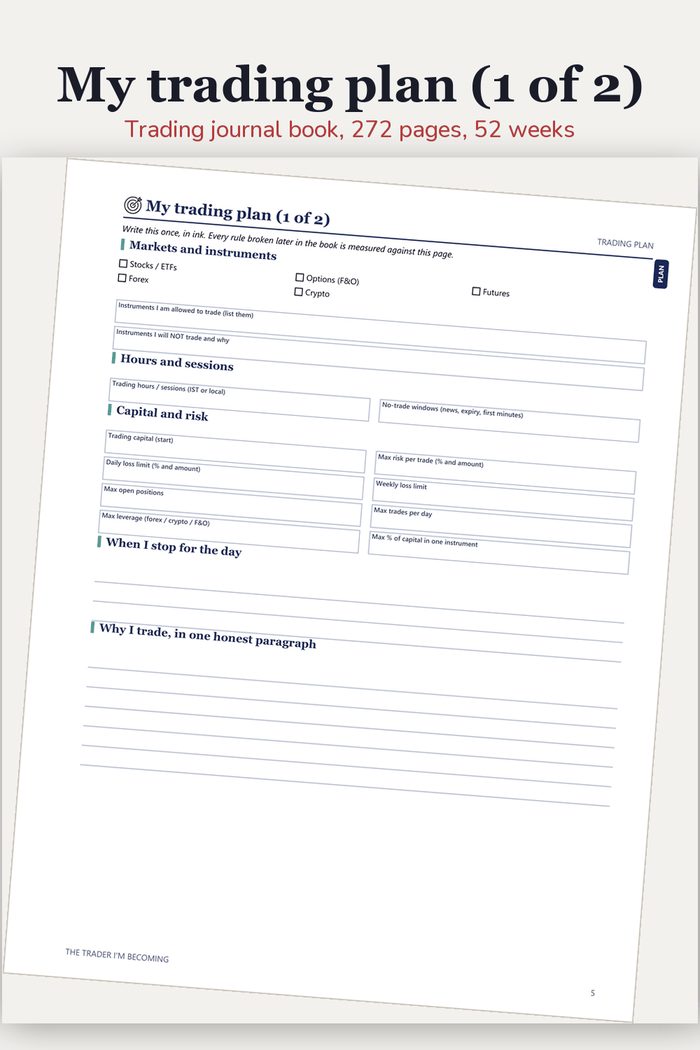
We made The Trader I'm Becoming around exactly this structure. It is an undated, 52-week paper journal for stocks, options, futures, forex and crypto: a trading plan and rules page, a position sizing sheet, eight setup pages, a mistake catalogue, emotion tags and a tilt routine, twelve trade rows a week with a PLAN row and a RESULT row, a weekly review, and a four-week dashboard with an equity-curve grid and R histogram you draw by hand. It is a notebook for your own records. It contains no investment advice, no trading calls and no promise about results.
Frequently asked questions
What should I include in a trading journal?
Before the trade: date, market, instrument, direction, setup, entry, stop, target, size and the amount at risk. After the trade: exit, fees, the result in money and in R, whether you kept your rules, how you felt, any mistake and one lesson.
How often should I review my trading journal?
Write each trade the same day, review every week for about fifteen minutes, and do a larger review every four weeks, when you count your mistakes and draw your equity curve.
Is a paper trading journal better than a spreadsheet?
Neither is better for everyone. Paper makes you slow down and write the plan before you trade; a spreadsheet adds up totals faster. Many traders use both.
Does a trading journal tell me what to trade?
No. A journal is a record of what you did and why. It helps you notice your own habits and mistakes, but decisions about what and how to trade are entirely yours.