
There is a moment every December when a child climbs into bed, looks up and says "read the Christmas one." For a great many families, the Christmas one is the night before Christmas poem, and it has been for two hundred years. It is short enough for a bedtime, it rhymes like a drumbeat, and it ends with Santa laughing into the night, which is exactly where you want a small child's imagination to be when the light goes off.
Below is the full text, a little of its surprisingly tangled history, and some honest advice on reading it aloud to children who are four, five or six and have never sat still for 56 lines in their lives.
Where the night before Christmas poem came from
The poem was first printed on 23 December 1823 in the Troy Sentinel, a newspaper in upstate New York, with no author's name and under the title "Account of a Visit from St. Nicholas." Most readers still know it by its first line.
Years later, Clement Clarke Moore, a professor in New York City, was named as the author, and he included it in a book of his poems in 1844. Some descendants of another New Yorker, Henry Livingston Jr., have long argued that Livingston wrote it instead. Nobody has settled that argument, and it does not change a word of the poem.
What the poem did change is how Christmas looks. Before it, St. Nicholas had no fixed shape in American stories. After it, he was plump, jolly, dressed in fur, arrived on a sleigh pulled by eight reindeer, came down the chimney and filled the stockings. Almost every picture of Santa you have ever seen owes something to these lines.
The reindeer names, then and now
In the 1823 printing, the last two reindeer were called Dunder and Blixem, the Dutch words for thunder and lightning. Later printings changed them, and the version most families know today calls them Donder and Blitzen. Rudolph is not in the poem at all; he arrived more than a hundred years later, in a department store booklet.
The full text of the poem
This is the poem as it appears in our coloring book, one couplet under each of 27 pictures, with the one couplet the book leaves out restored and marked in grey.
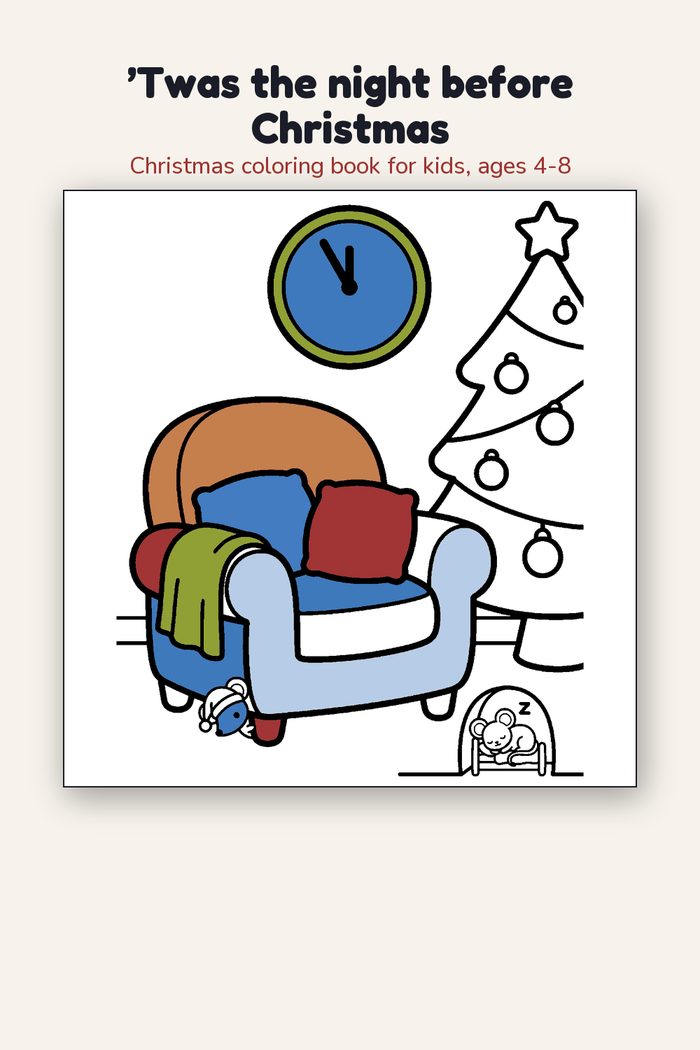
’Twas the night before Christmas, when all through the house
Not a creature was stirring, not even a mouse;
The stockings were hung by the chimney with care,
In hopes that St. Nicholas soon would be there;
The children were nestled all snug in their beds,
While visions of sugar-plums danced in their heads;
And mamma in her 'kerchief, and I in my cap,
Had just settled our brains for a long winter's nap,
When out on the lawn there arose such a clatter,
I sprang from the bed to see what was the matter.
Away to the window I flew like a flash,
Tore open the shutters and threw up the sash.
The moon on the breast of the new-fallen snow
Gave the lustre of mid-day to objects below,
When, what to my wondering eyes should appear,
But a miniature sleigh, and eight tiny reindeer,
With a little old driver so lively and quick,
I knew in a moment it must be St. Nick.
More rapid than eagles his coursers they came,
And he whistled, and shouted, and called them by name:
"Now, Dasher! now, Dancer! now Prancer and Vixen!
On, Comet! on, Cupid! on, Donder and Blitzen!"
"To the top of the porch! to the top of the wall!
Now dash away! dash away! dash away all!"
As dry leaves that before the wild hurricane fly,
When they meet with an obstacle, mount to the sky;
So up to the house-top the coursers they flew,
With the sleigh full of toys, and St. Nicholas too.
And then, in a twinkling, I heard on the roof
The prancing and pawing of each little hoof.
As I drew in my head, and was turning around,
Down the chimney St. Nicholas came with a bound.
He was dressed all in fur, from his head to his foot,
And his clothes were all tarnished with ashes and soot;
A bundle of toys he had flung on his back,
And he looked like a peddler just opening his pack.
His eyes, how they twinkled! His dimples, how merry!
His cheeks were like roses, his nose like a cherry!
His droll little mouth was drawn up like a bow,
And the beard of his chin was as white as the snow;
The stump of a pipe he held tight in his teeth,
And the smoke it encircled his head like a wreath;
(the one couplet the coloring book leaves out)
He had a broad face and a little round belly,
That shook when he laughed, like a bowlful of jelly.
He was chubby and plump, a right jolly old elf,
And I laughed when I saw him, in spite of myself;
A wink of his eye and a twist of his head,
Soon gave me to know I had nothing to dread;
He spoke not a word, but went straight to his work,
And filled all the stockings; then turned with a jerk,
And laying his finger aside of his nose,
And giving a nod, up the chimney he rose;
He sprang to his sleigh, to his team gave a whistle,
And away they all flew like the down of a thistle.
But I heard him exclaim, ere he drove out of sight,
"Happy Christmas to all, and to all a good-night!"
How to read it aloud to a young child
The poem is written in a bouncing rhythm, four strong beats to every line, and children feel that bounce before they understand a single word. A few things make it work at bedtime:
- Read it slower than you think. The rhythm carries it, so you can afford to linger on the good parts: the clatter on the lawn, the reindeer names, the belly that shakes like a bowlful of jelly.
- Let them shout the reindeer. "Now, Dasher! now, Dancer!" is the best part of the poem for a five-year-old. Pause, and let them call the names with you.
- Explain one old word, not ten. "Kerchief", "sash" and "coursers" can all be left alone. If you explain one, make it "coursers": it just means fast horses, and here it means the reindeer.
- Split it across nights. Fifty-six lines is a lot for a small child. Stopping when Santa lands on the roof is a perfectly good cliffhanger.
- Point at things. A picture for each couplet helps a child follow a story told in old-fashioned words, which is exactly why we made one.
Why we left out one couplet
Our coloring book is made for children aged 4 to 8, so it leaves out the couplet about St. Nick's pipe and the smoke circling his head. Everything else is there, in order, one couplet under each picture, so the book reads aloud page by page. You will find the missing couplet above, marked, if you would like to read the poem exactly as it was printed.
A countdown hidden in the poem
Here is a small trick we like. The poem has 27 couplets in our book. Start reading one a night on 28 November, and the last line, "Happy Christmas to all, and to all a good-night!", lands on Christmas Eve. Add a picture to color each night and you have an Advent calendar that nobody has to assemble.
Every picture in the book also hides a small mouse in a Santa hat, a nod to the poem's own line that "not a creature was stirring, not even a mouse." Finding him first is the part children talk about the next morning.
Frequently asked questions
Who wrote The Night Before Christmas?
It was first printed anonymously in 1823. Clement Clarke Moore was later named as the author and published it among his poems in 1844. Descendants of Henry Livingston Jr. have argued he wrote it, and the question has never been fully settled.
What is the real title of the poem?
It was first printed as "Account of a Visit from St. Nicholas" and is often published as "A Visit from St. Nicholas." Most people know it by its first line, "'Twas the night before Christmas."
How long is the poem?
The original has 56 lines, which is 28 couplets. Read aloud at a gentle pace, it takes about three to four minutes.
Is The Night Before Christmas in the public domain?
Yes. It was published in 1823, so the text is free for anyone to print, read and share.