
Some years you feel busy all the time and still end up somewhere you did not mean to go. Work took the best hours, health took whatever was left, and the things you once said mattered most (friends, a hobby, a sense of purpose) quietly fell off the list. A wheel of life assessment is a ten-minute exercise that shows you, on one page, where your life actually is right now, and where the gaps are. It is the page we put near the very front of our planner, because it is the most honest place to start a year.
What is a wheel of life?
A wheel of life is a circle divided into slices, one for each area of your life. You score each slice from 1 to 10 for how satisfied you are with it today, mark the score on the wheel, and join the dots. What you get is a shape. If every area scored the same, it would be a perfect circle. Almost nobody's is.
The idea is widely credited to Paul J. Meyer, who founded the Success Motivation Institute in the 1960s, and it has been used by coaches ever since. You do not need a coach to do it. You need a pen, ten minutes and a little honesty.
The eight areas
Different versions use different slices. Our planner uses eight:
- Health: sleep, energy, movement, how your body feels most days.
- Money: not how much you have, but how settled you feel about it.
- Work or study: whether the way you spend your working hours feels right.
- Relationships: partner, family, friends; the people you would call at 2 a.m.
- Growth: learning, reading, getting better at something you care about.
- Fun: play, hobbies, the things you do for no reason at all.
- Home: the space you live in and how it feels to walk through the door.
- Purpose: whether your days add up to something that feels like yours.
How to do a wheel of life assessment, step by step
- Score each area 1 to 10 for today. Not for last year, not for how it should be. Today. Go with your first instinct; overthinking makes everything a 6.
- Mark each score on the wheel with a dot, where 1 is the centre and 10 is the rim.
- Join the dots. Look at the shape for a moment before you judge it.
- In a second colour, mark where you want each area to be by the end of the year. Not 10 everywhere. Where you honestly want it.
- Look at the gaps. The distance between your two shapes, area by area, is your list of possible goals.
- For each area, write one change that would move it. Just one. Small is fine.
How to read your wheel
The shape tells you more than any single score.
- A small, even circle usually means a tired year. Nothing is broken, but nothing has much energy. Rest may be the first goal.
- A big, lopsided shape often means one area has been eating the others. Very often it is work. Think of the wheel as a real wheel: a lopsided one gives a bumpy ride, even if one side is huge.
- One deep dent is a gift. It is usually where a small change will make the biggest difference to how the whole year feels.
Resist the urge to fix everything. The point of the wheel is not to score 10 across the board; it is to choose.
From the biggest gap to one goal
Here is how we use the wheel in the planner. The area with the biggest gap between "now" and "by year end" usually deserves to become your one big goal for the year. That goal then goes in the centre of a 9 grid goal chart, where it is broken into eight supports and sixty-four small actions.
Sometimes the biggest gap is not where you expected. People who start the exercise certain they need a new job discover that it is Health or Fun that has fallen furthest, and that fixing those will change how the job feels too.
Questions to ask for each area
If a score is hard to pin down, these questions help:
- Health: How many nights last week did I wake up rested?
- Money: If an unexpected bill arrived tomorrow, how would I feel?
- Work or study: Do I dread Sunday evenings?
- Relationships: Who have I been meaning to call for months?
- Growth: What have I learned this year that I am proud of?
- Fun: When did I last lose track of time doing something I love?
- Home: Is there one room I avoid?
- Purpose: If this year repeated ten times, would I be glad?
How often to repeat it
Once at the start of the year, and again at the end of every quarter. The second time is where the magic happens: when you see a dent filling in, the small daily actions suddenly feel worth it. Keep the old wheels. Your future self will like seeing the shape change.
Doing it in a planner
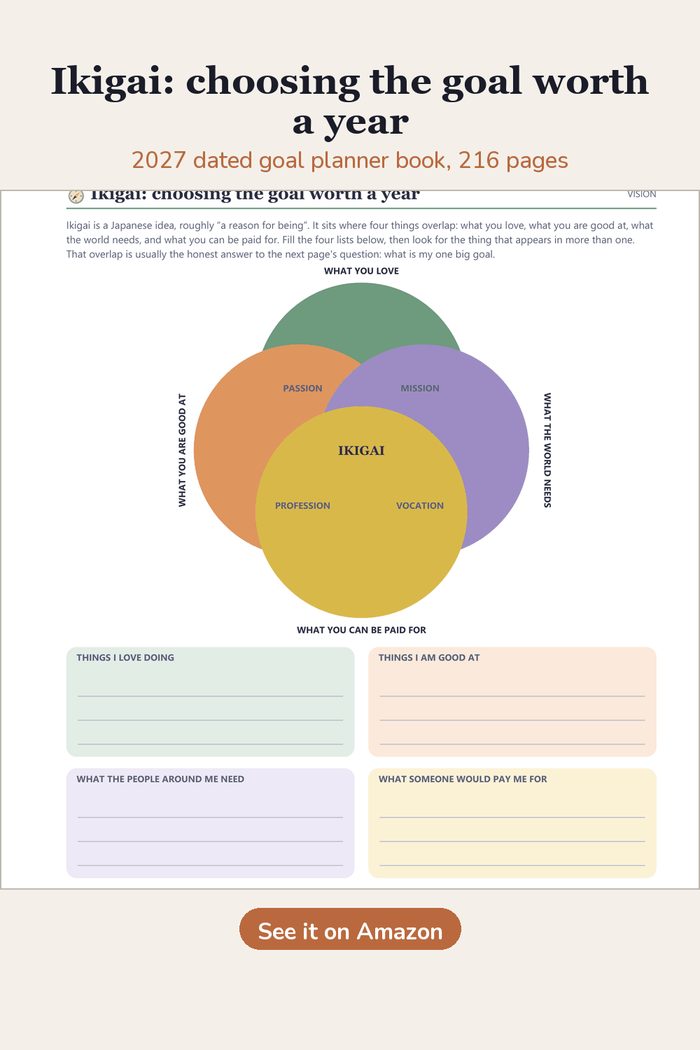
You can draw a wheel on any piece of paper. We put a full-page wheel in The Life I'm Building, with space for your score now, your score by year end and the one change that would move each area, and it sits right before the pages where you choose your word for the year, fill in an ikigai chart and set your one big goal. There is an undated edition too, if you would rather begin whenever you are ready.
Frequently asked questions
What is a wheel of life assessment?
It is a simple exercise where you score each area of your life from 1 to 10, mark the scores on a circle and join the dots. The shape shows which areas are strong, which are neglected, and where a goal would make the biggest difference.
What are the categories on a wheel of life?
There is no fixed list. A common set of eight is health, money, work or study, relationships, growth, fun, home and purpose. Change any that do not fit your life.
How often should I do a wheel of life?
At the start of the year and at the end of each quarter is a good rhythm. Repeating it lets you see which areas are improving and whether your goals are working.
Should I aim for 10 in every area?
No. Very few people want or need a 10 everywhere. Mark where you honestly want each area to be by the end of the year, and focus on the biggest gap.