
When someone dies, the will is rarely the first problem. The will says who gets what. It does not say which drawer holds the deed, which bank has the second account, or who to even call about the pension. Those answers usually live in one person's head — and when that person is gone, the people who loved them can spend weeks or months simply working out what they had. Estate professionals have a quiet name for the document that closes that gap, and it is not a will. It is a letter of last instruction, and in its fuller, ready-to-use form it is a final affairs organizer book.
This article is about pre-need organization. It is not legal, financial or medical advice, and it is not a substitute for a will or for a professional.
The short answer: A final affairs organizer is a plain, non-legal record of where your important things are and whom to contact — documents, accounts, insurance, bills, digital life, medical wishes, funeral preferences, and letters. It sits alongside your will, not instead of it. Fill it in at your own pace, never write passwords or full account numbers in it, keep it somewhere safe, and tell one or two people you trust where it is.
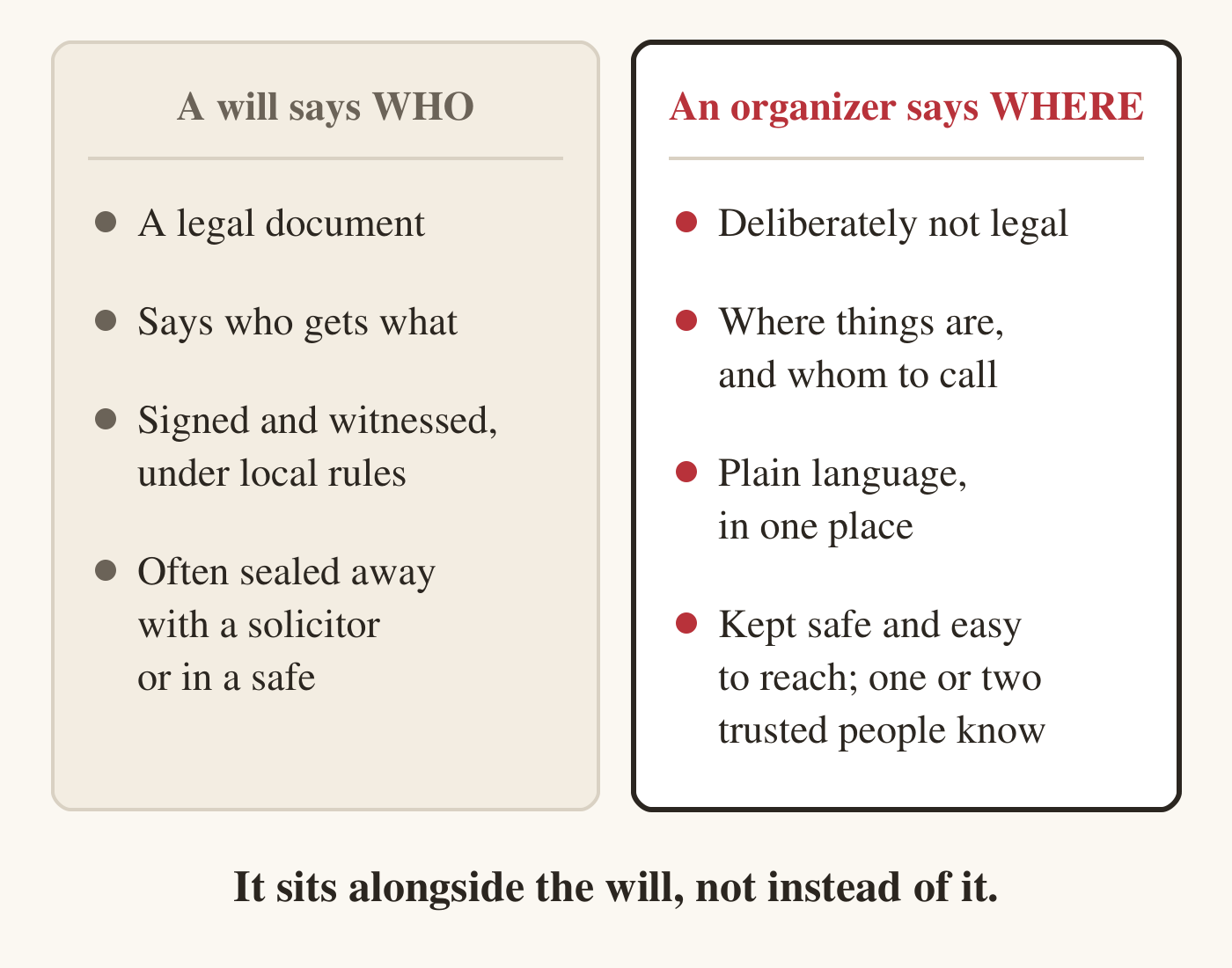
A will says who; an organizer says where
A will is a legal instrument. It is often signed once, witnessed, and then sealed away with a solicitor or in a safe — exactly where a grieving family cannot easily reach it in the first difficult week. And a will does important work of its own — depending on where you live, it can do more than name who inherits. But it is not written to be the ordinary map of a life. Where is the house deed? Is there a second pension from a job three decades ago? Which of the fourteen online accounts matter, and which are junk? Who services the boiler, and is there a burial plot already paid for? None of that belongs in a will, and none of it should be locked away from the people who need it soonest.
A final affairs organizer is that map. It is deliberately not legal. It records locations and contacts and wishes, in plain language, in one place — so the person holding it can begin, instead of guessing.
What actually goes in one
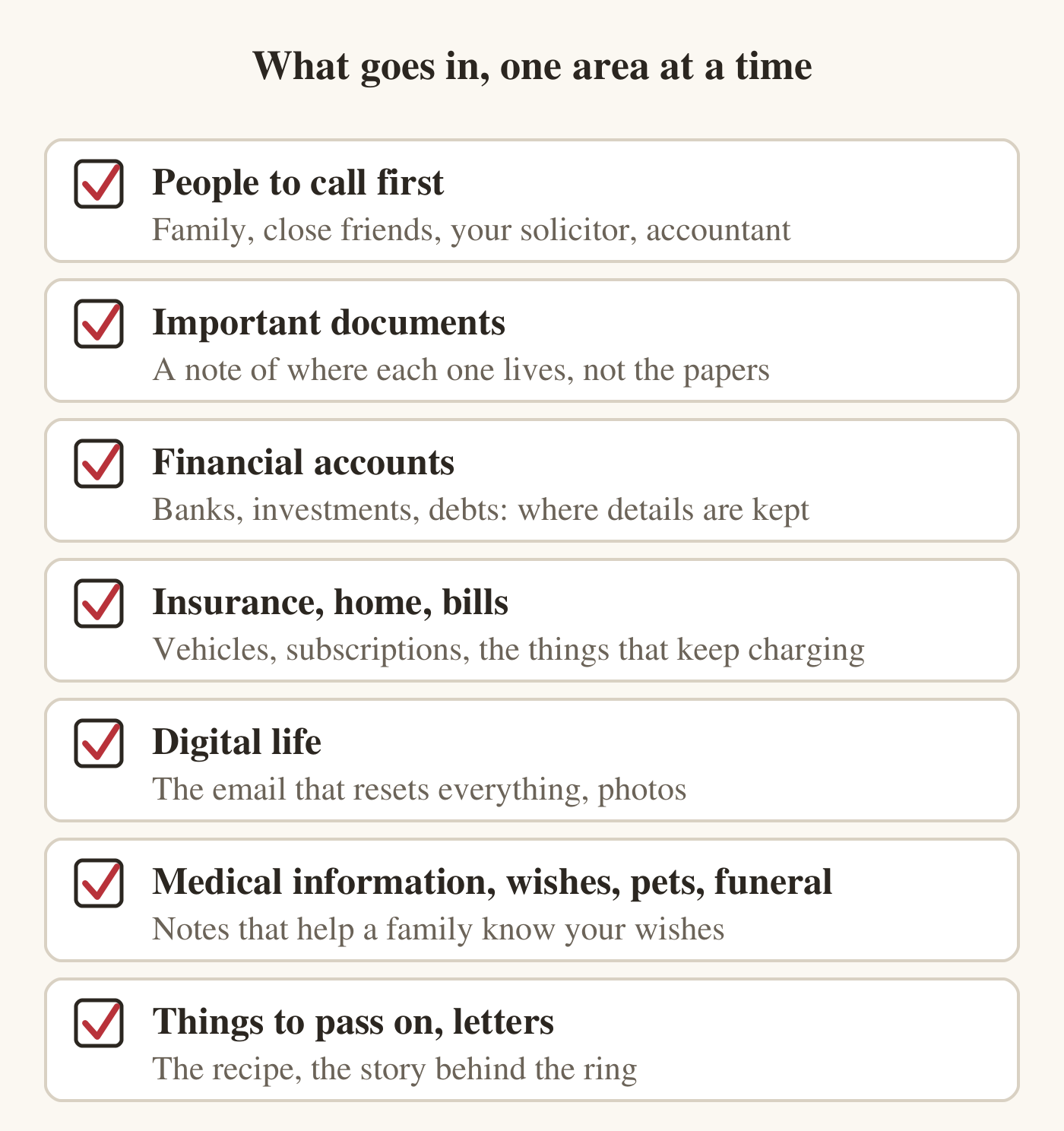
A good organizer works through life one area at a time. The version we built has fourteen sections, and they are a fair checklist for any organizer, homemade or bought:
- People to call first — family, close friends, and the professionals (solicitor, accountant, financial adviser) who already know your affairs.
- Important documents, and where they are — the will itself, the deed, birth and marriage certificates, the passport. Not the documents; a note of where each one lives.
- Financial accounts — banks, retirement and investment accounts, debts, and the advisers attached to them, recorded by where, never by number.
- Insurance, home and vehicles, monthly bills and subscriptions — the recurring things that keep charging, or lapse, if no one knows they exist.
- Digital life — the email address that resets everything, the photos, the subscriptions. Again, only where they are, never the passwords.
- Medical information and wishes, pets, funeral and memorial preferences — the things that spare a family from having to decide, alone and under pressure, what you would have wanted.
- Things to pass on, and letters to loved ones — the recipe, the story behind the ring, the words that are not on any form.
The one rule that keeps it safe
Here is the single most important thing, and it is the thing most homemade versions get wrong: never write a password, a PIN or a full account number in it.
Record only where those things are kept. A book that lists your logins is a book you cannot leave in a drawer, cannot hand to anyone, and would be a gift to whoever finds it first. A book that points — "the bank details are in the grey folder in the desk," "the passwords are in the manager on my laptop" — is far safer to keep and to hand on, because it reduces the risk of exposing sensitive credentials, and it still does its whole job. It guides the right person toward what matters without ever becoming a book of access credentials.
This is not a small detail. It is the difference between a document that helps your family and one that quietly exposes them.
Why large print matters more than you'd think
Whoever fills one of these in wants to be able to read it back easily, and so does the family member who opens it later, often distressed and in an unfamiliar house. Small print serves neither of them. Every line in a well-made organizer should be large and easy — genuinely large print, labels included — because legibility here is simply a form of kindness. It is worth checking, whether you make your own or buy one.
How to actually do it
- Fill in a few pages at a time. You do not have to finish it in an afternoon. Do a section, have your tea, come back next week.
- Skip what does not apply. No pets, no second property, no crypto — leave the page blank and move on.
- Tell someone where it is. The finished book only helps if the right person can find it. One or two trusted people is enough.
- Review it once a year. Accounts close, documents move, wishes change. Ten minutes a year keeps it true.
Most people expect this to be a heavy afternoon, and find instead that it feels the way making a will felt: weighted for a minute, then genuinely lighter. Every page you finish is one less thing someone you love will have to guess at.
The ready-made version
You can build all of this in a notebook. What a designed book removes is the setup — the wondering what to include, the small print, the blank intimidating page. That is the job of our Large Print Final Affairs Organizer: What My Family Needs to Know: fourteen ready sections in true large print, the no-passwords rule printed on every sensitive page, generous room to write, and space for letters in your own words. It is an organizer, not a will and not legal advice — a calm, practical place to leave your family a clearer beginning.
Whether you use ours or make your own, the kindest version of this document is the one that actually exists — the one your family can find and read on the day they need it.
Frequently asked questions about a final affairs organizer
Is a final affairs organizer the same as a will?
No. A will is a legal document that says who inherits, and it is usually stored away with a professional. A final affairs organizer is a plain, non-legal record of where things are and whom to call. It sits alongside the will and is the document a family often needs first, in the earliest days.
What should you never put in one?
Passwords, PINs and full account numbers. Record only where those details are kept. This is what keeps the book safe to leave in a drawer — it points trusted people toward what matters without becoming a book of access credentials.
Where should you keep it, and who should know?
Somewhere safe and reasonably easy to reach — not locked in a bank vault no one can open in the first week. Tell one or two people you trust exactly where it is. The book only helps if the right person can find it.
Does it really need to be large print?
No, but large print can make the organizer easier to fill in and read. Whoever fills it in wants to read it back easily, and so does the family member who opens it later. Large, clear print, labels included, is simply a kindness to both.