
Somewhere near the desk at a national park visitor center there is often a rubber stamp and an ink pad. You press it down and it leaves a ring of ink: the park's name, and the date. The whole thing takes only a moment and costs nothing. National park passport stamps date to 1986, and collecting them has become a familiar ritual across the National Park System.
The short answer: A national park cancellation stamp is a free ink stamp, kept at visitor centers and park stores, that prints the park's name and that day's date — a postmark for a place instead of a letter. The tradition began in 1986 with the Passport To Your National Parks® program, run by the nonprofit Eastern National. The stamps cost nothing; what you need is somewhere to put them.
What a cancellation stamp actually is
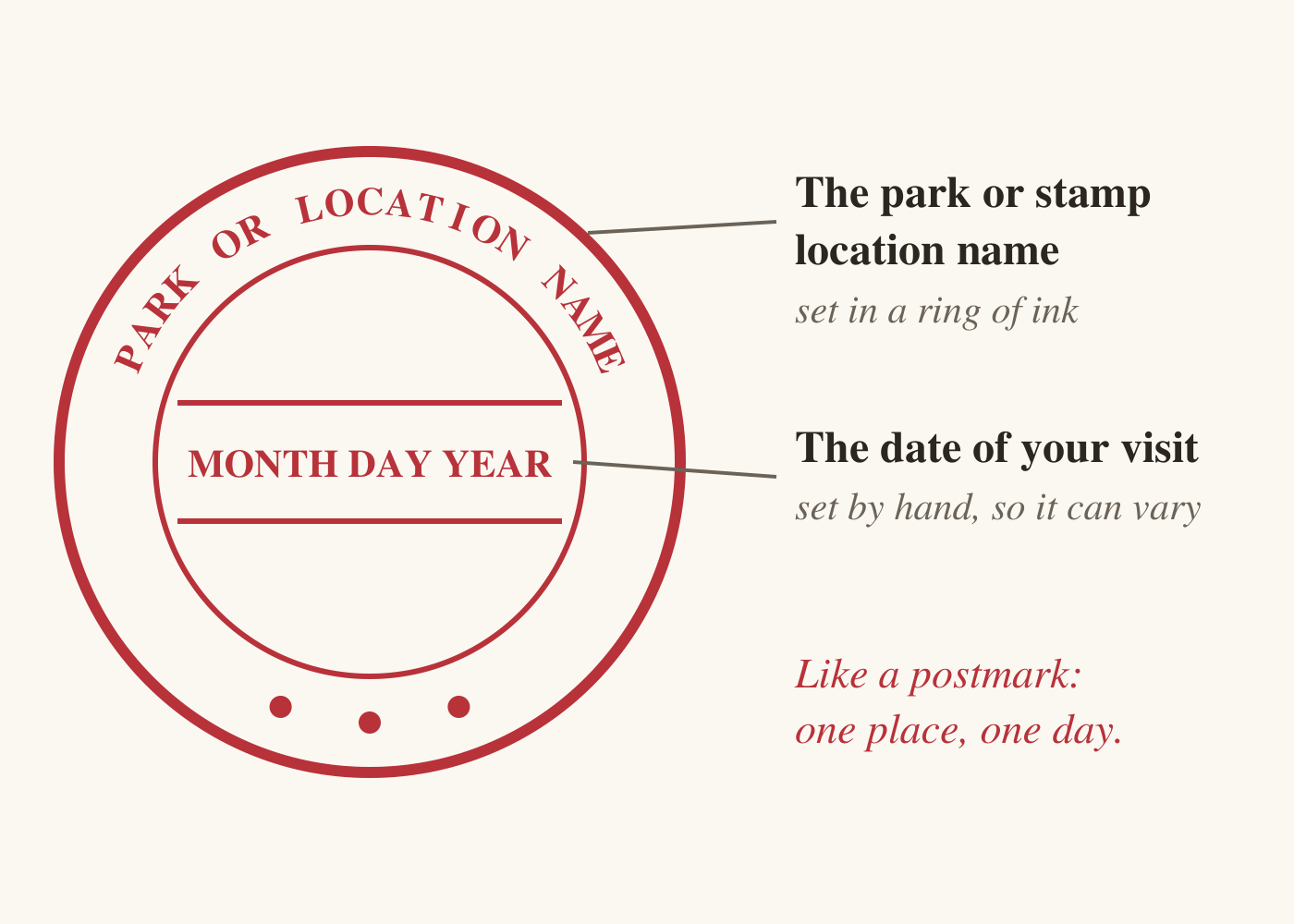
It is a dated ink stamp, and that is the point of it. A cancellation records the national park or stamp location and the date of your visit. In that sense it works a little like a postmark: a small physical record of one place on one day.
That makes it different from a photograph. A photograph records what you saw; the cancellation records where and when the visit happened. Years later, the ink impression can sit beside your own notes, photographs and memories from the same day.
Because the date is set by hand and the stamp is used repeatedly, impressions can vary. A date wheel may be wrong, an ink pad may be running dry, or an older stamp may print less sharply than a newer one. Those small irregularities simply become part of the physical record of the visit.
Where national park passport stamps came from
The ritual is younger than many visitors assume. The Passport To Your National Parks® program began in 1986 through Eastern National, the nonprofit that still owns and operates it. The idea was simple: a travel-sized book in which visitors could collect dated ink cancellations from their park visits.
Four decades on, the cancellations have outgrown the book they were invented for. People collect them in all sorts of places, and the habit has spread well beyond the 63 national parks to the wider park system. The stamp is the thing; what it lands in is a matter of taste.
It is worth saying plainly, since the names get tangled: Passport To Your National Parks® is Eastern National's program and its trademark, and the National Park Service is a separate federal agency. Any other book you keep your stamps in — including ours — is an independent one.
Where the stamps live
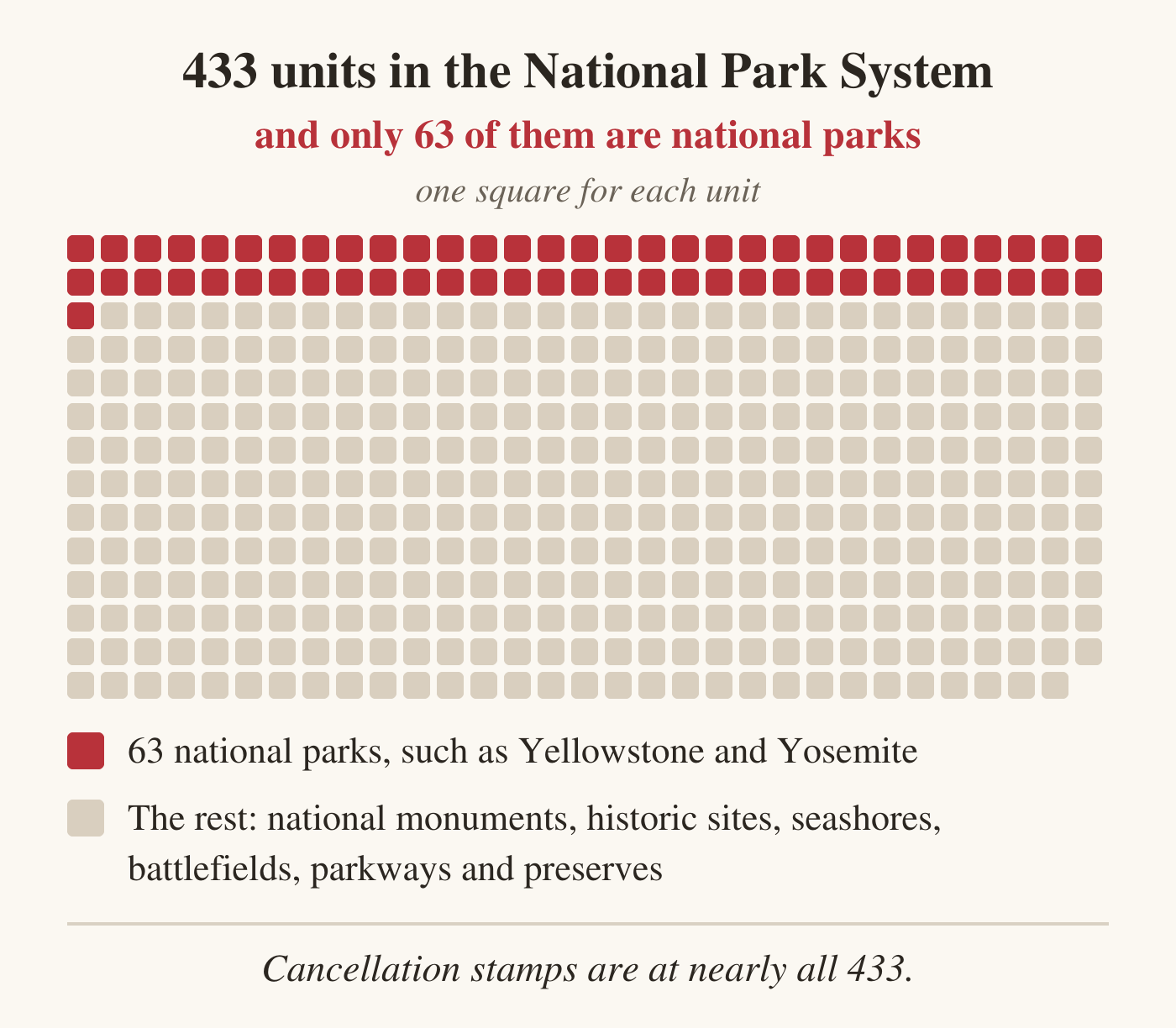
Cancellation stamps are available at nearly all of the 433 units of the National Park System, usually in visitor centers or park stores. Some affiliated or related areas also have cancellations. The ink stamps themselves are free to collect.
For a current location, use the official Passport cancellation-location directory, then check the individual park's page for opening hours. Stamp locations can move or change seasonally.
That figure of 433 is the one that surprises people, and it explains a lot of confusion. Only 63 of those units are congressionally designated national parks — the Yellowstones and Yosemites. The rest are national monuments, historic sites, seashores, battlefields, parkways and preserves, and a great many of them keep a stamp too. A weekend at a national historical park an hour from home can fill a page as honestly as a flight to Alaska.
A few practical things are worth knowing before you plan around a stamp:
- Large parks have several stations. A park with multiple visitor centers often has a different cancellation at each one, and some have seasonal stations that only appear in summer.
- The desk is not always open. Visitor center hours change with the season, and a station inside a building closes when the building does. Check the park's own pages before you count on it.
- You do not need to buy a Passport book to make an ink impression. At some locations the stamp is self-service; at others, staff can point you to it. The Park Service's own pages show cancellations being collected on park brochures, Junior Ranger materials, tickets and ordinary paper.
What to do when there is no stamp
Sooner or later a trip produces no ink: the center is closed, the pad is dead, you came in through a trailhead and never passed a desk at all. This is not a hole in the record unless you let it be.
Write the date in by hand where the stamp would have gone. Tuck in an entrance receipt or ticket stub, add a small sketch, or write a sentence about why the stamp was missed. Years later, that handwritten record can be just as useful a reminder of the day. In our visit log, each park has a stamp box about 6.9 inches wide, with a separate date line underneath for recording the visit.
A missing stamp can become part of the record rather than a hole in it.
The numbers, for the people who like numbers
A few facts that make the whole thing easier to picture:
| National parks | 63 |
| Units in the National Park System | 433 |
| First national park | Yellowstone, 1872 |
| Most recent | New River Gorge, December 27, 2020 |
| State with the most | California, with nine |
| Most visited in 2025 | Great Smoky Mountains, about 11.5 million recreation visits |
Thirty states hold at least one national park, along with two U.S. territories: American Samoa and the U.S. Virgin Islands. New River Gorge, in West Virginia, was redesignated from a National River at the end of 2020, which is why older checklists stop at 62.
Somewhere to put them
A stamp needs a page, and once a collection grows, it helps to have a consistent place for each visit. Loose cards can be misplaced, while a general travel notebook can leave stamps scattered among unrelated notes and receipts. A dedicated park page keeps the cancellation and the memories from that visit together.
That is what we built U.S. National Parks Stamp & Visit Log to be. It gives every one of the 63 national parks its own 8.5 x 11 page, grouped into seven regions, with a cancellation box nearly 7 inches wide and large-print lines underneath for the day, who was with you, the weather, the trails and the one moment you want to keep. There is a checklist of all 63 at the front to tick as you go, a wishlist and a tally at the back. It deliberately leaves out time-sensitive travel details such as opening hours, directions and recommendations, so the pages stay focused on your own record of each visit.
It is an independent keepsake, not an official Park Service product, and the stamps are the ones you collect yourself, one visit at a time.
Frequently asked questions
Are national park passport stamps free?
Yes. The ink cancellation stamps kept at visitor centers and park stores can be used at no cost. The passport books sold in park bookstores are a separate purchase, and you do not need one to use the stamps.
How many cancellation stamps are there?
More than there are national parks. Cancellations are available at nearly all of the 433 National Park System units, and large parks often have a different one at each visitor center, so the total runs well past the 63 national parks.
What does the stamp print?
The name of the park or stamp location, and the date of your visit. It reads like a postmark.
Can I stamp my own book instead of the official passport?
Yes. You do not need to buy a Passport book to collect an impression, and what you press it into is up to you — an official passport, a notebook, a journal or a dedicated visit log.
Do the stamps work at national monuments and historic sites?
Many of them, yes. Cancellations are available across the wider park system, not only at the 63 designated national parks, so a cancellation collection can include many more sites than a 63-park checklist.
How many national parks are there?
Sixty-three. The National Park Service manages 433 units in total, but only 63 of them carry the designation "National Park." The most recent addition was New River Gorge in December 2020.
---
Sources: National Park Service, National Park System and Visitor Use Statistics; America's National Parks, Passport cancellation locations; Wikipedia, List of national parks of the United States. Visitor center hours and stamp locations change; check the individual park's pages or the official cancellation-location directory before planning around one.