
It is a Tuesday evening in the armchair. The supper things are done, the news was all bad so you switched it off, and the lamp is on. The cat has taken the footstool. You do not want a thriller and you do not want the crossword you never finish; you want somewhere quiet to go for fifteen minutes, and you would like to be a little cleverer than whatever you find there. This is the exact feeling a cozy mystery word search was made for: a gentle puzzle that also tells you a story, one small piece at a time.
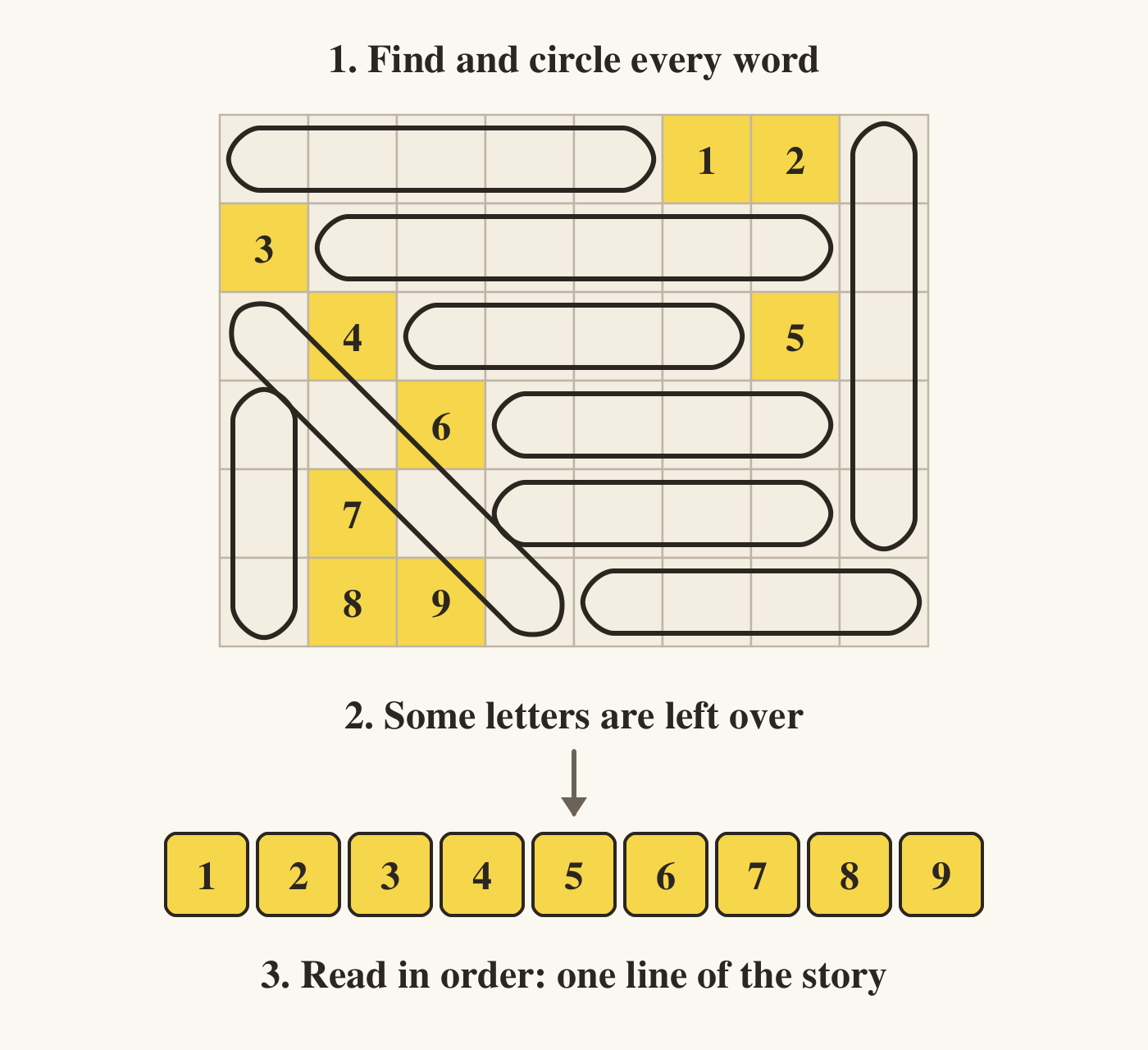
The short answer: In a cozy mystery word search, the letters left over after you circle every word spell out one line of a continuing story. Solve the puzzles in order and the hidden lines tell a whole gentle mystery — a small village puzzle that ends warmly — while the searching keeps big-print letters in front of you and your mind pleasantly busy.
Where the word search came from
The word search is younger than it looks. The familiar grid of hidden words is usually traced to 1968, when Norman E. Gibat printed one in the Selenby Digest, a free classified sheet in Norman, Oklahoma. Teachers asked for copies to hand out, other papers picked the idea up, and within a few years the hidden-word grid had spread across the country and then the world (Wikipedia).
What made it travel was the pleasure of the search itself: a clear task, a visible finish, and the quiet click of finding a word where a second ago there was only a jumble of letters. But that pleasure has always had a ceiling. When the last word is circled, the page is finished, and there is no particular reason to start the next one except that it happens to be there. A book of them is all middle: no beginning that pulls you in, and no ending you are working toward.
Why a story keeps you turning the page
Storytellers solved the "why keep going" problem a long time ago, and they solved it with the unfinished ending. In the 1830s Charles Dickens began publishing novels in cheap monthly parts, each instalment breaking off at a moment his readers could not bear to leave. People waited weeks for the next number, and, as the story is often told, some American readers crowded the New York docks to shout up at arriving ships and ask whether little Nell had lived. Half a century later, Arthur Conan Doyle released the Sherlock Holmes stories one at a time in The Strand Magazine, and readers queued at the newsstand for each new case (serial fiction).
Serialized stories work because a story can hold something back. You are not turning the page because the number went up by one; you are turning it because you need to know what happens next. And here is the useful part: a puzzle book, read one page at a time, is already shaped exactly like a serial. It simply usually has nothing to hold back.
What "cozy" actually means
The word "cozy" is doing real work here, too. A cozy mystery is a recognised tradition of storytelling: a small community, an amateur who notices what everyone else overlooks, a puzzle rather than a horror, and an ending that puts the world back in order. Agatha Christie's Miss Marple, knitting in her chair in St Mary Mead and quietly out-thinking the professionals, is one of the most influential examples of the village amateur detective.
What the cozy promises is comfort without going soft. The mystery is real — you genuinely do not know who did it — but the stakes are kind. A missing recipe, a borrowed brooch, a mix-up at the summer fair. Part of the appeal is simple: a puzzle is a problem you are allowed to finish, and a cozy mystery wraps that solvable puzzle in a world where nothing truly frightening is at stake. If you like the wintry version of that feeling, our roundup of Christmas mystery books for adults is full of it. At the end of a long day, a closed puzzle inside a gentle world is a very particular and underrated kind of rest.
Why one clue is more satisfying than ninety unrelated puzzles
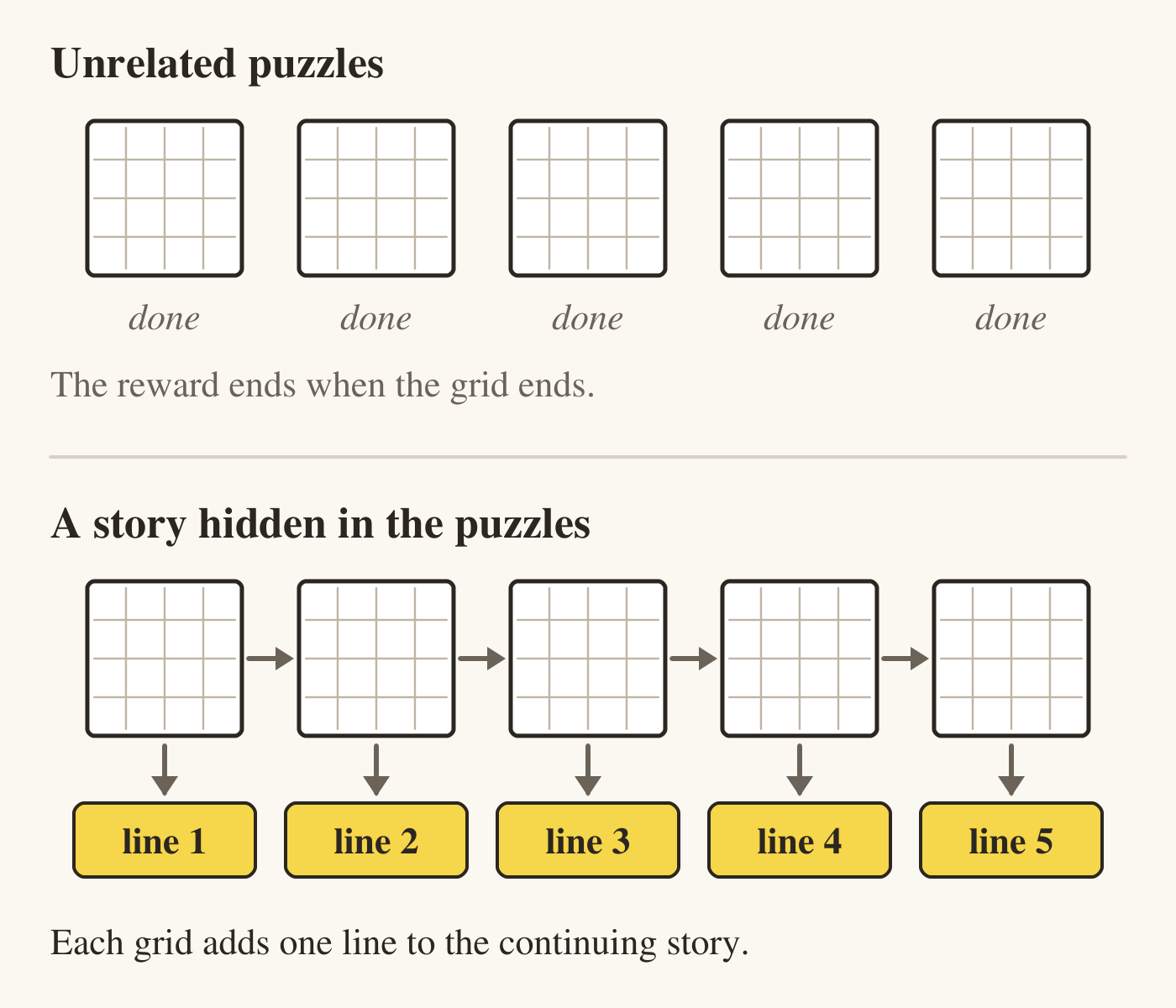
Think about the difference between opening a puzzle book at random and returning to something unfinished. In the first, the reward ends when the grid ends. In the second, solving the page changes what you know.
That is one reason mysteries are so good at creating "one more chapter" reading. A clue is rarely satisfying by itself. It matters because it alters the picture: the person who seemed suspicious now has an alibi; the harmless object on the mantel suddenly belongs to someone else; a sentence from twenty pages ago acquires a second meaning.
A hidden-message word search can borrow that same rhythm. The grid gives you the immediate pleasure of finding the words. The leftover letters give you something the page did not tell you before. One line is enough: a new clue, an unanswered question, a small reversal.
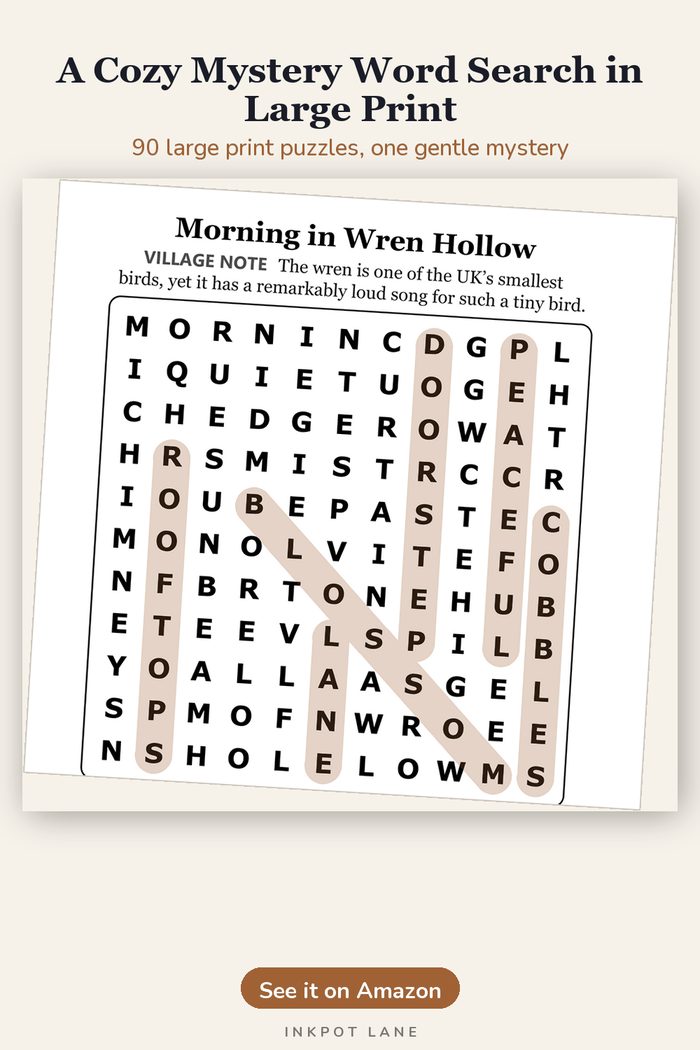
That is the page the Wren Hollow book gives you: the grid, the word list and two lines under it for the leftover letters.
And then you close the book with one thought still open.
That matters more than it sounds. The reason to return tomorrow is no longer simply that puzzle 18 follows puzzle 17. You return because a story has been interrupted at exactly the point where you want one more piece.
Done well, the word search and the mystery are not two activities stapled together. Each one supplies what the other lacks: the grid slows the story down, and the story gives the next grid a reason to exist.
Why a cozy mystery word search belongs in large print
There is one more reason this pairing works, and it is a practical one. The reader who most wants a quiet puzzle in the evening is often the reader whose eyes tire before their mind does. So large print is not a compromise here; it is part of the design. When the grid letters are set large and the word lists stay clear, the lamplight stops fighting you and the puzzle stays where it belongs — a pleasure, not a squint. It matters twice over in a book like this, because the leftover letters that carry the story have to be easy to read once you have circled everything else. A line of plot is no good if you need a magnifier to collect it. If you enjoy decoding as well as searching, the same big-print thinking runs through our guide to how to solve cryptograms.
The book we built around one clue a page
That is the principle behind our Large Print Cozy Mystery Word Search: The Wren Hollow Mystery. It is ninety large-print puzzles whose leftover letters, read in order, tell one gentle village mystery. Each page hides a single line of the story, so finishing a grid gives you two things at once: the satisfaction of the search, and one new piece of the case. There is a short village note on every page, and the whole mystery is printed again in full at the back, to read straight through once you have solved your way to the ending.
We will not give that ending away. That is rather the point. The case is yours to uncover, letter by letter — the armchair, the lamp, the cat and the tea, with a mystery you get to solve yourself.
Frequently asked questions
What is a cozy mystery word search?
It is a word search puzzle book in which the letters left over after you find every word spell out a line of a story. Solve the puzzles in order and the hidden lines add up to one gentle mystery, so the book reads like a novel you unlock one grid at a time.
Do you have to solve the puzzles in order?
It helps. Each hidden line is one piece of the story, so working through the grids in order lets the mystery unfold the way it was written. You can dip in and out for the searching alone, but the story makes most sense read from start to finish.
Are cozy mystery word searches good for adults?
Yes. They suit anyone who wants a calm, absorbing puzzle rather than a tense thriller, and a large-print edition is especially kind to tired eyes at the end of the day.
What makes a mystery "cozy"?
A cozy mystery keeps a real puzzle but low stakes: a small community, an amateur sleuth, no graphic violence, and an ending that sets things right. The pleasure is in working it out, not in dread.