
In December 1839, a writer on a Philadelphia weekly paper made his readers a promise. Send him any message written in a letter-for-letter code, he said, and "we pledge ourselves to read it forthwith". His name was Edgar Allan Poe, and until the spring of 1840 he mostly kept his word. His method is still the simplest way to learn how to solve cryptograms.
Poe had no secret gift, just a method, and he later turned it into one of his best-known stories. Here's the story, then the method step by step, and why its most famous part fails on short puzzles.
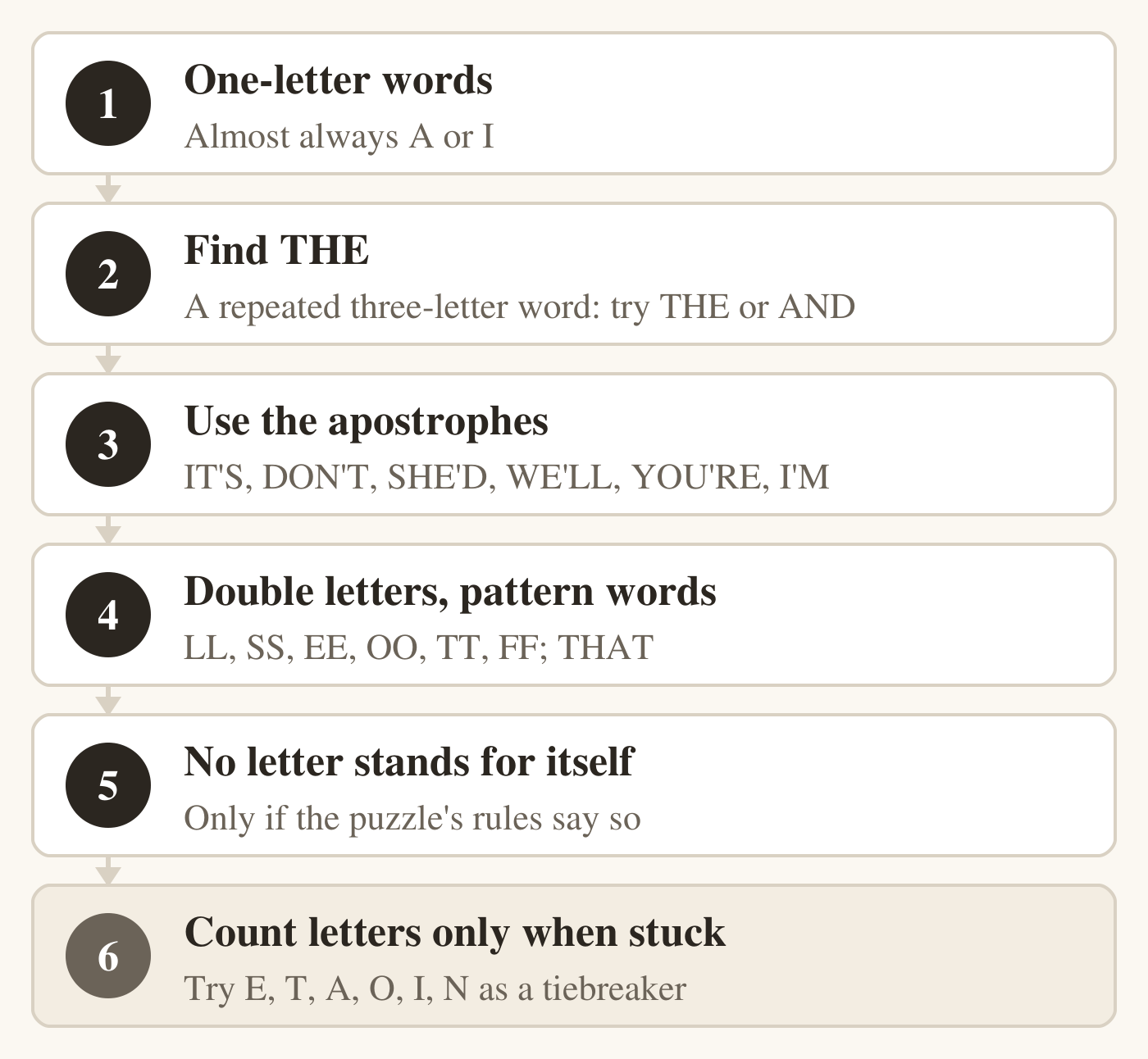
The short answer: Start with the one-letter words, which are almost always A or I. Look for a repeated three-letter word and test THE. Use apostrophes, double letters and word patterns to fill in more, and if the puzzle's rules say no letter stands for itself, use that too. Count how often each code letter appears only when you're stuck, because short puzzles don't follow the averages.
Poe's challenge: December 1839, and how many he really solved
The paper was Alexander's Weekly Messenger, and the piece, in the issue of 18 December 1839, was called "Enigmatical and Conundrum-ical". Poe described a kind of secret writing in which symbols stand in for the letters of the alphabet, then threw down the challenge: "Let this be put to the test. Let any one address us a letter in this way, and we pledge ourselves to read it forthwith." Codes arrived through the winter and spring, and Poe kept answering them until his work for the paper ended in May 1840.
In July 1841, in "A Few Words on Secret Writing" in Graham's Magazine, he looked back: "Out of, perhaps, one hundred ciphers altogether received, there was only one which we did not immediately succeed in resolving." That one, he said, he proved to be a jumble of random characters.
When the Yale scholar W. K. Wimsatt later counted the codes that actually appear in the paper, he found 36. Poe printed the cipher and its solution for nine of them, and the solution, or part of it, for fifteen more. The paper records far fewer codes than his later "perhaps one hundred". That doesn't prove only 36 were sent, but the larger number isn't documented anywhere. But the same essay holds the line every solver should know: "human ingenuity cannot concoct a cipher which human ingenuity cannot resolve."
The Gold-Bug (1843): the method, told as a treasure hunt
In June 1843 Poe put the method into a story. The Gold-Bug ran in two installments in the Philadelphia Dollar Newspaper and won its $100 prize, probably the largest single sum Poe received for any of his works. In it, William Legrand finds a scrap of parchment covered in numbers and symbols and decodes it into directions to buried treasure.
His reasoning begins with a fact about English: "Now, in English, the letter which most frequently occurs is e." Legrand takes the commonest symbol as E, then looks for a group of three symbols that repeats and ends in his E, because such a group will "most probably represent the word 'the.'" From there the message opens up a letter at a time.
The story traveled far. William F. Friedman, who later worked on breaking Japan's PURPLE code in the Second World War, first became interested in cryptography after reading it as a child.
The turning point: the spaces change everything
Legrand's parchment had no spaces between its words, which is why he had to start by counting. He said so himself: "Had there been divisions, the task would have been comparatively easy. In such case I should have commenced with a collation and analysis of the shorter words."
A puzzle cryptogram is usually that easier case. The words keep their spaces and punctuation, so you can do what Legrand wished he could: start with the short words.
Counting still has its place, and it's far older than Poe. In one well-known count of English text, E makes up about 12.7% of letters, T about 9.1%, A about 8.2%, O about 7.5%, I about 7.0% and N about 6.7%, and other counts give slightly different orders. Breaking a code this way is called frequency analysis, and the first known written explanation of it comes from the Arab scholar al-Kindi, in the ninth century.
Here is the method in the order that works on a modern puzzle.
Step 1: Start with the one-letter words
A code word of one letter is almost always A or I. Pencil it in everywhere that code letter appears in the puzzle, not just in that one word, because every letter you place helps several words at once.
Step 2: Find THE
A three-letter word that appears more than once is a good place to test THE, just as Legrand did, and AND is another common candidate. Once you have T and H, look for them at the start of longer words: THAT, THIS, THEY, THERE.
Step 3: Use the apostrophes
One letter after an apostrophe at the end of a word is nearly always S, T or D, as in IT'S, DON'T or SHE'D. Two letters after it are usually LL, RE or VE, as in WE'LL, YOU'RE or I'VE. And a single letter standing before an apostrophe is almost certainly I, as in I'M.
Step 4: Spot double letters and pattern words
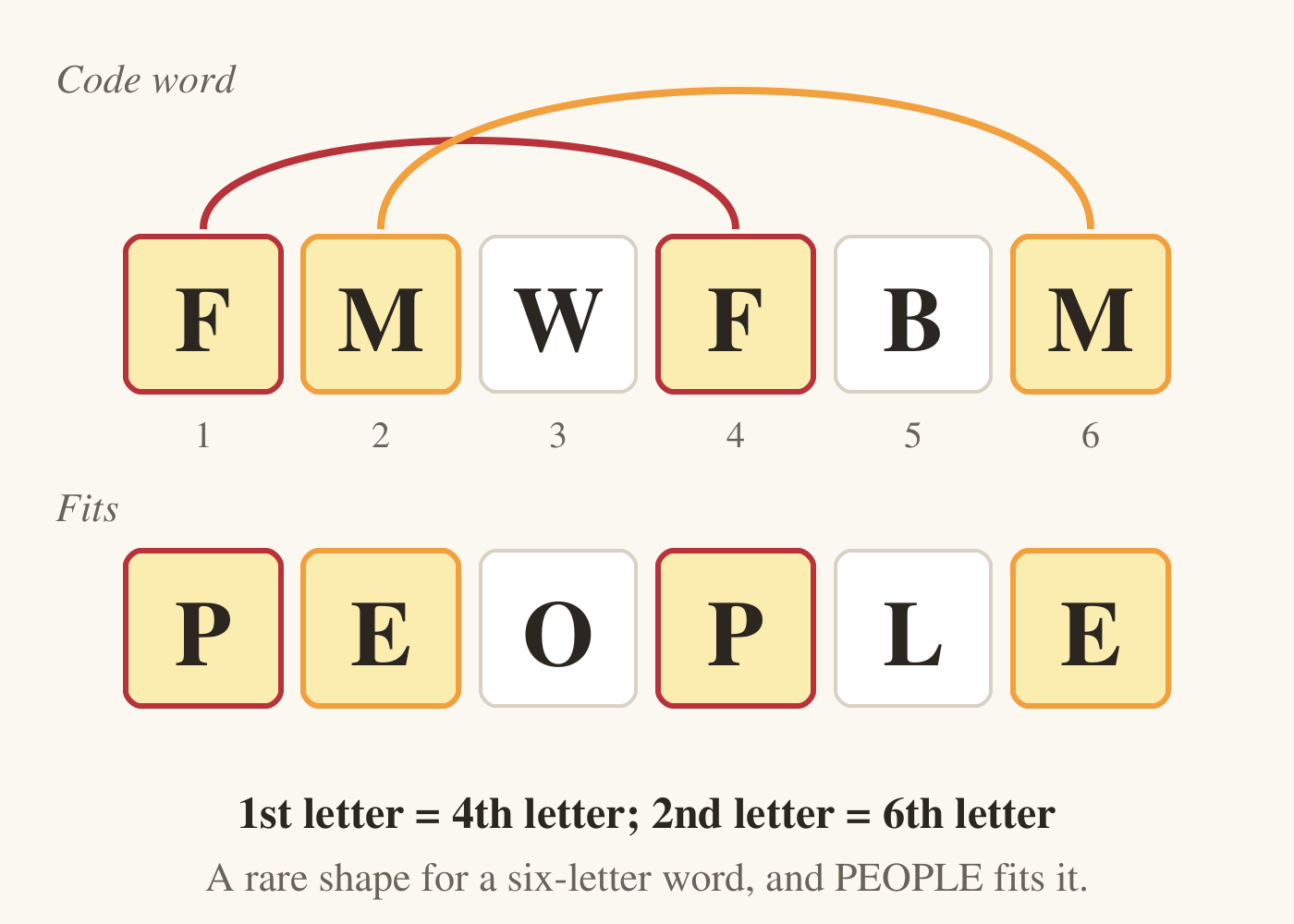
The common doubles in English include LL, SS, EE, OO, TT and FF. Repeated letters also give a word a shape you can match: THAT is a common four-letter word whose first and last letters match, but check the letters it shares with other words before you commit to it.
An example, made up for this article: the code word FMWFBM repeats its first letter in fourth place and its second letter in sixth. That's a rare shape for a six-letter word, and PEOPLE fits it.
Step 5: Remember that no letter stands for itself
The American Cryptogram Association, founded in 1930, calls the classic letter-for-letter puzzle the Aristocrat, and in an Aristocrat no letter may stand for itself: a code E never means E. If your puzzle follows the same rule (its instructions will say), it pays off near the end. When a word has two possible answers and one would need a letter to stand for itself, the other one is right. The Village Detective's Casebook keeps to that rule in every case, and its How to Play page says so up front.
Step 6: Count letters only when you're stuck
This is where the most famous part of Poe's method needs a warning. Letter counts work on long messages, like Legrand's parchment. A puzzle cryptogram may be one short sentence, and a short sentence doesn't have to follow the averages.
An example, made up for this article: A WARM CUP ON A COLD DAY. That's 18 letters, and not one of them is E. The commonest letter is A, which turns up four times. Call the most frequent code letter E, and you'd be wrong from the first move.
So use the count as a tiebreaker, not a starting point. When the short words and patterns run dry, try the most frequent code letters as E, T, A, O, I or N, and rub each one out if it makes nonsense.
Where to practice: a code with the first steps given
Poe started every code from nothing. A beginner doesn't have to. The gentlest way in is a puzzle that gives you a few letters to start, then fewer as you get better, until you're solving from nothing, the way Poe did.
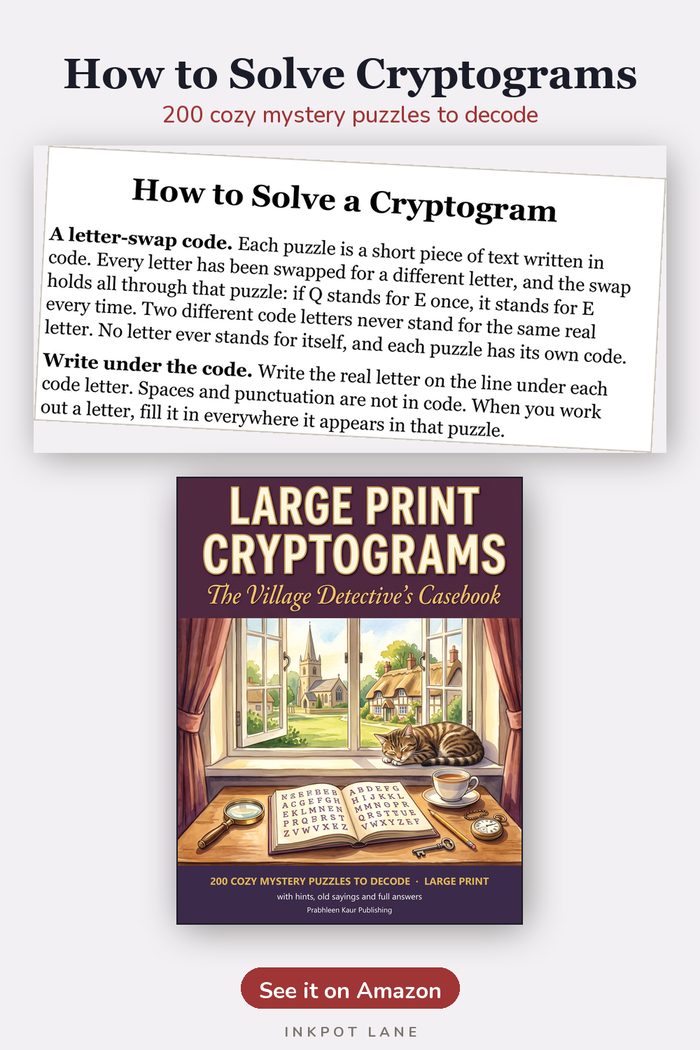
That's how we built Large Print Cryptograms: The Village Detective's Casebook. Hazel Quill, the retired postmistress of Little Pipwell, keeps her casebook in code: twenty cases of ten notes each, mixing case notes, "case closed" notes, old sayings, Hazel's rules and curious facts. The code letters are 19 pt. The first cases give you three letters, then two, then one, and the last cases none at all. Every case is a cozy village puzzle.
If you would rather decode sayings than cases, Large Print Cryptograms: A Little Book of Wisdom & Cheer has 200 puzzles across four levels, starting with three letters given and gradually removing that help.
The same patient habits carry over to how to solve logic grid puzzles.
The two codes Poe left for last
Poe's promise had a strange epilogue. To close his cipher contest, he printed two more codes in Graham's Magazine, said to come from a reader called W. B. Tyler. In 1985 Louis Renza of Dartmouth College suggested that Tyler was Poe himself.
Terence Whalen of the University of Illinois at Chicago solved the first Tyler code in 1992. The second held out longer, until a $2,500 prize was offered for it, and in July 2000 Gil Broza, a software engineer in Toronto, sent in the answer.
So Poe's cipher contest ended with two codes, printed under W. B. Tyler's name, that took more than 150 years to solve. Tyler may have been Poe himself, but that is still a theory. Poe's larger point survived: human ingenuity did resolve what human ingenuity had concocted. It just took rather longer than forthwith.
Sources
- Poe's challenge: "Enigmatical and Conundrum-ical", Alexander's Weekly Messenger, 18 December 1839, on the Edgar Allan Poe Society of Baltimore site. The paper and the dates of the series: C. S. Brigham, Edgar Allan Poe's Contributions to Alexander's Weekly Messenger (1943).
- Poe's look back: A Few Words on Secret Writing, Graham's Magazine, July 1841.
- Wimsatt's count: Edgar Allan Poe and Cryptography, Trinity College.
- Legrand's method: The Gold-Bug, Dollar Newspaper, 28 June 1843. The prize and William F. Friedman: The Gold-Bug, Wikipedia.
- Letter counts: Letter frequency, Wikipedia (figures from Robert Lewand's Cryptological Mathematics). Al-Kindi: Frequency analysis, Wikipedia.
- The Aristocrat rule: Aristocrat Cipher, Wikipedia. The ACA's founding: ACA history.
- The Tyler codes: A Cipher from Poe Solved at Last, Scientific American, November 2000.
Frequently asked questions
How do you solve cryptograms for beginners?
Start with a puzzle that gives you a few letters, and write those in everywhere they appear. Then look for one-letter words (A or I), a repeated three-letter word (probably THE) and any apostrophes. Work in pencil, and fill in each new letter everywhere in the puzzle.
How do you solve a cryptogram step by step?
One-letter words first, then THE and AND, then apostrophes, then double letters and pattern words like THAT. Use the rule that no letter stands for itself if the puzzle follows it, and count letters only when you're stuck.
How do you solve a cryptogram without a key?
A standard cryptogram doesn't come with the key: working it out is the puzzle, and the method above needs only the habits of English words. Some beginner books give a few starting letters. That's a head start, not the key.