
Twelve clues, a grid of forty-eight empty squares, and a pencil that hasn't moved in five minutes. You've read the first clue four times. Nothing in it says who did what. That moment is where learning how to solve logic grid puzzles really starts.
That's the moment most people give up, and it's the moment this guide is for. Learning how to solve logic grid puzzles isn't about being clever. It's a handful of moves, made in order, that turn clues which seem to say nothing into squares you can fill. By the end, every row will have one tick, and you'll be able to say why.
The short answer: Mark every "is" and "is not" clue in the grid, with an X for no and a tick for yes. Each tick puts X's across the rest of its row and column, and the last empty square in any row must be a tick. Then carry facts from one part of the grid to another, read either-or and order clues exactly, and never guess.
Before: how a logic grid is laid out
A logic grid puzzle gives you a short story, a few categories and a list of clues. Say four neighbors each bring a pie to a bake sale: the categories are the neighbors, the pies and the arrival times.
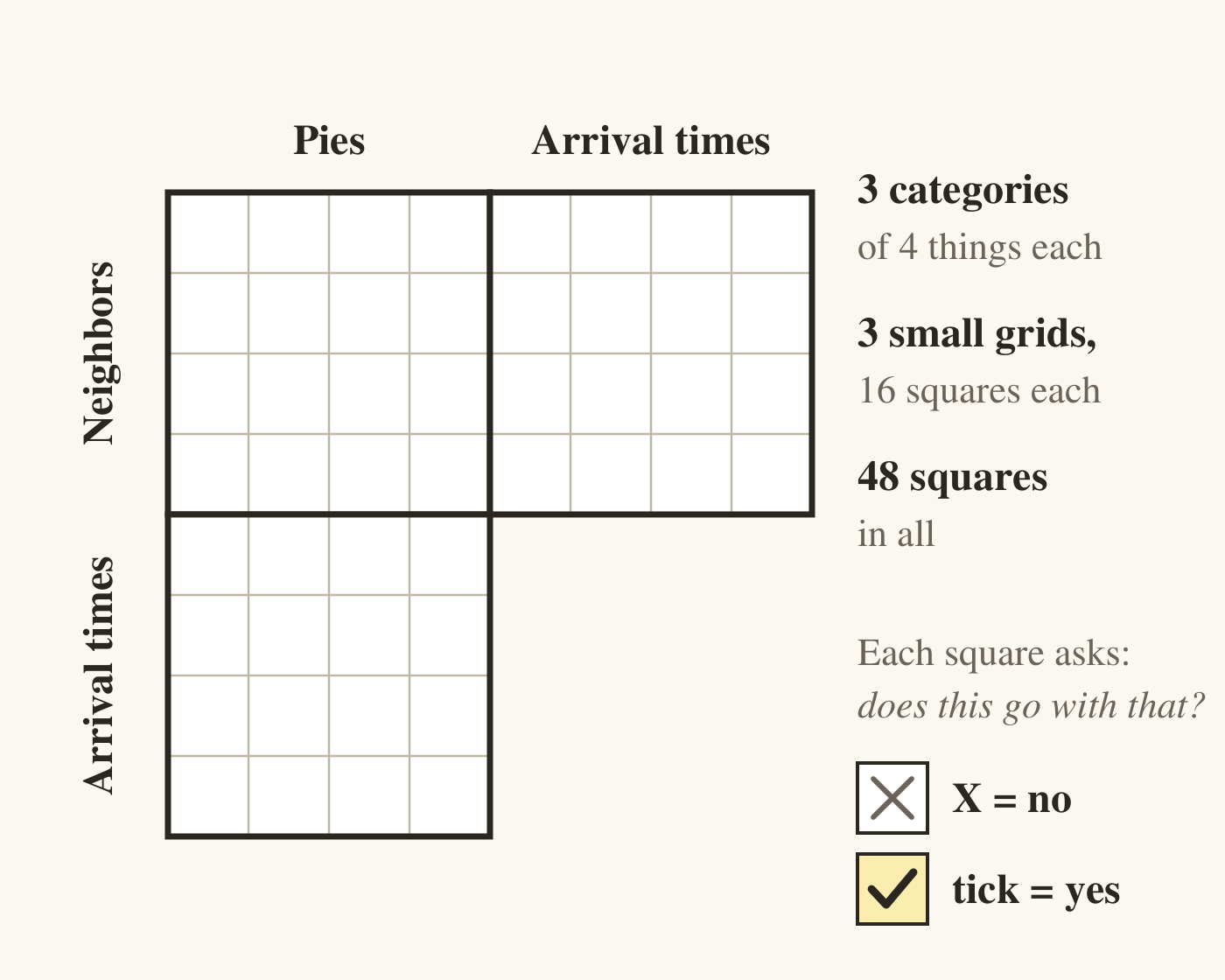
The grid is made of smaller square grids, one for each pair of categories. Each square asks one question: does this go with that? An X means no. A tick means yes (some solvers use a dot or an O). With three categories of four things each, the small grids hold 16 squares apiece, 48 in all: the blank grid from the opening.
After: what a finished grid looks like
In a finished grid, every row and column of each small grid has exactly one tick, and every other square is an X. A well-made puzzle has only one answer, so the grid proves itself: you can point at any mark and name the clue or step behind it. That's the goal: not speed, just a grid in which nothing was guessed.
Step 1: Mark the "is" and "is not" clues
Start with the clues that say something directly. "The pumpkin pie arrived at 9:30" is a tick. "Priya didn't bring the apple pie" is an X. Mark every clue like these first. It feels too simple, but it gives the other steps something to work with.
Step 2: Every tick puts X's across its row and column
A tick means this, and only this, goes with that. So each time you place one, put an X in every other square of its row and its column within that small grid. Forgetting these X's is the quickest way to end up stuck with a grid that's nearly empty.
Step 3: The last empty square in a row must be a tick
If three squares in a row of four are X's, the fourth is a tick, even if no clue mentions it. The same goes for columns. After every new X, check whether it has left a single empty square.
Step 4: Carry facts from one small grid to another
This is the move beginners miss. If Mabel brought the cherry pie, and the cherry pie arrived at 10:00, then Mabel arrived at 10:00, though no clue says so. X's carry too: if Otis didn't arrive at 10:00 and the cherry pie did, then Otis didn't bring the cherry pie. Whenever you add a tick, ask what it tells you in the other small grids.
Step 5: Either-or, neither-nor and "one ... the other"
These clues pack two facts into one sentence. In most puzzles:
- "Either A or B" means exactly one of them is true. "Priya brought either the pumpkin pie or the cherry pie" means she didn't bring the apple pie.
- "Neither A nor B" rules out both options for the person in the clue: "Priya brought neither the apple nor the cherry pie" puts an X at Priya with apple and at Priya with cherry.
- "Of A and B, one ... the other ..." means A and B are different people, and the two things named belong to different people. "Of Otis and Mabel, one brought the cherry pie and the other arrived at 9:00" means Priya did neither, and the cherry pie didn't arrive at 9:00.
Setters don't all define these words the same way, so if a puzzle book has a page of clue words, read it first. The Pennyfold Deduction Club includes a page explaining clue language, followed by 80 puzzles with worked solutions that identify the clues used.
Step 6: Order clues ("earlier than" rules out the ends)
"Otis arrived earlier than the baker with the cherry pie" gives no times, but it still rules out three squares. Otis wasn't last, because somebody came after him. The cherry pie wasn't first, because somebody came before it. And Otis didn't bring the cherry pie, because nobody arrives earlier than themselves.
Read the words exactly. "Earlier than" means any time earlier, not "immediately before". "Exactly 30 minutes later" is stronger: it ties two things together, so placing one fixes the other.
A worked logic grid puzzle (invented for this article)
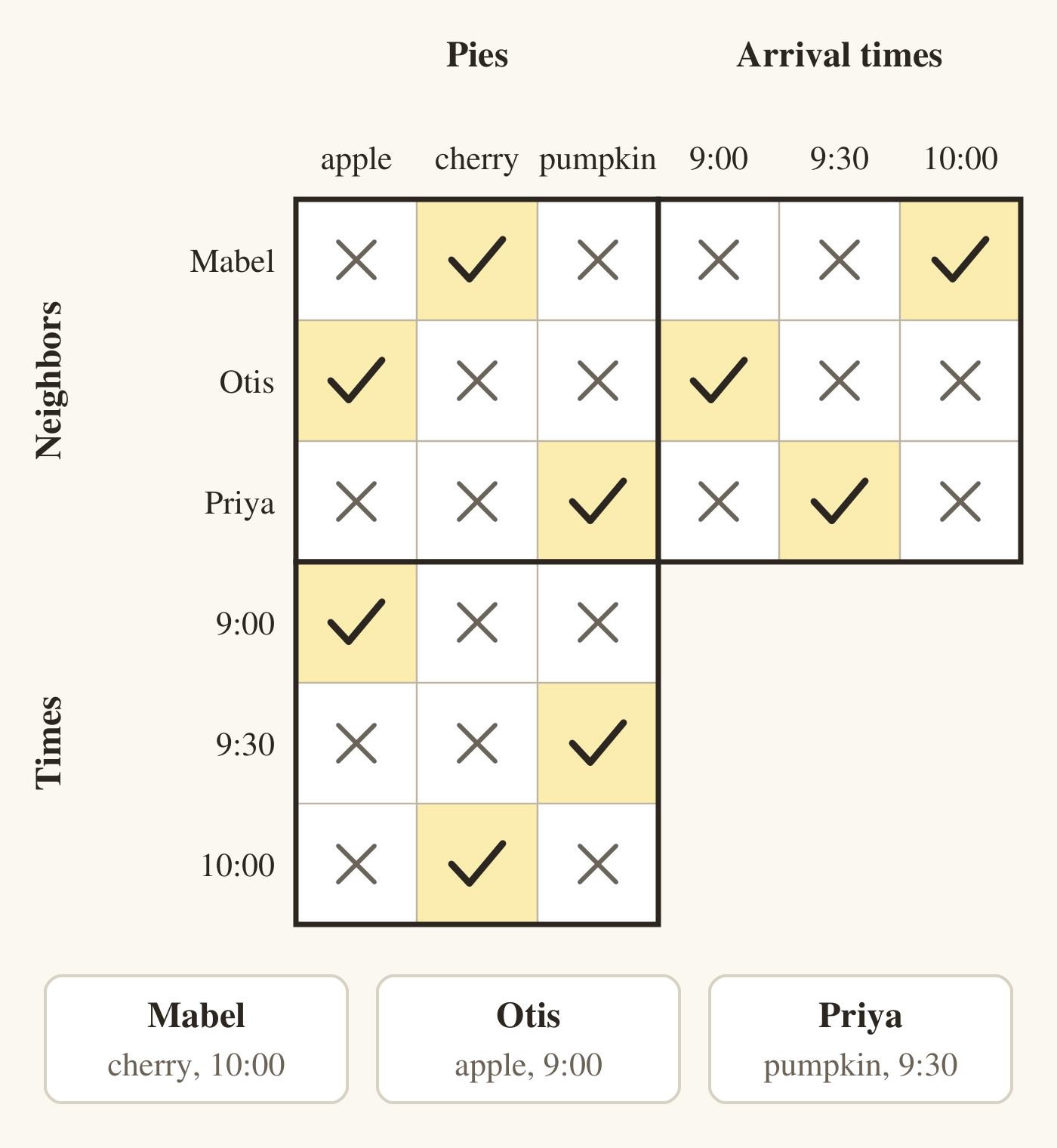
Here's a small puzzle made up for this guide, with three neighbors (Mabel, Otis and Priya), three pies (apple, cherry and pumpkin) and three arrival times (9:00, 9:30 and 10:00). The clues:
- Otis arrived earlier than the baker with the cherry pie.
- The pumpkin pie arrived at 9:30.
- Priya brought either the pumpkin pie or the cherry pie.
- Mabel arrived later than Priya.
Stage one, the direct clues. Clue 2 is a tick: pumpkin with 9:30. That puts X's on pumpkin with 9:00 and 10:00, and on apple and cherry with 9:30. Clue 3, an either-or, is an X on Priya with apple.
Stage two, the order clues. Clue 1 gives three X's: Otis with 10:00, Otis with cherry, and cherry with 9:00. Cherry's last empty square is 10:00, so that's a tick, which leaves 9:00 for the apple pie. Clue 4 gives two more X's: Priya with 10:00, and Mabel with 9:00. The 10:00 column now has one empty square left, and it's Mabel's.
Stage three, carrying across. Mabel and the cherry pie both arrived at 10:00, so Mabel brought the cherry pie. Priya brought neither apple nor cherry, so she brought pumpkin, at 9:30. Otis is left with the apple pie, at 9:00.
Check it: Otis (9:00) came before the cherry pie (10:00), the pumpkin pie came at 9:30, Priya brought one of her two pies, and Mabel (10:00) came after Priya (9:30). Every mark has a reason.
When you're stuck: re-read the clue words, and never guess
Go back through the clues one at a time and ask not "what does this say?" but "what does this rule out?" Order and either-or clues usually hold an X you haven't marked. Then carry each tick into the other small grids, and re-read the exact words.
Don't guess. A lucky guess still leaves you not knowing, and a wrong one spreads X's you can't trace back. If you test a possibility, treat it as a temporary assumption, not a solved mark. If it forces a contradiction, you've proved that square is an X; if it doesn't, erase the trial and keep working from what you know.
The same patience works on letters instead of squares. Here's how to solve cryptograms, starting with a challenge Edgar Allan Poe set his readers in 1839.
Back to the forty-eight squares
Now go back to that first grid: twelve clues, forty-eight empty squares, the pencil still. You know where to start: the direct clues, the X's each tick earns, the rows with one square left, the ends the order clues rule out. The pencil starts moving, and each mark makes the next one easier to find.
After that, what helps most is practice in a steady climb, from grids that teach each move to grids that need all of them at once. That's how we built The Pennyfold Deduction Club. Its 80 story logic grid puzzles are set in one invented village over one year: 20 easy puzzles in spring, 25 medium in summer, 20 hard in autumn and 15 fiendish in winter. There's a club of four, Winnie, Fergus, Lottie and Arjun, and puzzles drawn from village life, like The Egg Hunt and The Raffle. Near the front are a page on the clue words and a worked example, and every solution is written out step by step, so when you're stuck you can check your reasoning, not just the answer.
Sources
- Logic grid puzzles, and the Zebra Puzzle as the best-known example: Logic puzzle, Wikipedia.
- The Zebra Puzzle's first known printing and the Einstein story: Zebra Puzzle, Wikipedia.
- The X and tick marks: How to solve logic grid puzzles, ThePuzzleLabs.
Frequently asked questions
How do you solve logic grid puzzles step by step?
Mark the direct "is" and "is not" clues first. Add the X's each tick earns across its row and column, and tick any square that's the last one left in its row or column. Then carry facts between the small grids, work through the either-or and order clues, and repeat until every row has one tick.
How do you solve hard logic grid puzzles?
Harder puzzles hide more of their facts in order clues and either-or clues, so ask of each clue what it rules out, and carry every new tick into the other small grids. Test a possibility only lightly, and never leave a guess in the grid.
What symbol is used in a logic puzzle grid?
Most solvers use an X for "no" and a tick, a dot or an O for "yes". Any two marks work, as long as you never mix them up.
What are logic grid puzzles called?
Usually logic puzzles or logic grid puzzles. The best-known example is the Zebra Puzzle, which asks who owns the zebra. Its earliest known version appeared in Life International on 17 December 1962. It's often called Einstein's riddle, but there's no evidence that Einstein wrote it.