
Buying a planner feels like a promise. Using one is a different thing entirely. Most of us know how to use a planner in theory, and still watch it gather dust by the end of February, not because we stopped caring, but because nobody told us what to actually do with it, and when. This is the routine we built our own planner around: fifteen minutes on a Sunday, a minute or two each morning, and a way back in when life gets in the way.
Why most planners are abandoned
Planners fail for three ordinary reasons. We try to fill every box, so planning becomes a chore. We plan the week but never look at the bigger goal, so the weeks go by without adding up to anything. And we miss a week, feel guilty, and never open it again. A good routine fixes all three: it is short, it connects the week to the year, and it has a built-in restart.
How to use a planner: the Sunday routine
Sit down somewhere quiet with a cup of something warm. Set a timer for fifteen minutes. Then go through these steps in order.
Minute 1 to 2: Look at the big picture
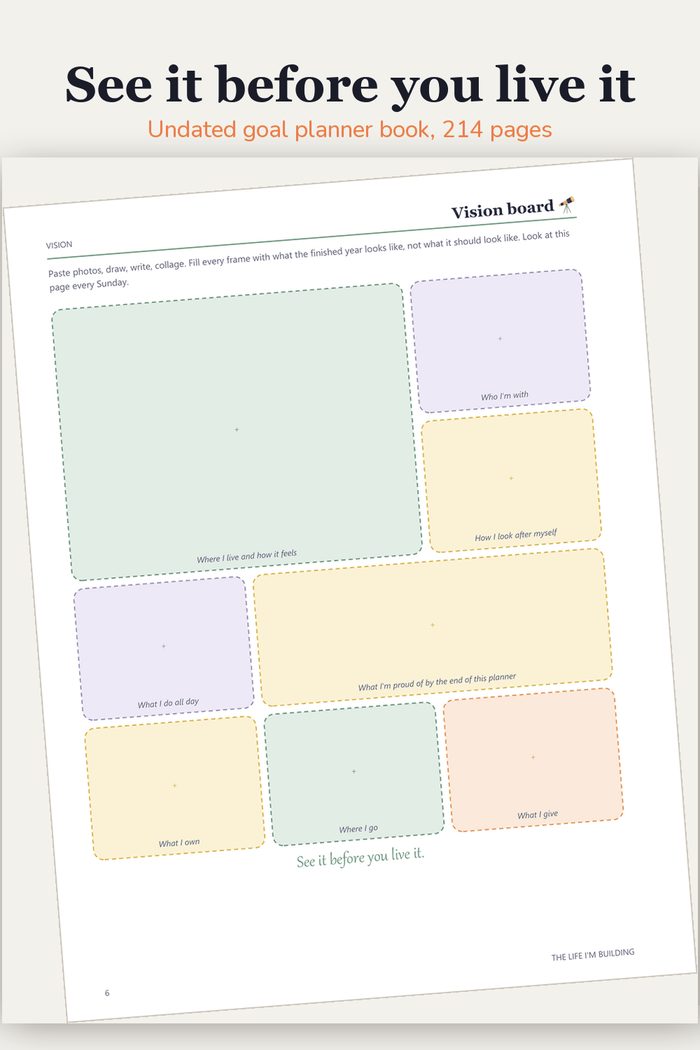
Open your vision board or your one big goal for the year. Just look at it. Our planner's vision page literally says "Look at this page every Sunday", and there is a reason: it reminds you why the rest of this matters.
Minute 3 to 4: Check the quarter
Look at your three goals for this quarter and colour in the box for each one that moved last week. Honestly. An uncoloured box is not a failure; it is information.
Minute 5 to 7: Choose three big rocks
Write the three things that, if they happened this week, would make it a good week. Each one should come from your quarter goals. Three, not ten. Big rocks go in the jar first; the sand fits around them.
Minute 8 to 10: Add the small steps
From your goal ladders, write the small steps you will take this week, ten minutes each. These are the actions that keep every goal alive, even the ones you are not pushing this quarter.
Minute 11 to 13: Give every day a top priority
Glance across the week and write one top priority for each day. Only one. On a good day you will do more; on a hard day, doing that one thing is enough.
Minute 14 to 15: Set up your habits
Write the habits you are tracking this week, no more than three, and the smallest version of each for bad days. "Walk ten minutes" on a good day can be "put my shoes on and step outside" on a bad one.
That is it. Close the book. The week is planned.
What to do each morning
Open the planner, read today's top priority, and do it before you check your messages if you possibly can. That takes about a minute. Tick the habits from yesterday while you are there.
What to do at the end of the week
Before you start next Sunday's routine, spend two minutes on the week that just ended:
- Wins of the week. Count the small ones. They are the ones that add up.
- Something you are grateful for. One line is plenty.
- Brain dump. Anything rattling around in your head goes here, so it stops rattling.
- Next week, the one thing. Carry it straight into your three big rocks.
How to restart after a missed week
This is the part that matters most. You will miss a week. Everyone does. When it happens:
- Do not go back and fill in the missed week. It is gone; let it go.
- Turn to a fresh page and write today's date.
- Do the Sunday routine as normal, even if it is Wednesday.
- In your wins, write "I came back." It counts.
This is where an undated planner is a quiet gift: a missed week leaves no blank pages behind, so the book never makes you feel behind. If you are choosing between the two kinds, we wrote an honest comparison of dated vs undated planners.
Monthly and quarterly check-ins
Once a month, spend twenty minutes on a month review: colour each goal's progress bar to where it honestly is, write what went well and what you would do differently, and pick the one thing that would make the biggest difference next month. Once a quarter, choose which three goal ladders to push, which to keep ticking over, and which to pause. That triage is what stops a planner trying to do everything at once.
Common mistakes
- Filling every box. Leave space blank. A planner is a tool, not an exam.
- Planning without looking at the goal. Two minutes on the big picture makes the other thirteen count.
- Ten priorities a day. If everything is a priority, nothing is.
- Beautiful but not useful. Decorate if you love it, but never let it stop you planning.
A planner built for this routine
We designed The Life I'm Building around exactly this rhythm. Each week is a two-page spread: a top priority for every day on the left, and on the right three big rocks, small steps from your ladders, habits, body and mind, gratitude, wins, a brain dump and the one thing for next week. The goal ladders and the 9 grid goal chart at the front feed straight into it. The undated edition lets you begin on any Monday; the 2027 edition has the dates printed for you.
Frequently asked questions
How do you use a planner effectively?
Plan once a week for about fifteen minutes: look at your big goal, check your quarter goals, choose three big rocks, add small steps and give each day one top priority. Then spend a minute each morning on today's priority.
How long should weekly planning take?
About fifteen minutes. Any longer and it becomes a chore you will skip; any shorter and you will not connect the week to your goals.
What should I write in my planner every day?
One top priority, plus a tick for each habit you are tracking. That is enough for most days.
What if I miss a week in my planner?
Skip it and start fresh on today's date. Do not go back and fill in the missed week. Coming back is the habit that matters.