
Boston, three hundred years ago. A teenage apprentice in his brother's print shop has been arguing with a friend by letter, and his father finds the letters and reads them. The father doesn't take a side. He talks to the boy about how he writes: the spelling and punctuation are correct, he says, because the boy learned those setting type, but the writing falls far short in elegance, in method and in clearness. The boy is Benjamin Franklin, and what he did next gives a surprisingly clear way into the question what is copywork, and what the practice is meant to do.
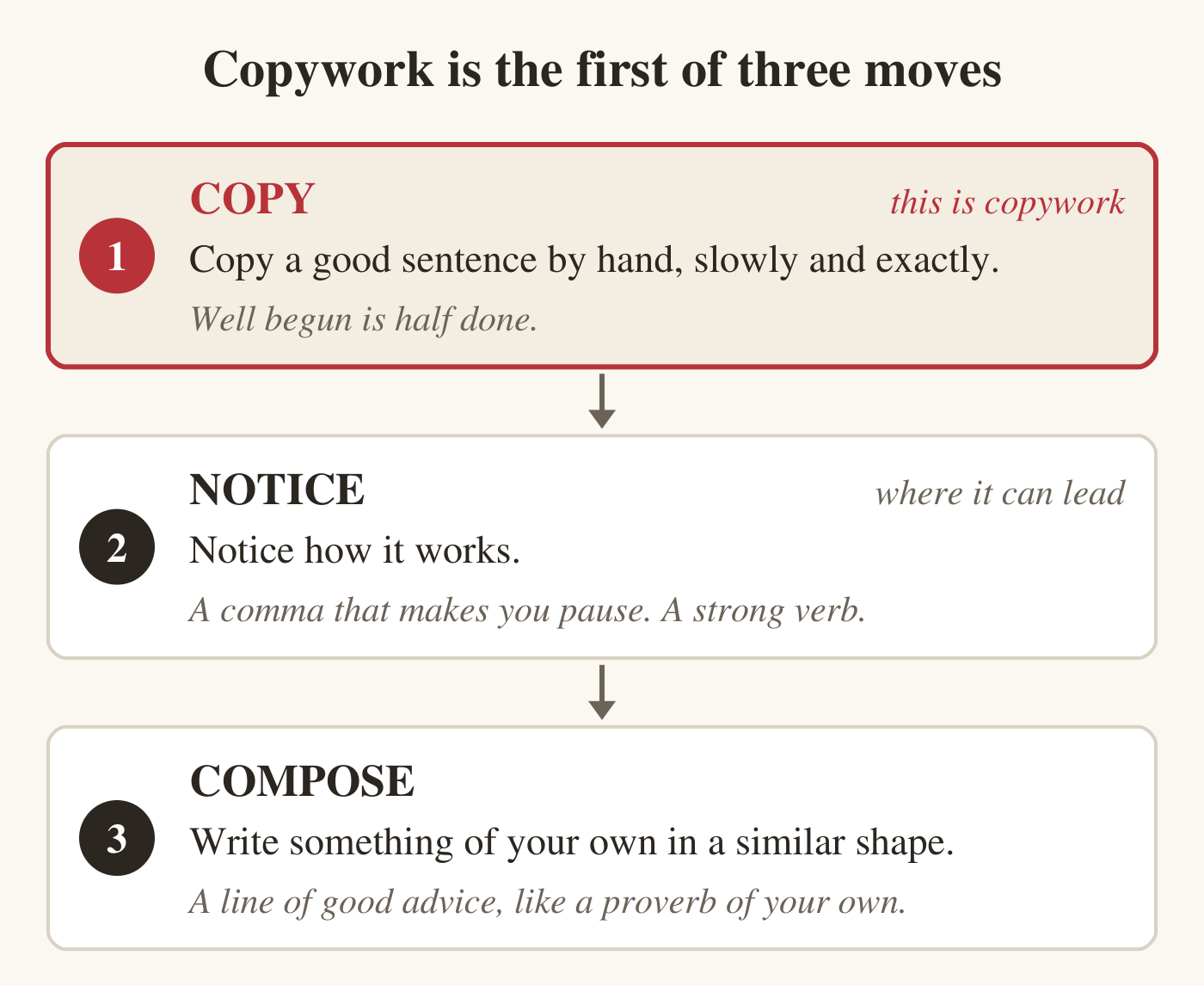
The short answer: Copywork is copying a well-written sentence or passage by hand, slowly and exactly. It gives a child practice with handwriting, spelling, punctuation and the shape of complete sentences by working from a good model. The British educator Charlotte Mason called this kind of careful copying transcription. It can also become the first of three moves: copy a good sentence, notice how it works, then try writing something of your own in a similar shape.
What Franklin did with an odd volume of essays
Franklin tells the story himself in his Autobiography. He had left school at ten. Soon after his father's criticism, he came across an odd volume, the third, of The Spectator, a London paper of short essays by Joseph Addison and Richard Steele. He had never seen it before. He read it over and over, thought the writing excellent, and "wished, if possible, to imitate it."
So he set himself an exercise. He took some of the essays and wrote a short note of the idea in each sentence. He put the notes away for a few days. Then, without looking at the book, he tried to write the essays out again in full from his notes, in whatever suitable words came to him. Finally he laid his version beside the original, found his faults, and corrected them.
He kept adding harder versions. When he felt he was short of words, he turned some of the stories into verse and, once he had mostly forgotten the prose, back again, because rhyme and rhythm made him search for the right word. When he wanted to learn how to order his thoughts, he shuffled his notes and put them back into the best order before writing. He did all of this at night, before work began in the morning, and on Sundays, when he could have the printing house to himself.
The payoff, in his own words, was that it encouraged him "to think I might possibly in time come to be a tolerable English writer." He became rather more than tolerable.
Franklin's exercise in three moves
Strip away the eighteenth-century details and Franklin's method is three moves:
- Take in a good model closely. He read the essays until he knew what he admired in them.
- Notice how it is made. Every comparison with the original showed him a choice the better writer had made and he had missed.
- Build your own in the same shape, then check it. His versions were his own words, measured against a model.
Franklin was a teenager who already read widely, so his exercise began with the hard part: rebuilding an essay from notes. A child does not need to start there. The first move can be made concrete: copy the good sentence itself, letter by letter, exactly as written. That first, concrete move is copywork. The other two moves are where it can lead.
What copywork is, in plain words
Copywork is copying. A child takes one good sentence, or a short passage or poem, reads it aloud, and copies it by hand as carefully and exactly as they can. The sentence is chosen because it is worth writing: a true old proverb, a line from a book they love, a few lines of a poem.
Charlotte Mason, the British educator whose book Home Education was first published in 1886, described a closely related practice as transcription. She wrote that a child's earliest practice in writing, at seven or eight, should be "not letter writing or dictation, but transcription, slow and beautiful work." She wanted transcription to be an introduction to spelling, and she suggested letting children choose their favorite verses to copy into a book of their own. Her description is an important historical example of the kind of careful copying now discussed as copywork.
What a copywork session practices
The value of the exercise is easier to see when you look at what the child actually does while copying:
- The child works from a complete model. Instead of looking at punctuation as an isolated rule, they see commas, capitals and sentence structure being used inside an actual sentence.
- The same sentence is seen, heard and written. The child reads the line aloud, looks closely at how it is written, and then copies it slowly. Spelling and punctuation are part of the same piece of work rather than a separate drill.
- It puts good wording under close attention. Franklin himself complained that he lacked "a stock of words." Copywork asks a child to spend a little time looking closely at vocabulary and sentence rhythm instead of rushing past them.
- It can stay small. One carefully copied sentence can be the whole session. There is no need to fill a page simply for the sake of filling it.
What copywork is not: punishment lines, tracing forever, or a page of letters filled in to get it over with. The point is the sentence, and the care.
How to start copywork at home this week
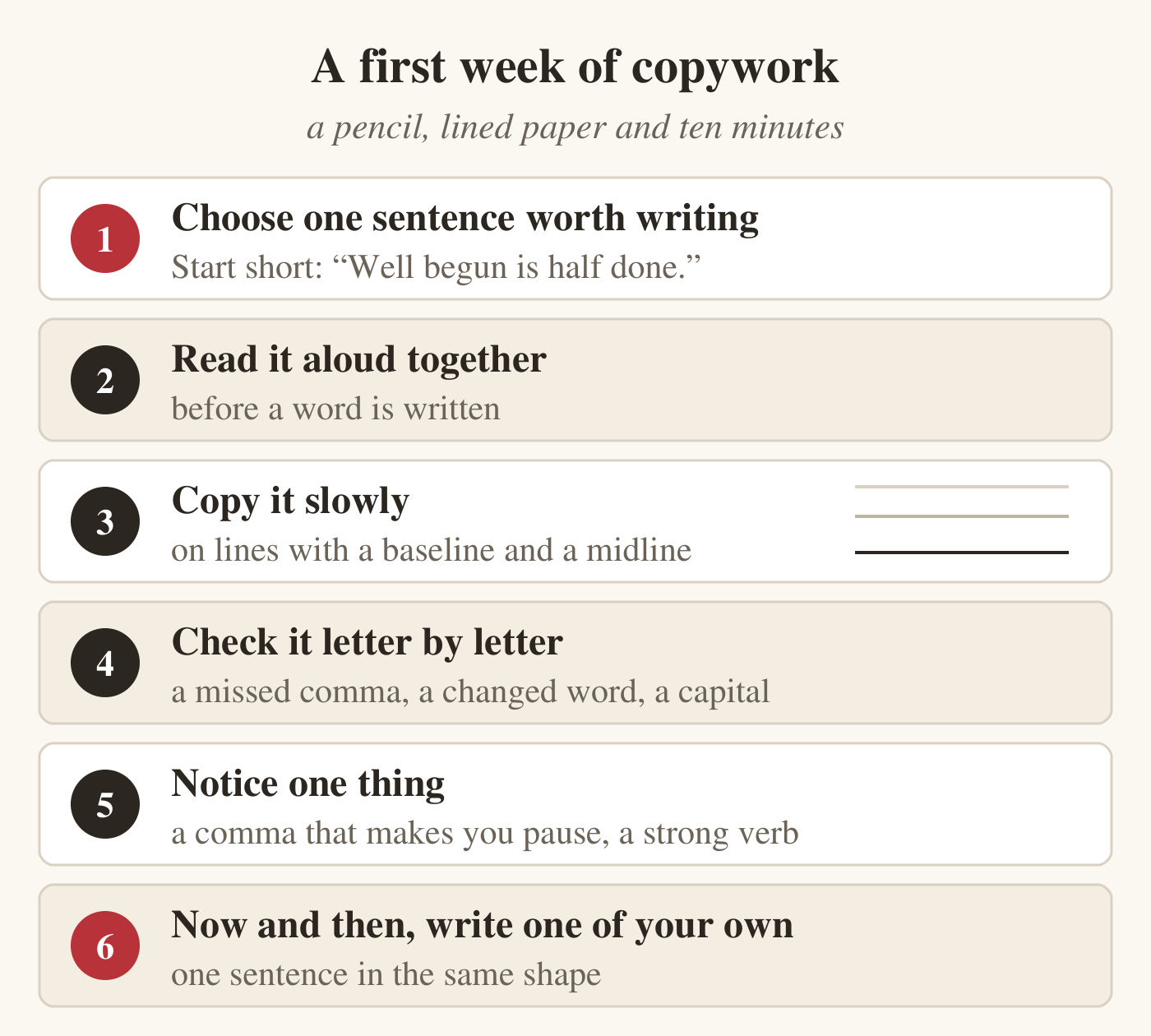
You need a pencil, lined paper with room to write, and ten minutes. Here is one way to run the first week with a child of about 8 to 12:
- Choose one sentence worth writing. Start short. "Well begun is half done." "Look before you leap." A line from the book at their bedside.
- Read it aloud together before a word is written.
- Copy it slowly, on lines with a baseline and a midline, so small letters sit between them and tall letters reach up. One careful line beats a page in a hurry.
- Check it against the original, letter by letter. This echoes Franklin's comparison step. Let the child look for differences themselves: a missed comma, a changed word, or a capital letter that was overlooked.
- Notice one thing. A comma that makes you pause. A strong verb. A comparison, like Wordsworth wandering "lonely as a cloud."
- Now and then, try Franklin's move in miniature. Once copying feels steady, ask for one sentence of their own in the same shape. After "Well begun is half done," write a piece of good advice for a younger child in a single short line, like a proverb of your own.
Keep it brief and regular. The point is not to produce a large amount of handwriting; it is to give one small piece of writing careful attention.
A workbook built on the same three moves
You can do all of this with a notebook and a pile of good books. What a designed workbook adds is the choosing, the order and the lines, already done. That is why we made Copy & Compose: Handwriting Through the Classics around Franklin's arc, in three levels for ages 8 to 12.
- Level One, Copy: 30 single sentences, one to a page: traditional proverbs, traditional moral lines from Aesop, and lines by Lewis Carroll and John Muir.
- Level Two, Copy Longer: 26 short passages and poems, from Stevenson, Rossetti, Grahame, Alcott, Wordsworth, Dickinson and others, each with a "Notice this" line pointing out one thing to look for.
- Level Three, Compose: 18 pages where the child reads a passage, gets a "Notice this" line, and then answers two short "Now you write" prompts on ruled lines. After Aesop's lion and mouse, for example, the prompts ask for a short fable of their own about two animals and one small kindness, ending with a one-line lesson.
Before the levels come a short warm-up and a page of letter shapes in clean print handwriting (the book does not teach cursive). After them come seven ruled "Bring Your Own Copywork" pages for sentences the child finds in their own reading, an echo of Mason's "book of their own," followed by two Sources pages listing the authors and works with their dates.
Franklin's exercise began with a father's honest comment and a secondhand volume of essays. A child can start the same habit at the kitchen table tomorrow: one good sentence, copied with care, then a sentence of their own.
Sources
- Benjamin Franklin, Autobiography, the passage on The Spectator: Project Gutenberg.
- Charlotte Mason, Home Education (1886), chapter "Transcription": AmblesideOnline.
Frequently asked questions about copywork
What is copywork in homeschooling?
It is the practice of copying a short, well-written sentence or passage by hand, slowly and exactly. In homeschool and Charlotte Mason settings it can be used for handwriting, spelling and punctuation practice, and as a first step toward a child's own writing.
What age should a child start copywork?
Charlotte Mason suggested transcription as a child's earliest writing practice at about seven or eight. As the writing gets longer, the practice can move from single sentences to passages and, later, to writing something of the child's own from a model.
How long should a copywork session be?
Short. Ten calm minutes, or a single sentence done carefully, is plenty. The value is in the care, not the amount.
What are the benefits of copywork?
Copywork gives a child one place to practice careful handwriting while paying attention to the spelling, punctuation and structure of a complete sentence. It can also be kept very short: one sentence or a few lines at a time. It is practice from a model, not a full writing curriculum or a guarantee of any particular learning result.
Is copywork the same as Benjamin Franklin's writing exercise?
Not exactly. Franklin's exercise was harder: he made notes from essays, put them aside, then tried to rebuild the essays in his own words before comparing his version with the original. Copywork is the simpler first step: look closely at a good sentence and copy it exactly, before moving on to noticing and composing.
Is copywork the same as handwriting practice?
It overlaps, but it is more. Handwriting practice is about forming letters well. Copywork also chooses words worth writing, so the child practices spelling, punctuation and the shape of good sentences at the same time.