Who this copywork workbook is for
This copywork workbook opens by naming the moment it is for: the quiet at the kitchen table when a child slows down to copy one worthwhile sentence by hand, as carefully as they can.
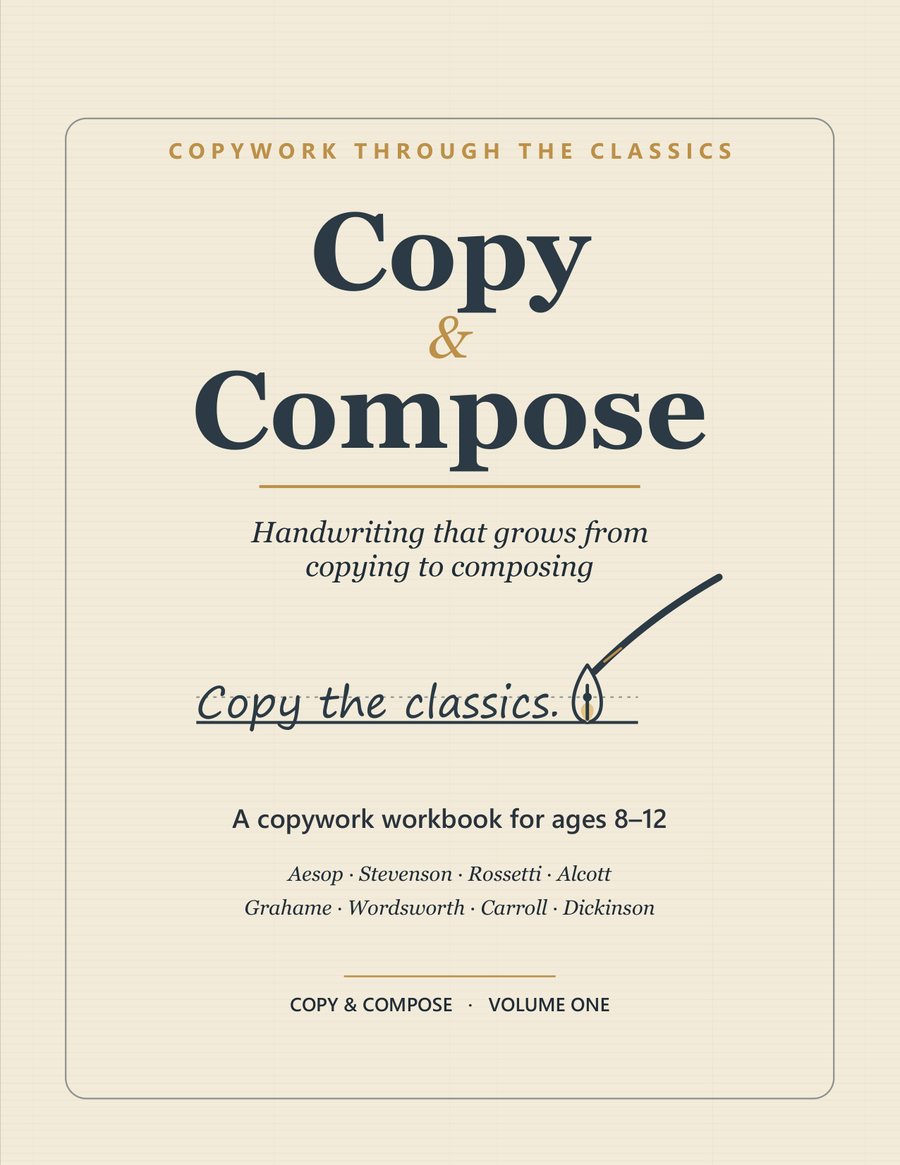
This copywork workbook is for ages 8 to 12. It begins with clean print letter shapes and a short tracing warm-up, then moves from single sentences to longer passages and finally to short pieces of the child's own writing.
It can be used a page at a time at home or as part of a homeschool routine, including classical-education and Charlotte Mason routines. The book suggests one page or about ten quiet minutes a day, with the emphasis on careful writing rather than speed. It is a write-in workbook, not a graded curriculum.
Inside the book
- Four short pages to read first: why one carefully copied sentence matters, why copywork works, how the three levels work, and how to sit, hold the pencil and pace yourself.
- Letter shapes to check: the lowercase alphabet, the capitals and the numbers, drawn in the same clean print handwriting the book uses throughout.
- A short warm-up: trace and copy letters, then short words, then a short phrase.
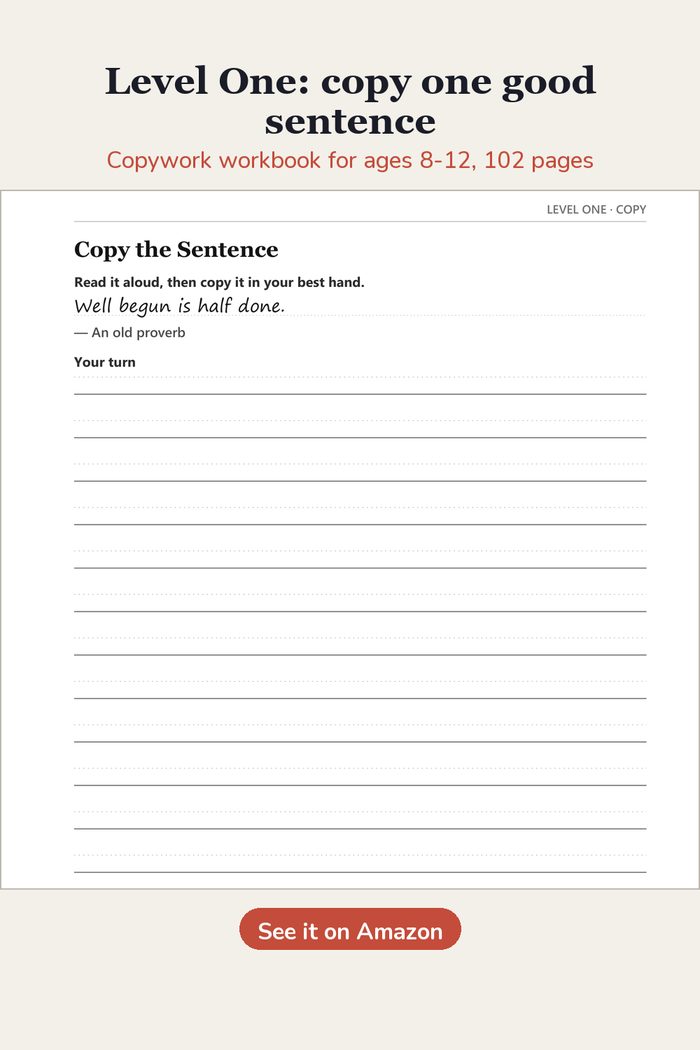
- Level One, Copy: 30 single sentences, one to a page, from traditional proverbs, traditional moral lines from Aesop and lines by Lewis Carroll and John Muir, each above handwriting lines.
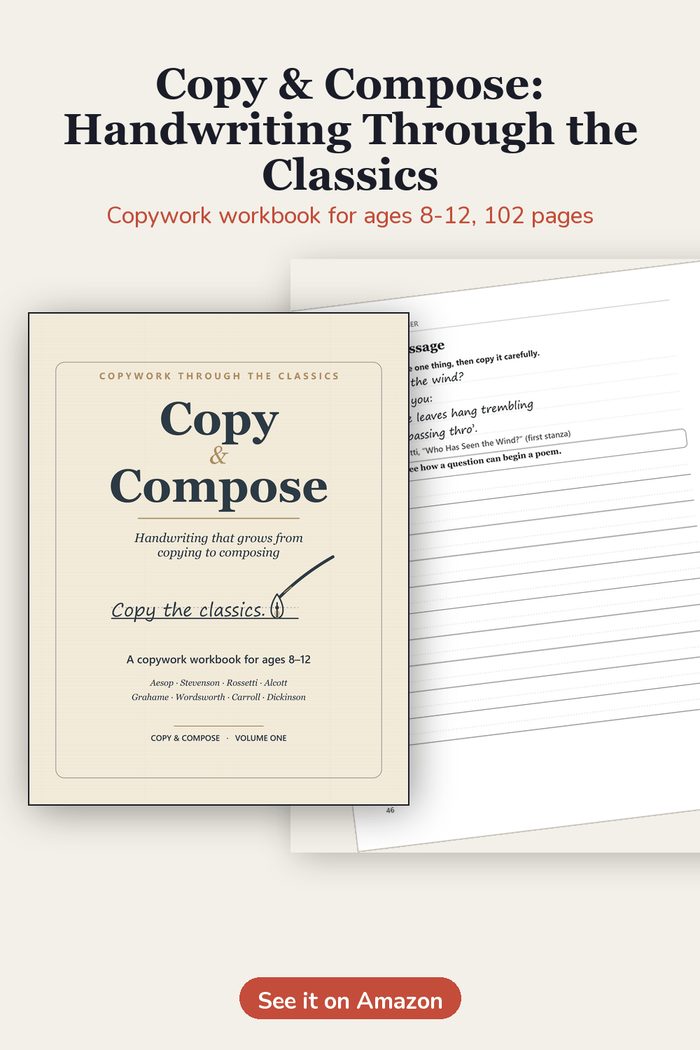
- Level Two, Copy Longer: 26 short passages and poems by writers such as Robert Louis Stevenson, Christina Rossetti, Kenneth Grahame, Louisa May Alcott, William Wordsworth and Emily Dickinson. Each page has a boxed "Notice this" line that points out one thing to look for, such as a comma that pauses the sentence, a vivid verb or a comparison.
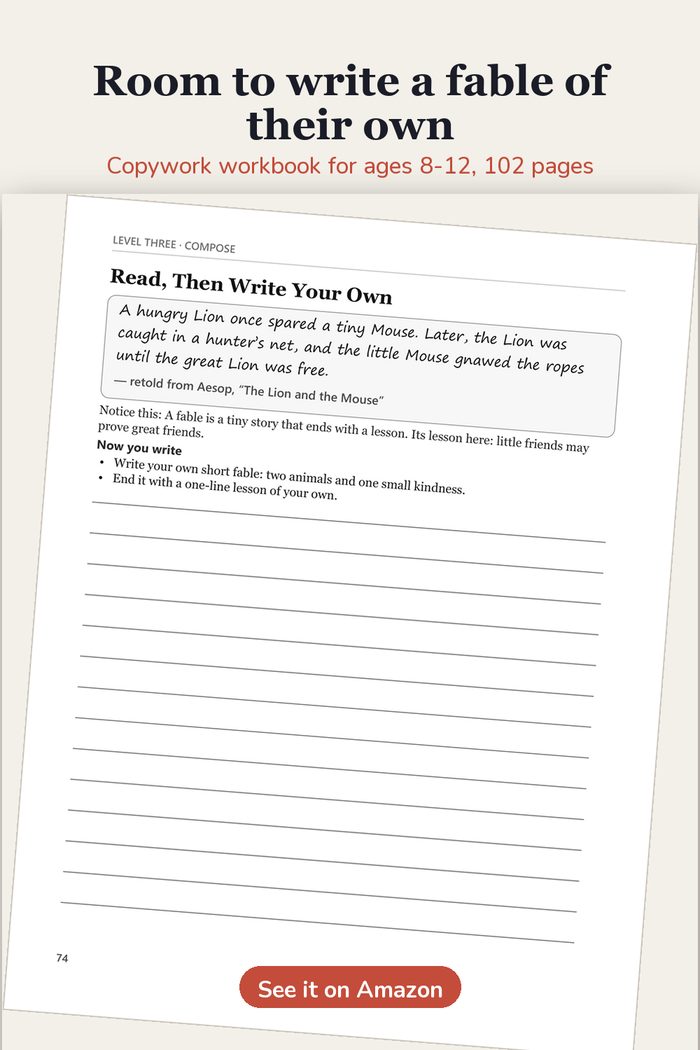
- Level Three, Compose: 18 pages where the child reads a passage, gets a "Notice this" line, and answers two short "Now you write" prompts on ruled lines. After Aesop's lion and mouse, for example: write your own short fable about two animals and one small kindness, and end it with a one-line lesson.
- Bring Your Own Copywork: 7 ruled pages for copying out a sentence the child loves from their own reading, with a line to write who wrote it.
- Sources & Their Public Domain: every author and work, with its date, on two pages at the back. Then a "How Far You've Come" page, a "Keep Going" page and a copywork certificate.
How it works
- A little each day. The book suggests one page, or ten quiet minutes. Neat beats fast.
- Read it aloud first, so the ear hears the sentence before the hand writes it.
- Rest the letters on the lines. Every practice row has a solid baseline and a dashed midline; the book shows small letters sitting between them, tall letters reaching up and tails hanging down. The model to copy is set in a clean print handwriting, not cursive.
- In Level Three there is no single right answer. The child's own words are the point.
New to the idea? What Is Copywork? Ben Franklin's Copy-Then-Compose Habit tells the story behind the practice and gives a simple way to begin at home.
How it compares
Picture the page after the copying is done. Some copywork books focus on copying passages alone; others emphasize cursive handwriting practice. Copy & Compose keeps the copying and adds two steps. Each of the 26 Level Two passages carries a "Notice this" line, and the 18 Level Three pages ask the child to read, notice and then write a short piece of their own. The model is clean print, not cursive, and a list of sources and dates appears at the back.
Frequently asked questions
What does "Copy & Compose" mean?
The book has three levels. Level One asks the child to copy 30 single sentences. Level Two moves to 26 longer passages and poems, each with a "Notice this" box. Level Three has 18 pages with a passage, a "Notice this" line and two "Now you write" prompts, so the child ends the book writing short pieces of their own.
What age is it for?
Ages 8 to 12. The book begins with letter shapes and a short tracing-and-copying warm-up, moves through single sentences and longer passages, and ends with short pieces of original writing in Level Three.
Does it teach cursive?
No. The model sentences are set in a clean print handwriting, and the book does not teach joined-up cursive.
Where do the passages come from?
From traditional proverbs and sayings, Aesop's fables and public-domain writers, including Stevenson, Rossetti, Grahame, Alcott, Sewell, Carroll, Wordsworth, Dickinson, Blake, Lear, Thoreau and Muir. Literary texts are given in a lightly modernized reading form, and a shortened passage is marked with an ellipsis or an "excerpt" note. The Sources & Their Public Domain pages at the back list every author and work with its date.
Is it religious instruction?
No. The book's copyright page states that it is not religious instruction. Its copywork selections come from traditional sayings, Aesop and the public-domain writers listed on the Sources pages.
Is it a full writing curriculum?
No. The book states that it is not a graded curriculum, a reading primer or professional educational advice. It is a write-in copywork workbook that moves from handwriting practice into short composition prompts.
How big is it?
8.5 x 11 inches, 102 pages, printed in black ink on white paper.
See it on Amazon