Who this secret codes book is for
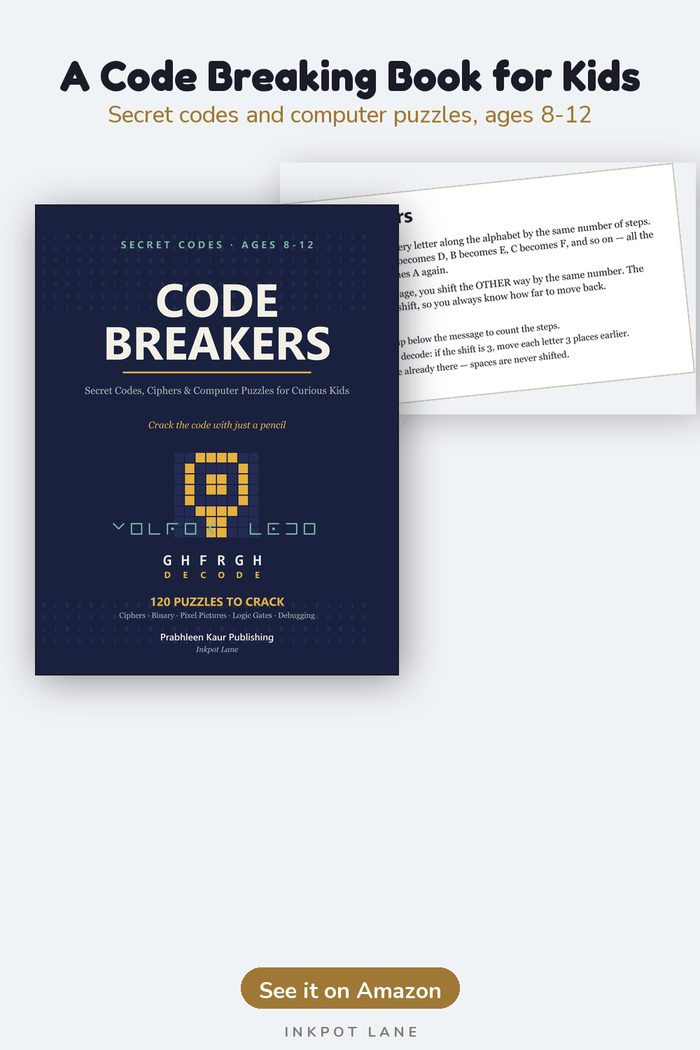
This secret codes book for kids ages 8 to 12 is for the moment a child finds a line of strange letters, or a row of little shapes, and cannot rest until they know what it says.
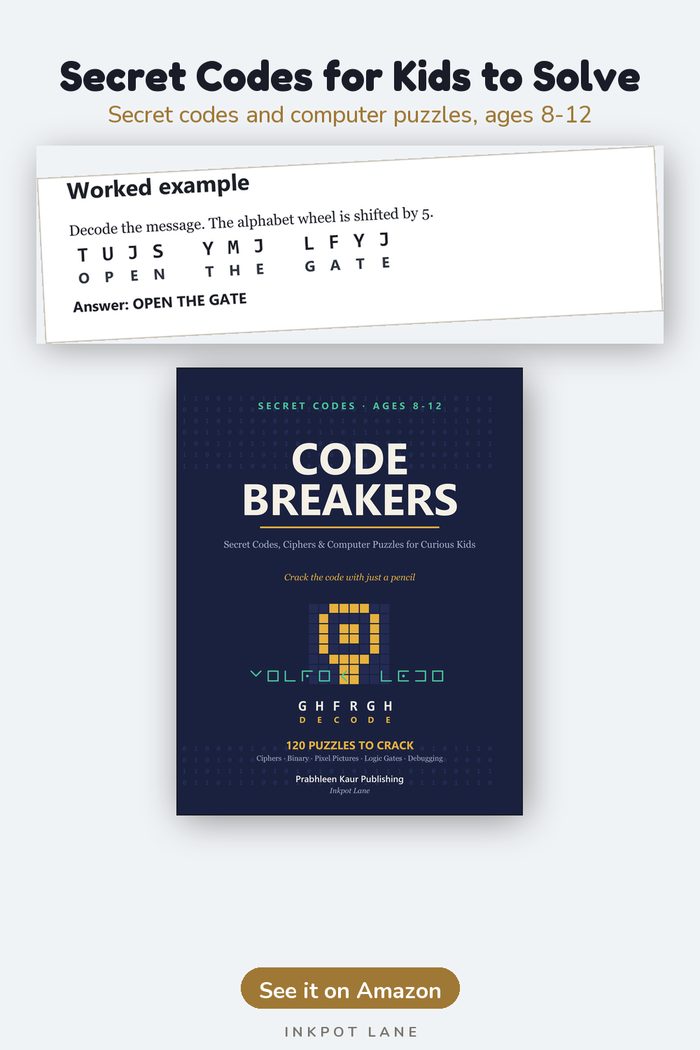
Each chapter introduces one kind of code or computer-style puzzle, shows one worked example, and then gives the child puzzles marked Easy, Medium or Tricky. It starts with shift ciphers, keyword ciphers and pigpen, then moves into binary, base sixteen, pixel pictures, following steps, sorting, logic gates and finding a mistake.
No computer is needed. Everything is solved in the book with a pencil, and all 120 answers are at the back.
Inside the book
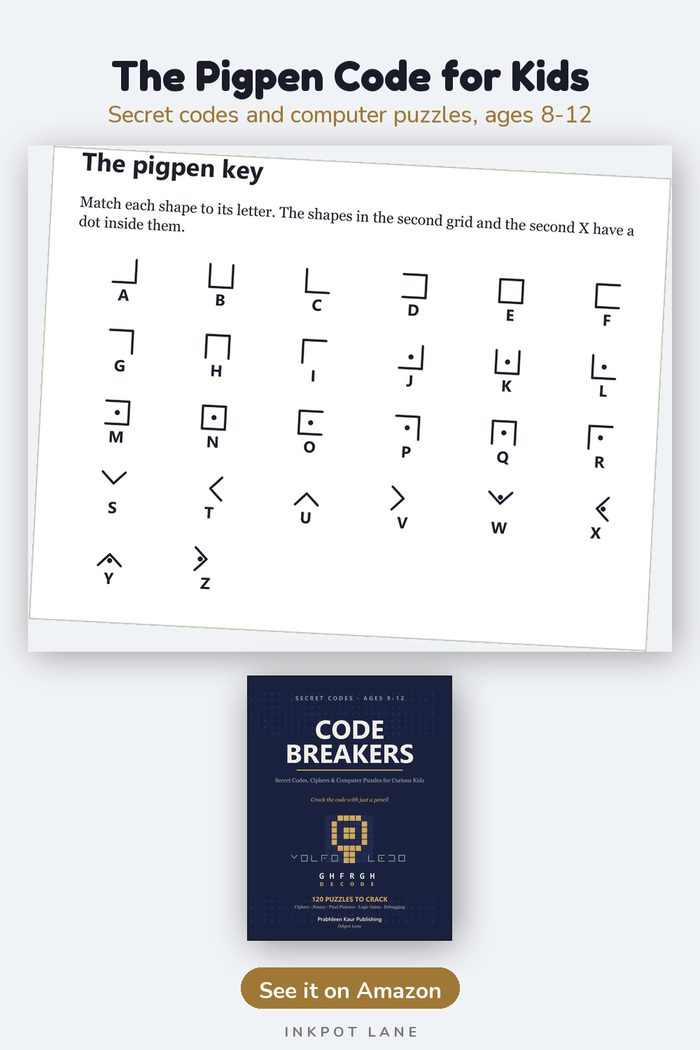
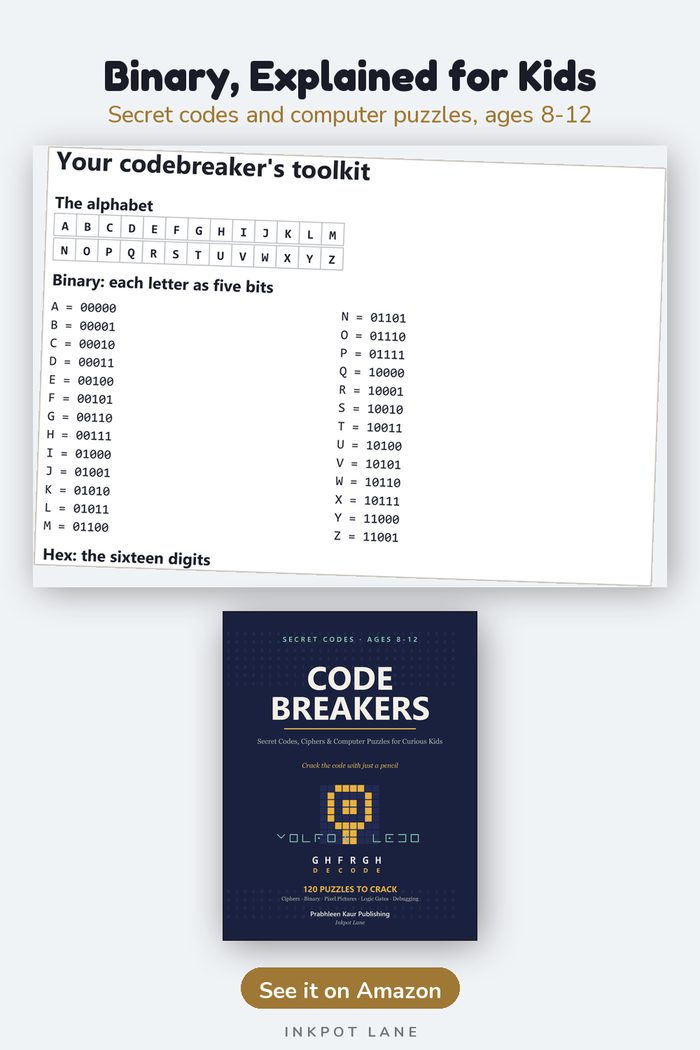
- A note to codebreakers and a how-to-use page: read the lesson first, keep the toolkit handy, work in pencil, skip a hard one and come back, and check the back. Peeking is allowed. - Your codebreaker's toolkit: the alphabet, a five-bit binary code for every letter (A = 00000 up to Z = 11001), the sixteen hex digits, and a full pigpen key. - 120 puzzles in 10 chapters, each chapter opening with a lesson page, tips and one worked example: - Shift Ciphers: 14 messages, with the shift given. - Keyword Ciphers: 13 messages; the child builds the cipher alphabet from a keyword such as GALAXY or SECRET. - The Pigpen Code: 11 messages written in grid-and-dot shapes. - Talking in Binary: 13 puzzles: 10 messages in five-bit letter codes, then 3 binary numbers to turn into ordinary numbers. - Base Sixteen: 10 puzzles: 3 hex numbers, then 7 words written with a hex letter table. - Picture in the Grid: 10 pictures hidden in 8 x 8 grids. Each row is a number; turn it into binary, fill in the 1s, and a house, a star, a boat or a moon appears. - Follow the Steps: 13 short sets of instructions to follow in order, some with an "if" step. - Sorting Networks: 10 rows of numbers put in order by a fixed list of compare-and-swap steps. - Logic Gates: 13 switch puzzles using AND, OR, NOT and XOR; in the last four, the child finds the one setting that lights the bulb. - Debug This: 13 number lists that follow a rule, each with exactly one number that breaks it. - Three levels in every chapter, marked on each puzzle: 39 Easy, 46 Medium and 35 Tricky in all. - Answers for all 120 puzzles on four pages at the back, then a short closing page, "One last secret."
How it works
- Read the lesson, then look at the worked example. Each chapter includes one solved example before the numbered puzzles, so the child can see the method before trying it.
- Keep the toolkit open. The book suggests folding the corner so the alphabet, five-bit binary table, hex digits and pigpen key are easy to flip back to.
- Work in pencil. A wrong guess is a clue, not a mistake: rub it out and try the next one.
- Skip and come back. The how-to-use page says the puzzles get harder inside each chapter, and that if one is too tricky today, the child can skip it and come back. Peeking at the answers is allowed.
- Checked twice. The copyright page states that every puzzle was generated and then solved twice by computer, once by the program that made it and once by a separate checking program, to confirm each puzzle has one clear answer before it was printed.
Want a first code to try together? Secret Codes for Kids: Three Pencil Codes to Teach Tonight walks through a shift cipher, pigpen and a binary picture you can make at the kitchen table.
Frequently asked questions
What age is it for?
Ages 8 to 12. Each chapter starts with a lesson and one worked example, and every puzzle is marked Easy, Medium or Tricky.
Does my child need a computer?
No. The binary, hex, sorting and logic-gate puzzles are all done on paper with a pencil. The book says it plainly: you do not need a computer, and you do not need to be fast.
Does it teach programming?
It is not a programming course, and there is no code to type. It is a puzzle book that shows, on paper, some ideas computers use: binary, base sixteen, pixels, following steps in order, sorting, logic gates and finding a mistake.
Which codes are in it?
Shift ciphers, keyword ciphers and the pigpen code, then five-bit binary letters, binary numbers, hex numbers and hex letters, and binary pixel pictures. The copyright page notes that the codes shown, such as shift ciphers and pigpen, are historical, public methods.
Are the answers included?
Yes. All 120 answers are at the back. The pixel-picture answers name the picture the child should see, such as a house, a heart or a key.
Is it a book to write in?
Yes. It is made to be worked in with a pencil: the message puzzles have answer boxes, the keyword puzzles leave a row for building the cipher alphabet, the picture puzzles have an empty 8 x 8 grid to fill in, and the number puzzles have an answer line.
How big is it?
8.5 x 11 inches, 106 pages, printed in black ink on white paper.
See it on Amazon