
Christmas puzzles for adults don't usually come from a spy agency. In December 2015, though, the Director of GCHQ, Britain's signals intelligence agency, sent out his Christmas card with a puzzle printed inside: a grid of squares to shade black or white. Shade it correctly and the grid became a QR code, which led to a second stage of puzzles, and then more. GCHQ put the puzzle online too, and people all over the world joined in.
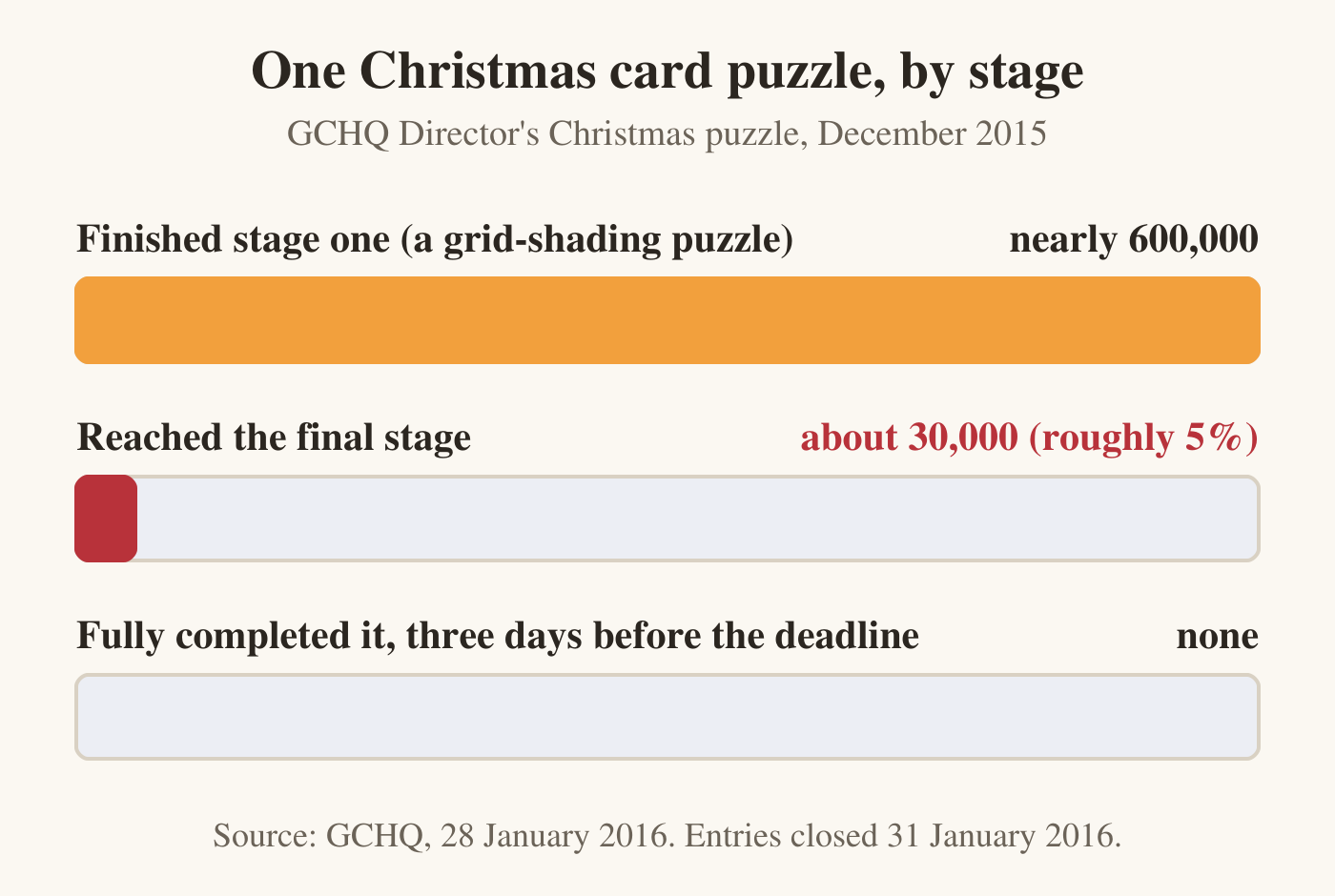
By 28 January 2016, GCHQ said, nearly 600,000 people had finished that first grid, and about 30,000 had reached the final stage. With entries closing on 31 January, nobody had yet fully completed it.
The short answer: Good Christmas puzzles for adults come in different forms, from word searches to logic grids and elimination mysteries. Try the three below: a hidden-message word search, a four-clue logic grid and a small suspect mystery. Each has one answer you can check, and the answers and reasoning are at the end.
Why a mix of Christmas puzzles works
GCHQ's first grid was a way into a much larger challenge. Hundreds of thousands of people finished it, and far fewer reached the final stage. The numbers can't tell us why people joined in or how much they enjoyed it. What makes the challenge interesting is how it was built: one finished puzzle opened the door to the next.
A Christmas puzzle table can offer that same variety, even when the puzzles aren't linked. People around it may want different things. One person wants a quiet word search with a cup of tea. Another wants a chain of clues to follow, and someone else likes working through a long list until one name is left. A short puzzle offers an approachable start, while a longer one gives the keen solver something to come back to.
So the three puzzles below each use a different kind of thinking: spotting hidden words, matching people to gifts and ruling out suspects. Each one is original and small enough to finish in a few minutes. Have a pencil ready.
Puzzle one: a word search with a secret
A word search is an easy place to begin. The words are already listed, and your job is to find where they sit in the grid. A hidden message adds a reason to finish. When every word is circled, the letters left over spell something.
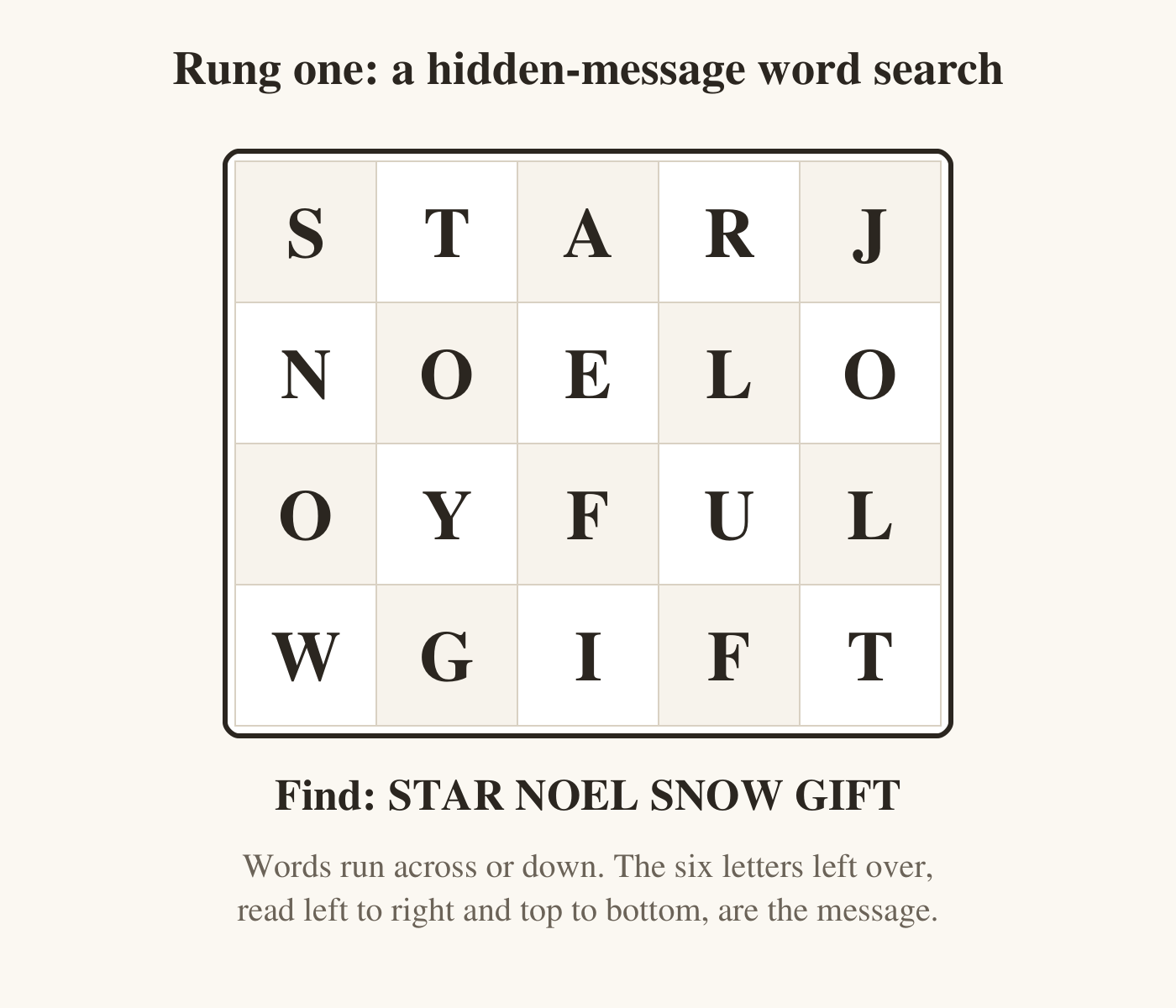
Find STAR, NOEL, SNOW and GIFT. Every word runs across or down, and two squares are shared by more than one word. When all four are circled, six letters are left. Read them left to right, top to bottom, and you have the message.
You can work at your own pace, and each word you find makes the rest of the search a little shorter.
Puzzle two: a four-clue logic grid
A logic grid asks for more. Nothing is hidden in plain sight. Instead, a handful of clues lets you work out who goes with what, and each clue rules something out. Your job is to keep track until only one answer is left in every row.
Three neighbors, Mabel, Otis and Ruth, have each wrapped one gift: a scarf, a jigsaw or a teapot. Each used a different paper: red, green or gold. Who wrapped what, in which paper?
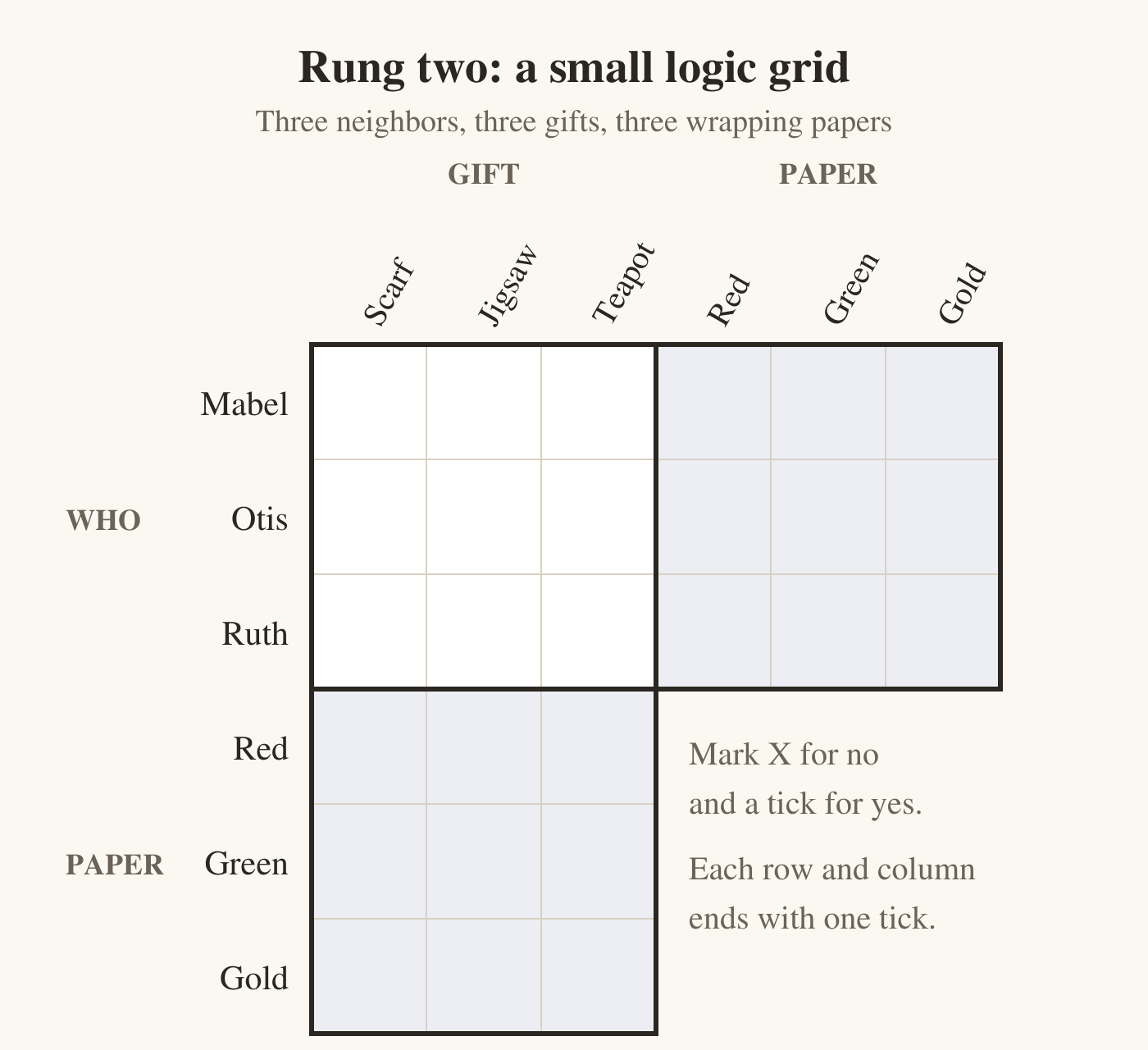
- The scarf is wrapped in red paper.
- Ruth's gift is in neither red nor gold paper.
- The teapot is not in green paper.
- Otis did not use gold paper.
Put an X in a square when a clue rules it out, and a tick when only one square is left in its row or column. Clue 2 gives you your first tick. After that, every tick tells you something about the other two blocks of the grid. You never need to guess: every square can be settled by reasoning alone, and all four clues are needed. If this is your first grid, our guide on how to solve logic grid puzzles walks through the marks step by step.
Puzzle three: a suspect list to cross out
This time, instead of filling a grid, you cross names off a list. Each clue removes the suspects who can't fit it. Work through the clues in order until one name is left.
On Christmas Eve, the last mince pie vanished from the village hall. Eight people were in the hall that afternoon.
| No. | Name | Lives on | Coat | Arrived |
|---|---|---|---|---|
| 1 | Agnes | Holly Lane | red | 4:10 |
| 2 | Bertie | Holly Lane | green | 4:40 |
| 3 | Clara | Holly Lane | red | 4:25 |
| 4 | Dennis | Holly Lane | blue | 4:22 |
| 5 | Edith | Mill Row | red | 4:20 |
| 6 | Fred | Mill Row | green | 4:35 |
| 7 | Gwen | Mill Row | blue | 4:15 |
| 8 | Hal | Mill Row | red | 4:45 |
- The culprit lives on Holly Lane.
- The culprit was not wearing blue.
- The culprit arrived before 4:30.
- The culprit arrived after 4:15.
Every clue is true about the culprit, and every clue rules out at least one person. Read the times exactly: "before 4:30" means 4:29 or earlier. If you are counting as you go, you should have three suspects left after clue 2.
Eight rows make a quick introduction. Longer versions can run to hundreds of names, or more than a thousand, and that's when careful tracking really matters.
How to choose Christmas puzzles for adults
If those three were fun, here is what to look for when you want more than a few minutes' worth.
- One answer you can prove. In a well-made logic or elimination puzzle, the clues lead to one answer without a guess.
- Solutions you can use. A word search needs a clear answer grid. A harder logic puzzle is better with worked explanations that show how the answer follows from the clues.
- A real climb. The first puzzles in a book should teach you the moves, and the later ones should ask for all of them at once.
- Print you can read. Large print matters for word searches most of all, where small letters can swim together.
- Something to follow. A story running through the puzzles gives you a reason to start the next one.
Three books for three kinds of solver
Want a longer session? Two of our Christmas puzzle books for adults build on the word search and the suspect list above. The third is a year-round collection of logic grids.
For the calm solver: Large Print Christmas Word Search. It has 90 puzzles in three levels. In the easy grids, words run across, down and diagonally down to the right; the harder grids add directions until all eight are used. Each puzzle leaves a hidden message, and together the 90 messages tell the story of the snowy village of Pine Hollow getting ready for Christmas. The grid letters are about 20 to 24 point, and the whole story is printed at the back.
For the keen solver: The Twelve Cases of Christmas. Twelve cases run from the nineteenth of December to Christmas Eve in a snowed-in town. The book describes its first case as having forty suspects and taking about ten minutes; the last has fifteen hundred. Every case gives checkpoint counts, so you can catch a wrong turn before you reach the end.
For the logic lover, all year: The Pennyfold Deduction Club. It has 80 logic grid puzzles set in one invented village over one year, from 20 easy puzzles in spring to 15 fiendish ones in winter, with every solution worked out step by step. It isn't a Christmas book, but it could suit someone who enjoyed puzzle two.
Answers
- Puzzle one: STAR runs across the top row, NOEL across the second, GIFT across the bottom row, and SNOW runs down the first column. The leftover letters are J, O, Y, F, U, L: the message is "Joyful".
- Puzzle two: From clue 2, Ruth's paper is green. From clue 4, Otis's paper isn't gold, and it can't be green, so it's red. That leaves gold for Mabel. The scarf is in red paper (clue 1), so Otis wrapped the scarf. The teapot isn't in green (clue 3), so it's Mabel's. That leaves the jigsaw for Ruth. Mabel: teapot in gold. Otis: scarf in red. Ruth: jigsaw in green.
- Puzzle three: Clue 1 rules out the whole of Mill Row (Edith, Fred, Gwen, Hal). Clue 2 rules out Dennis, leaving three. Clue 3 rules out Bertie (4:40). Clue 4 rules out Agnes (4:10). Clara took the mince pie.
Sources
- The 2015 card, the grid-shading first stage and the charity appeal: A Christmas card with a cryptographic twist for charity, GCHQ.
- Nearly 600,000 finishing the opening stage, about 30,000 reaching the final stage and none fully complete by 28 January 2016: As Christmas puzzle deadline looms, GCHQ says "no winning answers yet", GCHQ.
- The first grid's answer, a QR code leading to the next stage: Director's Christmas Puzzle: The Answers, GCHQ, 2016.
Frequently asked questions
What are good Christmas puzzles for adults?
Word searches with a hidden message, logic grids and elimination mysteries are three good kinds. They ask for different things: patience, careful reasoning and keeping track of a long list. A mix suits a family table, because everyone can find a way in.
Are there Christmas puzzles for adults with answers?
Yes. All three puzzles on this page have their answers and explanations in the Answers section. When you choose a puzzle book, look for a clear answer key and, for logic puzzles, worked solutions that show the steps.
What was the GCHQ Christmas puzzle?
In December 2015 the Director of GCHQ, the UK's intelligence and security agency, put a grid-shading puzzle in his Christmas card. Solving it made a QR code that led to harder stages. GCHQ said nearly 600,000 people finished the first stage and about 30,000 reached the final one.
Which Christmas puzzle is best for a group?
A word search or a small logic grid. Both can be shared on one page, and nobody needs any special knowledge. Save the long elimination cases for one keen solver by the fire.