
Every child who has ever lit a diya asks the same question sooner or later: why do we do this? It is a good question, and the answer is one of the oldest and best stories in the world. This is a Diwali story for kids, told the way you might tell it at bedtime, followed by the short answers teachers ask for, the five days of the festival, and a few ways to make the week feel special at home.
The Diwali story for kids: Rama comes home
Long ago, in the kingdom of Ayodhya, there lived a kind and brave prince named Rama. Everyone loved him, and one day he was meant to become king.
But the king had once made a promise, and because of that promise Rama was sent away to live in the forest for fourteen long years. Rama did not argue. He kept his father's word. His wife Sita and his brother Lakshmana went with him, because they would not leave him to go alone.
The forest was wild and beautiful, and for many years they lived there simply and happily. Then one day Ravana, the ten-headed king of Lanka, saw Sita and wanted her for himself. He tricked Rama and Lakshmana into leaving her alone, and carried her away across the sea to his island.
Rama searched everywhere. On the way he met Hanuman, a monkey with the heart of a hero, who could leap across mountains. Hanuman flew over the ocean, found Sita sitting in a garden in Lanka, and told her: "Rama is coming for you." Then the monkeys and bears built a bridge of stones across the sea, and Rama's army marched to Lanka.
There was a great battle. Rama fought Ravana, and good won over evil. Sita was free.
At last the fourteen years were over, and Rama, Sita and Lakshmana set off for home. It was the darkest night of the month, with no moon at all. So the people of Ayodhya filled little clay lamps with oil and set them along every roof, every wall and every path, thousands and thousands of them, so that Rama could find his way home through the dark.
That is why, every year, we light diyas on Diwali. It is a way of saying: welcome home, and may light always find its way through the dark.
Why do we celebrate Diwali? The short answer
If your child needs an answer for school, here it is in five sentences:
- Diwali is the festival of lights, celebrated by millions of people in India and all over the world.
- Hindus remember Lord Rama returning home to Ayodhya with Sita and Lakshmana after fourteen years.
- The people of Ayodhya lit rows of lamps to welcome them, so we light diyas too.
- Diwali celebrates light over darkness and good over evil.
- Families clean their homes, draw rangoli, share sweets and gifts, and pray to Goddess Lakshmi.
More than one story
Diwali is celebrated by many communities, and not every family tells the same story. Many families welcome Goddess Lakshmi, who brings good fortune, on the main night of Diwali, and draw rangoli at the door to invite her in. In some parts of India the festival also remembers Krishna's victory over the demon Narakasura. Jains mark the day Lord Mahavira attained nirvana, and Sikhs celebrate Bandi Chhor Divas. Every one of these stories comes back to the same idea: light, goodness and new beginnings.
The five days of Diwali
Diwali is really a festival of five days. Names and customs change from region to region, but many families follow this pattern:
- Dhanteras, the first day, when many families buy something new, often a small piece of metal or a kitchen pot, for good luck.
- Naraka Chaturdashi, sometimes called Choti Diwali or little Diwali, the day before the main festival.
- Lakshmi Puja, the main night of Diwali, with lamps, prayers, sweets and fireworks.
- Govardhan Puja, remembering how Krishna lifted a mountain to shelter the villagers from a storm. In Gujarat this day is also the new year.
- Bhai Dooj, a day for brothers and sisters, who pray for each other and share a meal.
In 2026, the main night of Diwali falls on 8 November.
Easy Diwali activities for kids at home
You do not need anything elaborate to make the festival week feel special. Here are a few things that work with children of four to eight:
- Paint your own diyas. Plain clay diyas are cheap and take poster paint beautifully. Let them dry overnight before anyone lights them.
- Make a rangoli with dots. Start with a small grid of dots on paper, join them into a flower, then try it with colored powder or rice at the door. Our rangoli guide for kids walks through it.
- Tell the story in pictures. Read the story above, then ask your child to draw or color the part they liked best: Hanuman flying, the bridge across the sea, or the lamps of Ayodhya.
- Make sweets together. Rolling laddoos is perfect for small hands, and a messy kitchen is part of the festival.
- Hang a paper lantern. A folded paper lantern in a window is a lovely first craft, and it is safer than a candle.
A coloring book that tells the story
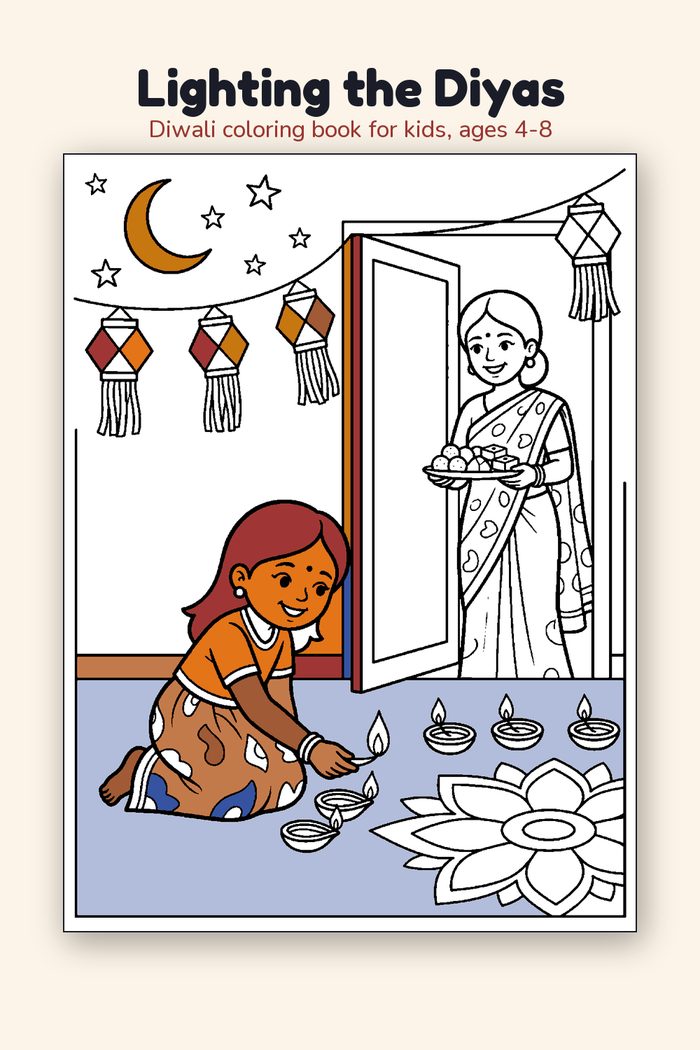
We made our Diwali coloring book for exactly this week. It opens with the story of Diwali told for young children, and then gives them 40 pictures to color: lighting the diyas, the sweet shop, Sita in the garden, Hanuman flying, rangoli, lanterns, Welcome Home and Ayodhya lit up at night. Every picture is printed on one side only, so the finished ones can be torn out and hung up for the festival.
Frequently asked questions
What is the story of Diwali in short?
Lord Rama was sent to live in the forest for fourteen years. The demon king Ravana kidnapped his wife Sita, and Rama rescued her with the help of Hanuman. When Rama, Sita and Lakshmana came home to Ayodhya on a dark, moonless night, the people lit rows of lamps to welcome them. That is why we light diyas on Diwali.
Why is Diwali called the festival of lights?
Because lamps are at the heart of it. Families light rows of small clay lamps called diyas, candles and lanterns, to remember the lamps of Ayodhya and to celebrate light winning over darkness.
When is Diwali in 2026?
The main night of Diwali in 2026 falls on 8 November. The five days of the festival fall around that date.
How do you explain Diwali to a young child?
Keep it to the story of Rama coming home and the lamps that lit his way. A child of four understands "the people lit lamps so he could find his way home in the dark," and that is the heart of the whole festival.