
A child notices the small things first. The clay lamp glowing on the step. The colours gathering in a pattern on the ground. Two little red footprints that seem to be walking into the house. A string of leaves and orange flowers over the door, a paper lantern swinging outside, and a plate of sweets nobody is allowed to touch yet. Then comes the question every parent hears at Diwali: "What is that one for?" This guide to Diwali symbols and meanings gives you a short, true answer for each, so you can point and explain as you go.
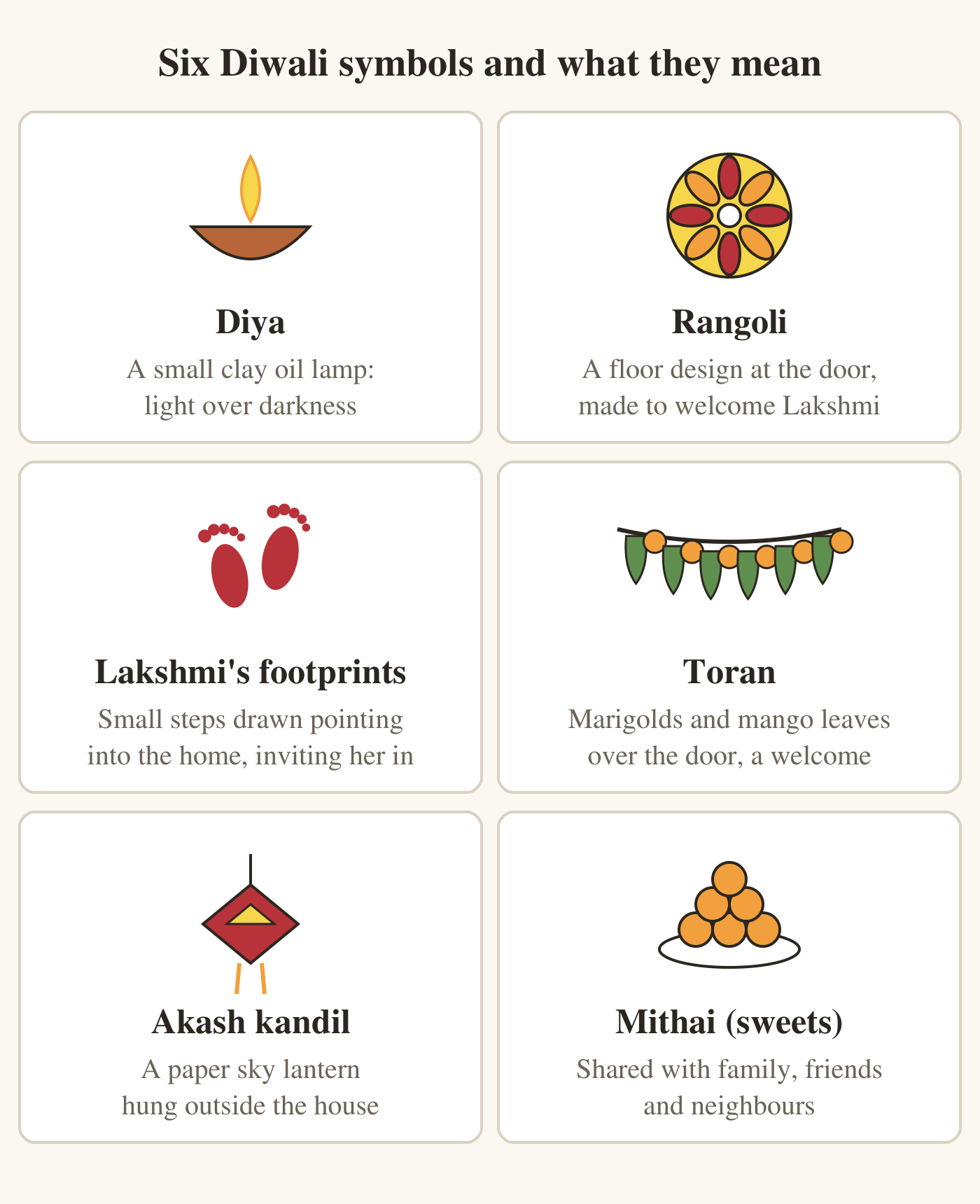
The short answer: Six familiar Diwali symbols are the diya (a small clay oil lamp, often explained as light over darkness), rangoli (a floor design at the entrance, often made to welcome Goddess Lakshmi), Lakshmi's footprints (in many Hindu homes, drawn pointing inward to invite her in), the toran (a decorative door hanging used as a welcome), the akash kandil (a paper "sky lantern" hung outside) and mithai (sweets shared with family, friends and neighbours). Diwali 2026 falls on Sunday 8 November.
Diwali symbols and meanings, one by one
Diwali takes its name from the Sanskrit dipavali, "a row of lights". Light is central to the festival, while several of the customs below are also about welcome and sharing. Families celebrate in many ways, and not every home uses all six.
The diya: light over darkness
A diya is a small clay lamp, usually with a cotton wick resting in oil or ghee. It is the symbol most closely tied to the festival. Families set diyas in rows on doorsteps, windowsills and balconies, and in many Hindu homes they are lit on the main Diwali night as part of welcoming and worshipping Lakshmi, the goddess of wealth and good fortune. The meaning most families give a child is simple: the lamp stands for choosing light over darkness, and knowledge over ignorance.
What to say to a four-year-old: "We light it so the dark can't win."
Rangoli: a welcome drawn on the ground
A rangoli is a handmade pattern on the floor, often right at the entrance, made from coloured rice, flour, sand, powder or flower petals. At Diwali it is drawn to welcome Lakshmi and guests into the home. Many designs use the lotus, a flower closely linked with Lakshmi. If your child wants to make one, rangoli for kids walks through a first design that is hard to get wrong.
What to say: "It's a welcome picture made on the ground, to say please come in."
Lakshmi's footprints: steps that walk inside
Some families draw small footprints, sometimes called paglya, leading from the rangoli through the door. They point towards the home to invite Lakshmi in, as if she has just stepped inside. Children love this one, because it turns the doorway into a little story.
What to say: "These are her footprints, so she can find her way in."
The toran: flowers and leaves over the door
A toran is a decorative hanging across the top of a doorway. At Diwali, torans are usually made from marigolds and mango leaves, often green, yellow and red, and hung at the main entrance to welcome both guests and Goddess Lakshmi for good luck and prosperity. Marigolds themselves are considered auspicious, especially when they mark new beginnings.
What to say: "It's how a door says welcome before anyone opens it."
The akash kandil: a lantern for the sky
An akash kandil is a paper lantern, often star-shaped or many-sided, hung outside the house during Diwali. The name is usually explained as "lantern of the sky". Kandils are especially associated with western India, including Mumbai and Goa. For a child, a simple explanation is enough: it is a festive light hung high outside the home.
What to say: "It's a light for the sky, so the whole street can see we're celebrating."
Mithai: sweetness to share
Mithai simply means sweets, and Diwali is full of them. Families make or buy trays of ladoos, barfi, jalebi and more, and share them with relatives, friends and neighbours. Sharing sweets is an important part of the celebration, and giving mithai can express goodwill and wishes for sweetness and good fortune in the time ahead.
What to say: "We give sweets away so other people's Diwali is sweet too."
How the symbols fit together at the front door
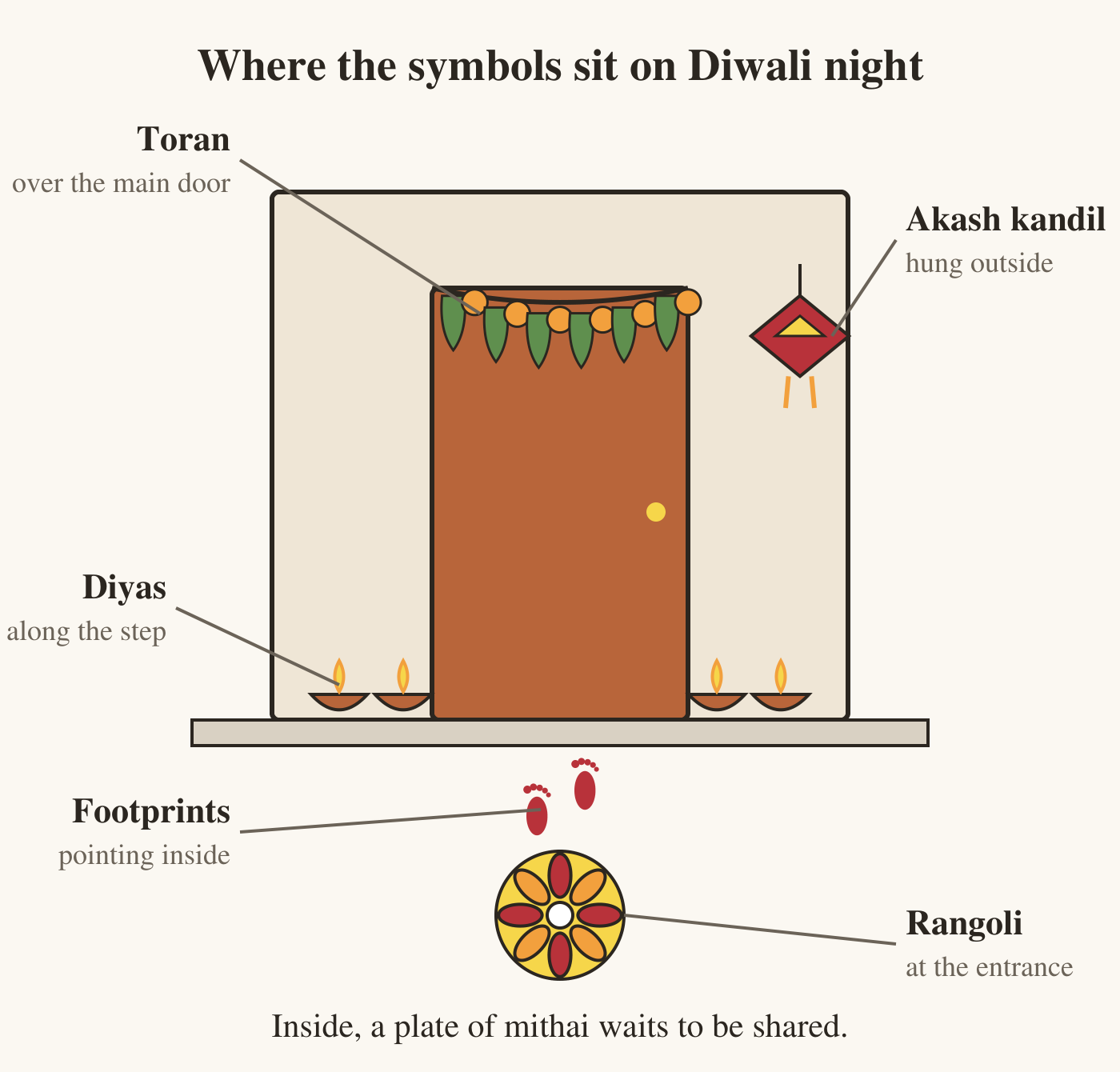
Notice how many of these symbols can gather at one place: the doorway. A toran may hang over it, diyas may line the step, a rangoli may sit in front, footprints may point inside and a lantern may hang nearby. In many homes, the entrance becomes a place of light and welcome. If your family uses some of these symbols, the doorway is an easy place to point them out to a child.
Different traditions, different meanings
Different communities connect this season with different histories and meanings. Many Hindu families remember Rama and Sita's return to Ayodhya, welcomed with lamps (you can tell that version in six short chapters with the Diwali story for kids), while others centre the worship of Lakshmi. Jains observe Diwali as the anniversary of Mahavira's nirvana. Sikhs mark Bandi Chhor Divas, commemorating Guru Hargobind Sahib's release from imprisonment and the freedom of 52 other prisoners. These observances may be marked at the same time, but their religious meanings are distinct.
A five-minute symbol hunt on Diwali night
Here is a small activity using whichever of these symbols are already part of your family's celebration:
- Choose the symbols from this article that your family actually uses.
- Walk around together and find each one.
- For each, ask "What do you think it's for?" before you tell them.
- Let them choose one symbol to draw on paper afterwards.
Children remember what they find themselves. If you want something for each of the five days, Diwali activities for kids gives one small thing per night, from painting a diya on Dhanteras to a card on Bhai Dooj.
Colouring the symbols
For younger children, colouring is often the easiest way to slow down and look at these shapes properly: the petals of a lotus rangoli, the flame of a diya, the leaves of a toran. Our Diwali Coloring Book for ages 4 to 8 has 40 big, easy pictures, each printed on one side only, from rows of diyas and peacock rangoli to Ayodhya lit up at night, with the story of Rama and Sita told for young children at the front.
Sources
- Diwali, lamps lit to invite Lakshmi, doors and windows kept open, rangoli materials: Britannica Kids, "Diwali".
- Diyas as the most closely associated decoration, rangoli materials, paglya footprints pointing towards the home, sweets: Al Jazeera, "Diwali 2023: The festival of lights, explained through rituals".
- The diya's meaning, rangoli to welcome Lakshmi, torans of marigolds and mango leaves, marigolds as auspicious: Tatler Asia, "7 important symbolism Deepavali decorations".
- The kandil as "lantern of the sky", placed in front of houses: Wikipedia, "Kandeel"; akash kandils in Goa, Mumbai and other western coastal cities: Outlook Traveller.
- Jain Diwali as the anniversary of Mahavira's nirvana: Wikipedia, "Diwali (Jainism)"). Bandi Chhor Divas, Guru Hargobind's release from Gwalior Fort and the freeing of 52 princes: RE Online, "Divali (Bandi Chhor Divas)".
- Sharing mithai with family, friends and neighbours: The Takeout, "The Cultural Reason Sweets Are Savored On Diwali".
Frequently asked questions
What are the main symbols of Diwali?
The diya (a clay oil lamp), rangoli (a floor design at the entrance), Lakshmi's footprints, the toran (a decorative door hanging), the akash kandil (a paper sky lantern) and mithai (sweets) are six familiar examples. Light is central to Diwali, and the festival's name comes from dipavali, "a row of lights". Different families and traditions may use different symbols.
What does the diya symbolize at Diwali?
The diya stands for light over darkness, and knowledge over ignorance. Families light rows of them on Diwali night. In many Hindu homes, diyas are also lit as part of welcoming and worshipping Goddess Lakshmi.
Why are footprints drawn at Diwali?
Small footprints, sometimes called paglya, are drawn pointing into the home to invite Goddess Lakshmi inside, as if she has just walked through the door.
What is a toran made of?
A Diwali toran is usually made of marigold flowers and mango leaves, hung across the top of the main door to welcome guests and Goddess Lakshmi.
How do I explain Diwali symbols to a young child?
Use the symbols your family actually has, keep each explanation to one sentence and point to it while you speak. For example: the lamp means light over darkness, the rangoli says welcome, Lakshmi's footprints invite her into the home, the toran says welcome, the lantern is a light for the sky, and the sweets are for sharing.