
In late-19th-century Apolda, a small town in Germany, Karl Friedrich Louis Dobermann worked as a tax collector, and by most accounts as the local dog catcher too, with the dogs of the town pound close at hand. Around 1890 he began developing a protective dog to walk beside him on his tax-collecting rounds. After Dobermann died in 1894, the new breed was named in his honor, and today dog lovers all over the world say his surname every time they call out "Doberman." That is the first surprise in this guide to dog breed name origins: some familiar names began with a person, others with a place, an old job or a visible trait, and a few still resist a tidy explanation. The next time you meet a dog in the park, you may know a little secret about its name.
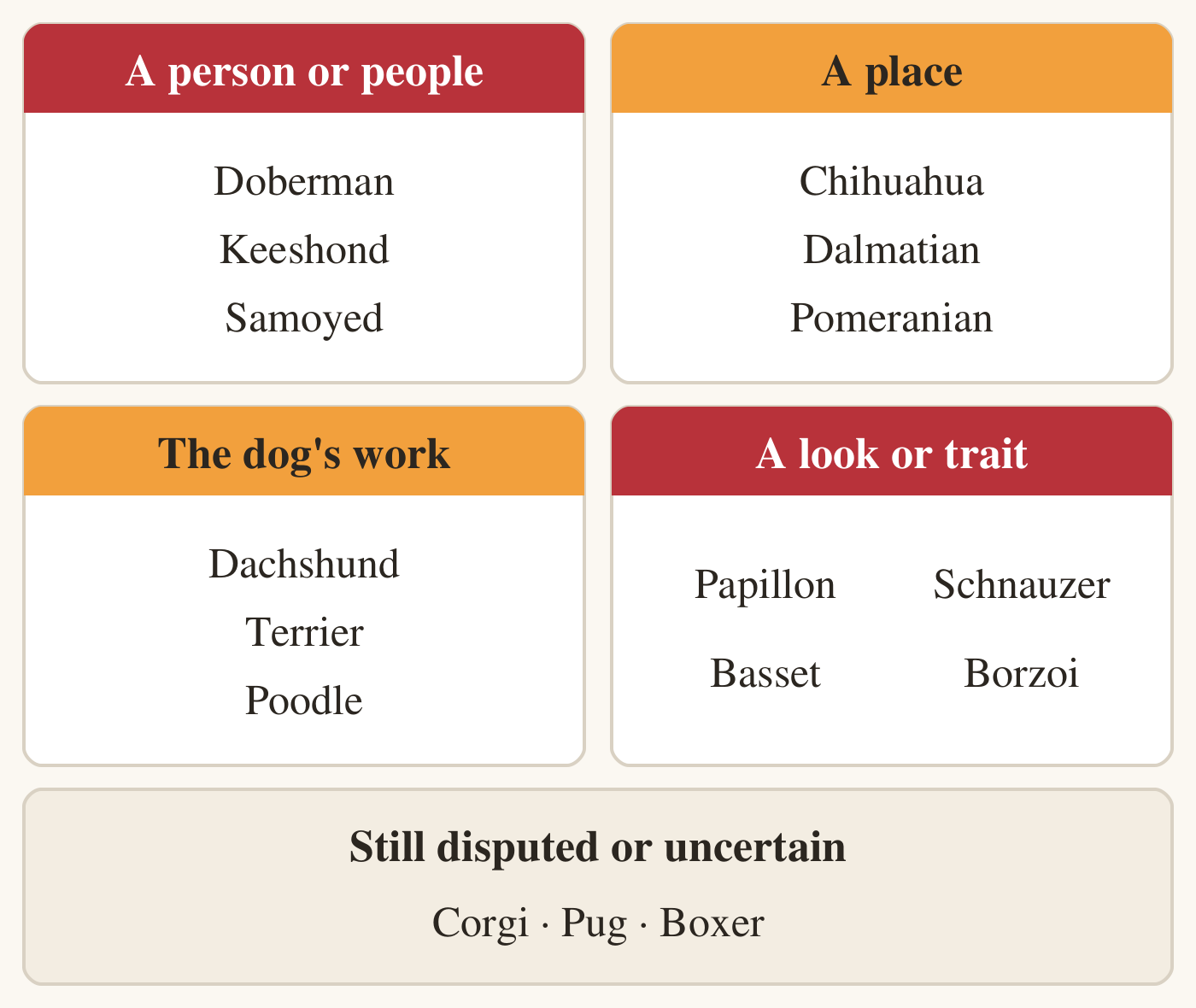
The short answer: Many familiar dog breed names follow a few recurring patterns: a person or people (Doberman, Keeshond, Samoyed), a place (Chihuahua, Dalmatian, Pomeranian), the work associated with the dog (Dachshund, Terrier, Poodle), or a look or trait (Papillon, Schnauzer, Basset, Borzoi). A few, including Corgi, Pug and Boxer, have disputed or uncertain name origins.
Dog breed names that came from people
Louis Dobermann is the best-known example, but he is not alone.
The Keeshond, a fluffy Dutch dog with a curled tail and distinctive "spectacles" around its eyes, became associated with the Dutch Patriot movement in the late 1700s. Cornelis "Kees" de Gyselaer was one of the movement's leaders, and his dog Kees became a symbol of the Patriot cause. The breed name is commonly explained as Kees plus hond, the Dutch word for "dog." "Kees's dog," in other words: a political nickname that became a breed name.
Not every people-derived name points to one individual. The Samoyed takes its name from an older term used for the Nenets people of Siberia, whose dogs were used for hunting, herding reindeer, guarding and sled work. The famous "Sammie smile" came along for the ride.
Breeds named after places
Many breed names are geographic: they point to a city, region, island or state, even when the breed's deeper origin story is more complicated.
- Chihuahua takes its name from the Mexican state of Chihuahua.
- Dalmatian points to Dalmatia, the region along the Adriatic coast of today's Croatia, although where the spotted breed actually began is still debated.
- Pomeranian comes from Pomerania, a region on the Baltic coast that today lies in Poland and Germany.
- Pekingese is named for Peking, the older English spelling of Beijing, where these little dogs were favored at the imperial court.
- Havanese is named for Havana, and it is the national dog of Cuba.
- Maltese points to Malta in its modern English name, although the breed's much older Mediterranean origins are difficult to document precisely.
- Rottweiler comes from Rottweil, an old town in southwest Germany, where the breed's ancestors drove cattle and pulled carts of meat to market for butchers.
- Weimaraner is named for the area around the city of Weimar, in Germany, where the breed is believed to have originated. The dogs are sometimes linked to the Weimar court in the early 1800s, although that part of the story is not firmly documented.
The place names do not always tell the whole story. The Great Dane is recognized as a breed developed in Germany, where it is called the Deutsche Dogge. The English name is a translation of the French grand Danois, "big Danish," a term in use by the mid-1700s; why Denmark became attached to the name is not known. The Labrador Retriever is another geographic tangle. Its forerunners were water dogs from Newfoundland, while the modern breed was developed further in Britain. The early name "Labrador Dog" became established there, but why "Labrador" rather than "Newfoundland" became the lasting name is not fully settled.
Names shaped by the jobs dogs once did
Many breeds were developed for particular kinds of work, and some of their names still preserve that history.
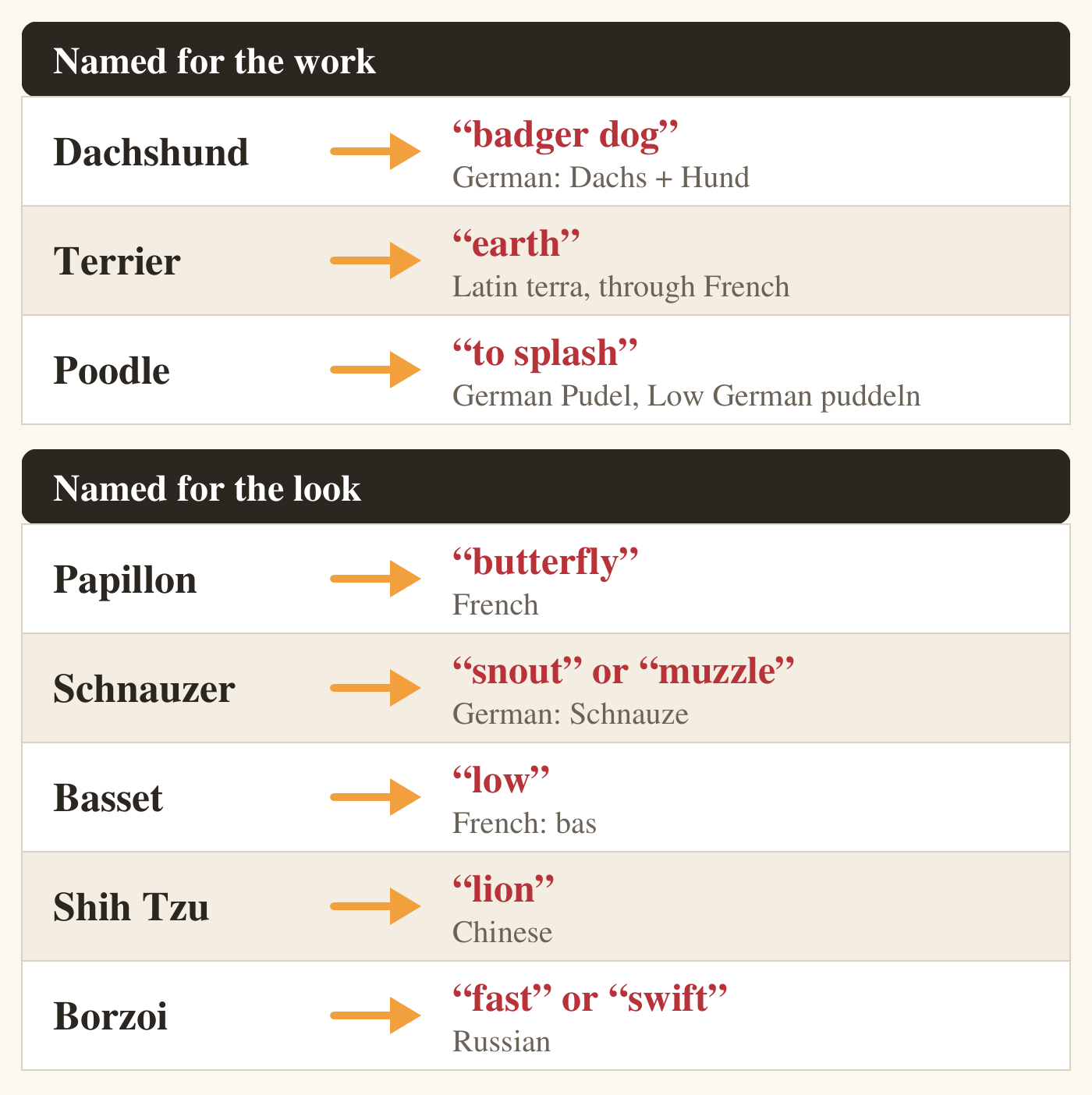
- Dachshund is German for "badger dog": Dachs (badger) plus Hund (dog). That long, low body was built to follow a badger down its burrow.
- Terrier comes, through French, from the Latin terra, "earth." Terriers were named for going to ground after quarry such as foxes and badgers.
- Poodle takes its name from the German Pudel, linked to the Low German puddeln, "to splash." Long before elaborate show trims, the breed worked as a water retriever.
- Pointer and Setter describe what the dogs did in the field when they found game birds: the Pointer froze and pointed, and the Setter crouched, or "set," low to the ground.
Next time a Dachshund trots past on a walk, its name carries a clue to the work the breed was developed to do, and judging by the way it inspects every hole in the park, it has not entirely forgotten.
Every breed in this section is a word to find in our large print dog word search, and the leftover letters in each grid spell a line about life with a dog.
Names that describe a look or trait
Some breeds are named for the first thing you notice about them.
- Papillon is French for "butterfly," for the large, fringed ears that stand out from the head like wings.
- Schnauzer comes from the German Schnauze, "snout" or "muzzle," for that famous bearded face.
- Basset comes from the French bas, "low," and a basset hound is exactly that: long ears, short legs, nose to the ground.
- Shih Tzu comes from the Chinese word for "lion," and the breed is often called the "lion dog."
- Borzoi comes from a Russian word meaning "fast" or "swift," a fair description of a tall sighthound built for speed.
The ones nobody can pin down
Not every name has one settled explanation.
The Corgi is a good example. One common explanation combines Welsh cor, "dwarf," with ci or gi, "dog." Other derivations have been suggested, so the etymology is best called debated. Either way, it suits a small, sturdy dog that herded cattle.
The Boxer may have been named for the way the breed uses its front legs while playing, rather like a boxer in the ring. Anyone who has lived with a Boxer will find the story easy to believe, but the origin of the breed name is not certain.
The Pug is a mystery too. One theory connects the name with the marmoset monkeys once known as "pug monkeys" and popular as pets in the 1700s. Another links it with the Latin pugnus, "fist," supposedly for the shape of the dog's face. Neither explanation has been proved.
A game for your next walk
Knowing where breed names come from turns every walk into a small game. See a long, low dog and think "badger dog." Spot a Papillon and look at the ears. Meet a Chihuahua and picture Mexico. Say "Keeshond" and remember a Dutch patriot and his dog.
It is also a reminder of how much dogs have done alongside us, hunting, herding, guarding, retrieving from cold water, and how many of those old jobs are still written into the words we use every day.
Where the breed names become the puzzle
If you, or someone you know, loves dogs and loves words, the two go together very well in a word search. We made Large Print Dog Lover's Word Search for exactly that reader. Every breed name explained in this article appears in its word lists, from Dachshund and Papillon to Keeshond, Schnauzer and Weimaraner, alongside happy dog words like walkies, zoomies and muddy.
It has 90 puzzles, one to a page. The first 30 use 11 x 11 grids with words running in just three directions; the middle 30 move to 12 x 12 and add two more; the last 30 are 13 x 13, with words in all eight. The grid letters are about 20 to 24 point, the word lists 16 point, and the answers at the back are in large print too.
The twist is the hidden message. When every word in a puzzle is circled, the leftover letters spell a short line about life with a dog. The very first one reads: "Some houses stay quiet until a dog comes home." Read in order, the ninety lines become one happy keepsake, from the day a pup arrives to the walks, the zoomies and the welcome at the door, and the whole thing is gathered at the back of the book to read straight through.
Sources
- Louis Dobermann and the breed's beginnings: Dobermann, Wikipedia.
- Kees de Gyselaer and the Keeshond: Keeshond, Wikipedia.
- The Samoyed's name: Samoyed dog, Wikipedia.
- Place names: Chihuahua (dog breed), Dalmatian dog, Pomeranian dog, Pekingese, Havanese dog, Maltese dog, Rottweiler, Weimaraner, Wikipedia.
- The Great Dane's name: Great Dane, Wikipedia.
- The Labrador's Newfoundland ancestors: Labrador Retriever, Wikipedia.
- Job names: Dachshund, Terrier, Poodle, Pointer, Setter, Wikipedia.
- Look and trait names: Papillon dog, Schnauzer, Basset Hound, Shih Tzu, Borzoi, Wikipedia.
- The Corgi's name: Pembroke Welsh Corgi, Wikipedia.
- The Boxer and Pug name theories: Boxer (dog breed), Pug, Wikipedia.
Frequently asked questions about dog breed name origins
Which dog breed is named after a person?
The Doberman is the best-known example, named after Louis Dobermann, a German tax collector who began developing the breed around 1890. The Keeshond is another: its name is commonly explained as "Kees's dog," after the Dutch Patriot leader Cornelis "Kees" de Gyselaer.
What does Dachshund mean?
It is German for "badger dog," from Dachs (badger) and Hund (dog). The breed was developed to follow badgers into their burrows.
Is the Great Dane from Denmark?
No. Modern breed history recognizes Germany as the Great Dane's country of development, where it is called the Deutsche Dogge. The English name is a translation of the French grand Danois, "big Danish," a term used by the mid-1700s. Why Denmark became attached to the name is unclear.
Why is a Chihuahua called a Chihuahua?
The breed is named after the Mexican state of Chihuahua.
Why is the Labrador called a Labrador if it came from Newfoundland?
The breed's forerunners were water dogs from Newfoundland, and the name "Labrador Dog" became established in Britain as the modern breed developed there. Why Labrador rather than Newfoundland became the lasting name is not fully settled.
Where does the name Pug come from?
Nobody knows for certain. One theory connects the name with the "pug monkeys," marmosets popular as pets in the 1700s; another links it with the Latin pugnus, meaning "fist."
Where does the name Boxer come from?
Nobody knows for certain. The popular explanation is the way Boxers play, batting with their front paws like a boxer, but the origin has not been settled.
Are these breeds in the Large Print Dog Lover's Word Search?
Yes. Every breed name explained in this article appears in the book's word lists, along with many other breeds and everyday dog words.