
When Bappa comes home for Ganesh Chaturthi, children always want to know who he is, why he has an elephant's head and why everybody is so happy to see him. This is the Ganesh Chaturthi story for kids, told in twelve short parts, each with the small lesson that goes with it. It is the same story that opens our Ganesha coloring books, so you can read it aloud and then let your child color the part they liked best.
1. The boy made of clay
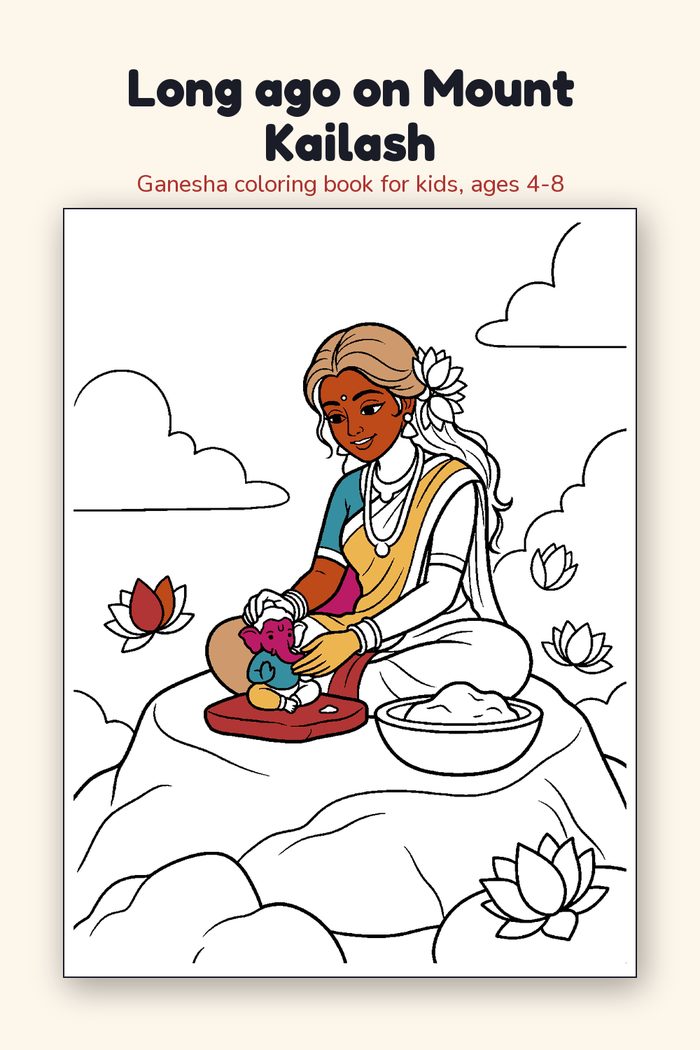
Long ago, on Mount Kailash, Goddess Parvati was alone while her husband, Lord Shiva, was away. She took clay and sandalwood paste, shaped a little boy with her own hands, and breathed life into him. She loved him the moment he opened his eyes.
The lesson: everything we make with love carries a little of us in it.
2. The brave guard at the door
Parvati wanted to bathe. "Guard the door, my son," she said, "and let no one in." The boy picked up a staff and stood tall at the door, proud to be trusted.
The lesson: a promise kept is the first form of strength.
3. The stranger who came home
Then Lord Shiva came home. The boy had never seen him, and he did not know this was his mother's husband. He would not let him pass. "Who is this brave little guard?" Shiva wondered, as the boy stood his ground before the greatest of gods.
The lesson: do your duty, even when it is hard.
4. Why Ganesha has an elephant head
When Shiva learned that the brave little guard was his own son, his heart filled with love. He gave the boy a great gift: the head of a wise elephant, so that the whole world would know him and love him.
The lesson: the elephant head stands for wisdom, memory and strength. Big ears to listen, small eyes to focus.
Older books tell this part of the story in a more frightening way. We tell it gently, the way our coloring book does, because this is how a small child should hear it first.
5. Ganapati, the one who comes first
"You shall be Ganapati, leader of my ganas," said Shiva, "and every prayer shall begin with you." That is why, before any puja, any wedding and any new beginning, people remember Ganesha first.
The lesson: begin every task by remembering the wisdom you carry.
6. The smallest friend
Ganesha could have chosen any animal to ride. He chose the smallest: Mushak, the little mouse. The great god and the tiny mouse became best friends, and wherever you see Ganesha, the mouse is never far away.
The lesson: nobody is too small to matter.
7. The sweet he loves best
Ganesha loves sweets, and modak most of all: a soft steamed dumpling shaped like a little teardrop, with sweet coconut and jaggery hidden inside. That is why families make modak for Ganesh Chaturthi.
The lesson: like a modak, wisdom is sweetest when you look inside.
8. The race around the world
One day Ganesha and his brother Kartikeya were told that whoever went around the whole world first would win a prize. Kartikeya jumped on his peacock and flew off. Ganesha, with only a little mouse to ride, simply walked around his parents, Shiva and Parvati, three times. "You are my whole world," he said. He won.
The lesson: your parents are your whole world; honour them.
9. The Moon who laughed
Once, after a big feast, Ganesha slipped and his modaks rolled everywhere. The Moon, watching from the sky, laughed at him. Ganesha was hurt, and he declared that anyone who looked at the Moon on that night would have bad luck. The Moon was sorry, and Ganesha softened the curse to just that one night of the year.
The lesson: never laugh at someone who falls; help them up.
10. The broken tusk
The wise sage Vyasa wanted to tell the great story of the Mahabharata, and he needed someone who could write it down without ever stopping. Ganesha agreed. Halfway through, his pen broke, so he snapped off one of his own tusks and kept writing with it. That is why Ganesha is often shown with one broken tusk.
The lesson: great things ask for a little sacrifice.
11. The festival in the street
For a long time, Ganesha was worshipped mostly at home. In 1892 the people of Pune began to celebrate him together, in public, and Lokmanya Tilak helped the celebration spread. Today, huge pandals fill cities with music, lights and giant murtis, and everyone is welcome.
The lesson: joy shared with everyone grows bigger.
12. Goodbye, Bappa, come back soon
On the last day of the festival, families carry Bappa to the river, the lake or the sea for visarjan, singing "Ganpati Bappa Morya, pudhchya varshi lavkar ya!", which means "Ganpati Bappa, come back early next year!" The clay murti goes back into the water, and Bappa goes back into our hearts until he comes again.
The lesson: everything comes and goes; love stays.
Why do we celebrate Ganesh Chaturthi?
Ganesh Chaturthi celebrates the birth of Lord Ganesha, the remover of obstacles and the god of new beginnings. Families bring a murti of Ganesha home, decorate a place for him, offer modak, durva grass and red hibiscus flowers, and sing aarti every day. After one and a half, three, five, seven or ten days, depending on the family, Bappa is taken for visarjan.
Telling the story at home
Twelve parts is a lot for one sitting. With a young child, try one or two parts a day during the festival, and let them color a picture of the part you read. Asking "why do you think he walked around his parents?" or "what do the big ears mean?" turns a story into a conversation, which is exactly what the lesson lines in our Ganesha coloring book for ages 4 to 8 are there to start. Older children who want more detail will like the 8 to 12 edition, which adds 32 murti styles from across India.
Frequently asked questions
Why does Ganesha have an elephant head?
In the story as it is told to children, Parvati made Ganesha from clay and asked him to guard her door, and he would not let even Shiva pass. When Shiva learned the brave boy was his own son, he gave him the head of a wise elephant as a great gift. The elephant head stands for wisdom, memory and strength: big ears to listen, small eyes to focus.
What is the story of Ganesh Chaturthi in short?
Parvati created Ganesha from clay and asked him to guard her door. He stood firm even before Shiva, who then learned the boy was his son, gave him the head of a wise elephant, and made him leader of his followers and the god who is worshipped first. Ganesh Chaturthi celebrates his birth.
Why is Ganesha's mouse so important?
Mushak the mouse is Ganesha's vehicle and friend. A great god riding the smallest creature teaches that nobody is too small to matter. The mouse is also said to stand for restless desire, which Ganesha keeps under control.
Why does Ganesha have a broken tusk?
He broke off his own tusk to keep writing when his pen broke while he was writing the Mahabharata for the sage Vyasa, which shows that great work sometimes asks for sacrifice.