
Imagine opening a carol-service sheet and finding the familiar words hard to make out in the dim light. The tune is still just as familiar; the printed page is simply less useful than it used to be. It is a small, common moment, and it is a good place to start when choosing gifts for seniors with low vision: not with a catalogue, but with the question of what, exactly, has gotten harder.
The short answer: Good gifts for seniors with low vision start with what the recipient actually finds comfortable, not with a label on a box. Look for type that states its real size, strong contrast between ink and page, good lighting, and an activity they already enjoy. Large-print books are commonly set in 16 to 18 point type, well above a typical paperback's 10 to 12 point, but no single size works for every reader. Below are a few places to look, sorted by what has changed, and a large-print Christmas word search and carol book built around real, stated numbers.
Low vision is common, and it changes what a gift needs to do
Vision changes gradually for most people as they get older, through conditions such as macular degeneration, cataracts and glaucoma, and the practical effect is usually the same: small print gets harder to read, pale or low-contrast print gets harder still, and reading for a long stretch gets tiring even when it is still possible. None of that touches someone's enjoyment of Christmas, carols, a crossword or a good story. It just changes what format lets them keep enjoying those things comfortably.
That is the test worth applying to any gift on this list: is the type size actually stated, can you see or picture an interior page, and does it suit the reading this particular person still does easily? Vision loss affects everyone differently, so the most useful check is still holding a sample page up to the reader it is for, or asking them directly.
Gifts for seniors with low vision, sorted by what has changed
- If small print is the main problem: look for books that state their actual type size and show a sample page, rather than trusting the words "large print" alone. A publisher's own large-print line is still worth a second look at the real numbers.
- If contrast is the problem, not just size: clear, dark lettering on a plain, light page reads better than a larger font fighting a decorative background or a glossy, glare-prone finish.
- If holding a book steady is tiring: a book stand, a reading rest, or anything that lies flat on a table removes one more thing to manage.
- If they enjoy puzzles or other hands-on activities: look for clear grids, large instructions and a familiar format, such as a word search or a crossword, rather than something new to learn.
- If the season itself matters to them: something built around Christmas, carols or a family tradition does double duty: useful today, and meaningful because of when it arrives.
How big "large print" actually needs to be
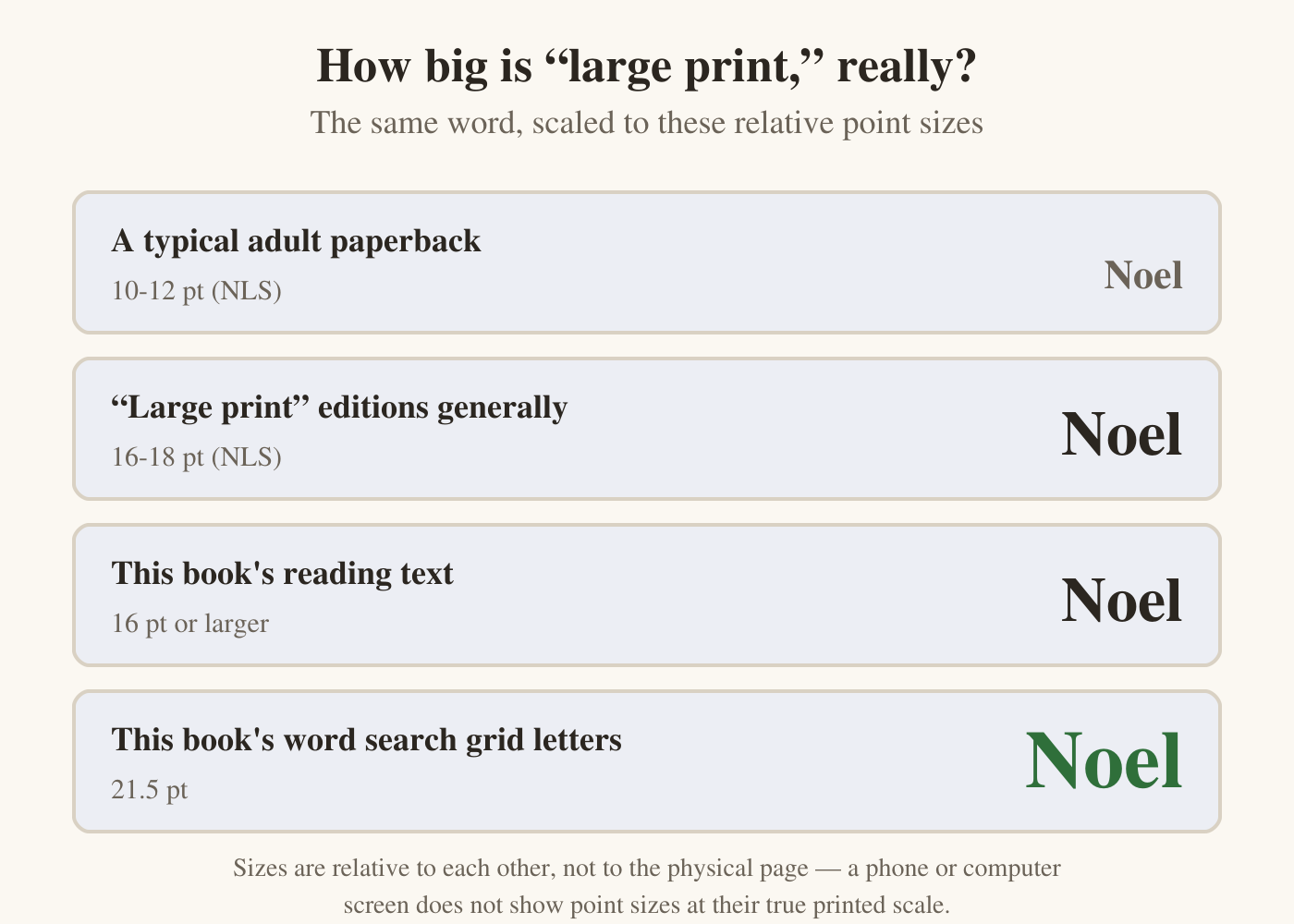
"Large print" is not one fixed size, and publishers use the phrase loosely. The US National Library Service for the Blind and Print Disabled puts typical adult books at 10 to 12 point type, with large-print materials commonly available in 16 to 18 point. There is no single number that guarantees readability for every reader; eyesight, lighting and the specific condition involved all matter, and comparing an actual page, or asking the person it's for, tells you more than the words "large print" on a cover ever will.
A carol book built around real numbers
Christmas Hymns Word Search Large Print brings together 48 traditional carols, among them "Silent Night," "O Holy Night," "Hark! the Herald Angels Sing" and "In the Bleak Midwinter," and gives each one its own two-page spread: two to four traditional verses and a short, sourced story about the carol on the left-hand page, and a word search built only from that carol's own words on the right.
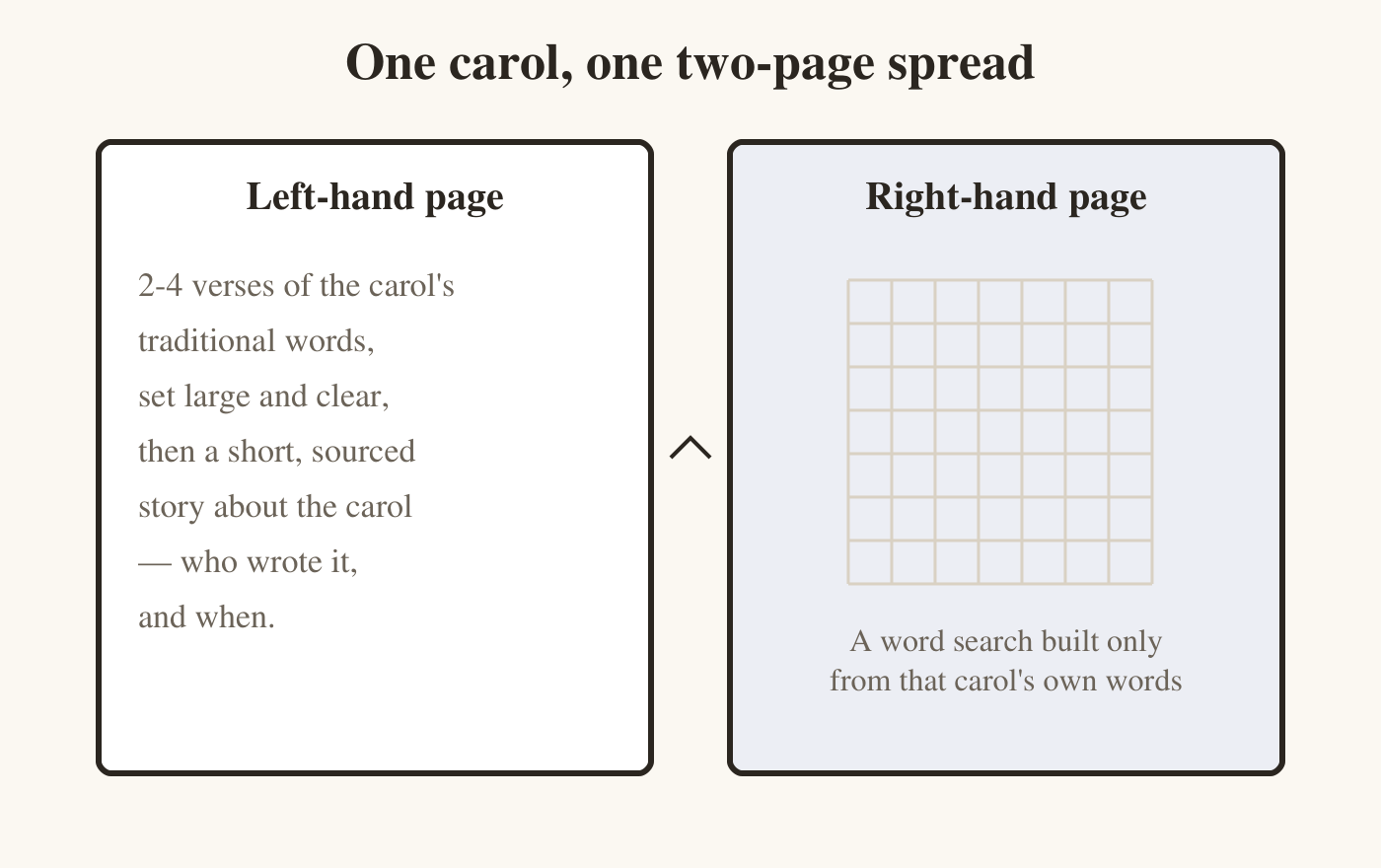
The reading text runs 16 point or larger throughout, including the stories and the answers at the back, and the word search grid letters are set at 21.5 point, both above the National Library Service's typical large-print range. The puzzles ease in gently: the first sixteen run words across, down and diagonally down, and later puzzles add backward and upward directions, so the book has something new in it on a second read next December.
It is not only a puzzle book. The carol histories separate what is documented from what is only legend: Joseph Mohr wrote the words of "Silent Night" in 1816, and Franz Xaver Gruber composed its tune for the first performance in Oberndorf, Austria, on Christmas Eve 1818; the familiar story that a broken organ forced them to use a guitar is not part of Gruber's own account. A reader who already knows every carol by heart will still find something they did not know.
When a carol book may be a good fit
If the recipient already enjoys traditional Christmas carols and word searches, this combination gives them a reading and a puzzle in one book, both set well above a typical paperback's type size. Because low vision affects people differently, the most useful check is still the same one: whether this particular reader finds this particular page comfortable, ideally by looking at a sample before you buy.
Sources
- Joseph Mohr's authorship of "Silent Night" in 1816, first sung in Oberndorf, Austria, on Christmas Eve 1818, and the absence of the "broken organ" detail from Gruber's own historical account: Stille Nacht Gesellschaft, Silent Night history.
- Typical adult and large-print type sizes: National Library Service for the Blind and Print Disabled, Library of Congress, "Large Print Materials".
Frequently asked questions
What are good gifts for seniors with low vision?
Start with what the recipient already enjoys, and look for a genuinely stated type size, not just a "large print" label: large-print books, a high-contrast clock, a reading light, a book stand, or a puzzle book with large, clear grids. Asking what actually works for their vision matters more than any single number.
Is a large-print word search book a good gift for someone with macular degeneration?
It may be, depending on their remaining vision and reading preferences. This book's grid letters are 21.5 point and its reading text is 16 point or larger, both above the National Library Service's typical large-print range, but no point size can guarantee readability for every reader. Checking a sample page first is the most useful step.
What point size counts as large print?
The National Library Service puts typical adult books at 10 to 12 point and large-print materials commonly at 16 to 18 point. Individual reading needs vary a great deal, so a stated point size is a starting point, not a guarantee.
Do I need to complete the puzzles to enjoy the carol stories?
No. Each spread carries the traditional verses and a short carol history alongside its word search, and either half works without the other.