
It's the first of December. The cards are still in their box, the tree is still in the garage, and Dad has already said he doesn't need a fuss this year. These Christmas activities for seniors are built for exactly that kind of December.
So don't make a fuss. Make one small thing a week.
There is one gentle activity for each week, each small enough to fit into an afternoon, and something quiet for the evenings in between. They can be adapted for a parent at home, a grandparent whose family lives far away, or an activity coordinator planning for a group. Nothing needs a craft store or a big budget, and each week ends with one small thing finished rather than a packed schedule.
The short answer: Give each week of December one small thing. In week one, write the cards and, if there are grandchildren, a letter to Santa, because both have to travel. In week two, hang the ornaments one at a time and ask for the story behind each. In week three, bake one family recipe and write it down as it's made. In week four, sing the old songs and drive out to see the lights. Keep a story going for the evenings in between.
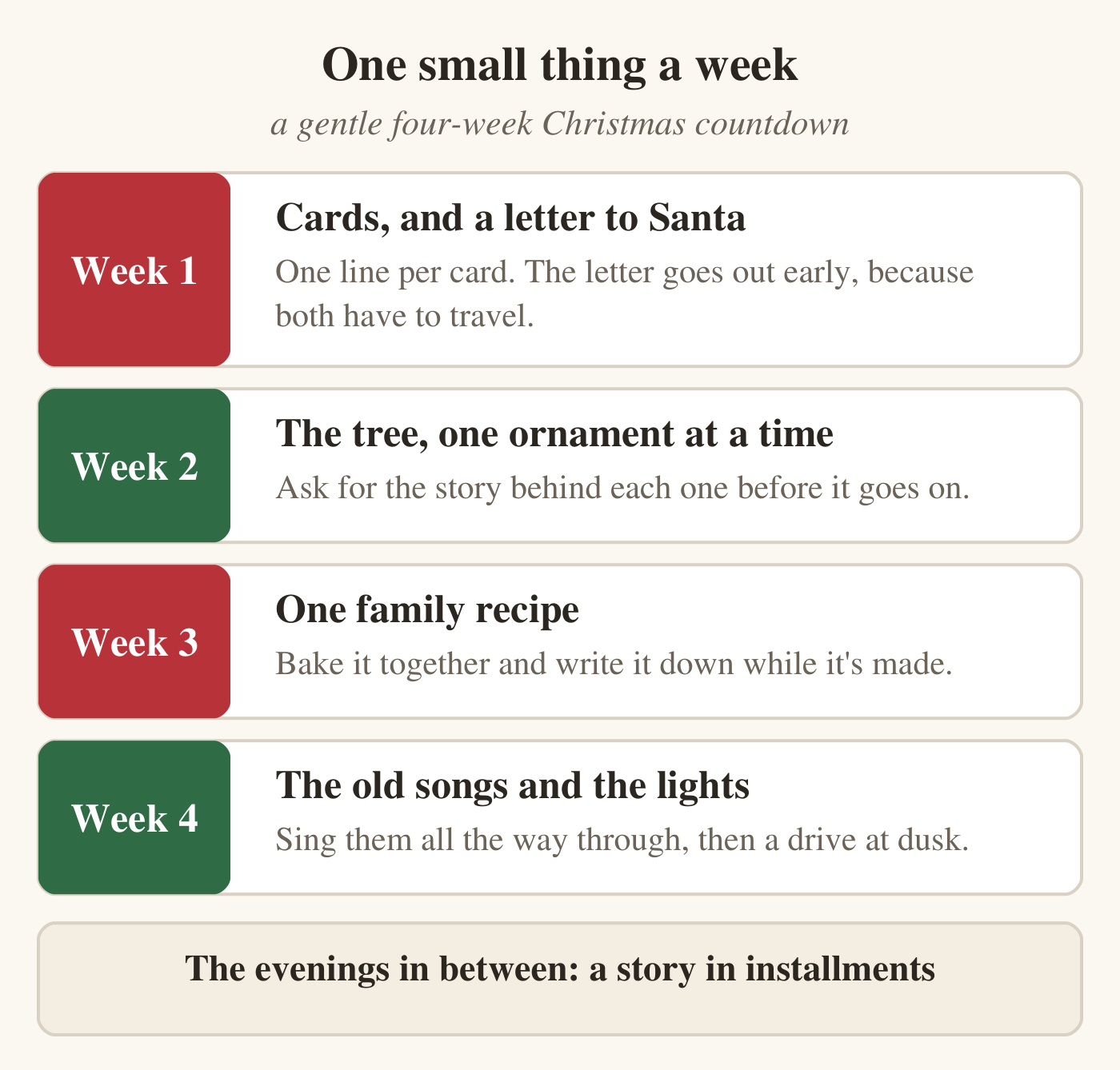
Week one: cards, and a letter that has to travel
Start with the box of cards, because cards need time in the mail.
There's a reason Christmas cards exist at all, and it's a comforting one for anyone who finds the pile daunting. In 1843 Henry Cole, a civil servant, had a busy household and a pile of unanswered mail, and he needed a shortcut. He asked the artist John Callcott Horsley to design a card that could be printed. A thousand copies were made, each with room for a handwritten greeting. Copies were also offered for sale at a shilling each, which was expensive at the time, and that side of it was judged a commercial flop. But the idea stuck. The first Christmas card was a time-saver for someone with too many letters to write.
That's the permission to take. Nobody needs a long letter.
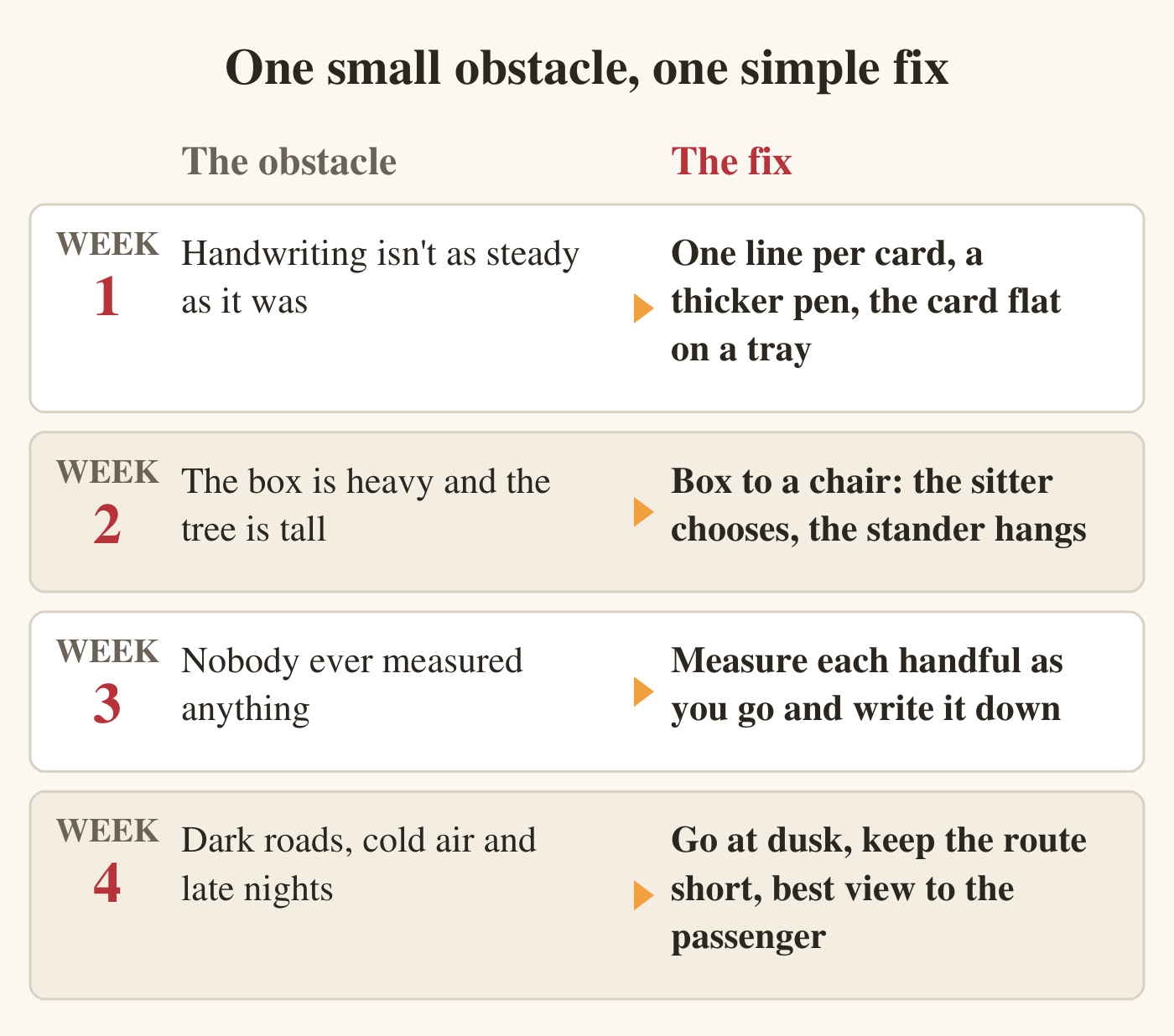
The small obstacle: handwriting that isn't as steady as it was. The fix: one line per card, in your own words. "Thinking of you this Christmas" is plenty. Write the line and let someone else address the envelopes. A thicker pen, and a card held flat on a tray at the table, help more than any amount of trying harder.
If there are grandchildren, add one more envelope this week. A 2018 AARP survey found that over half of grandparents have at least one grandchild who lives more than 200 miles away, and a letter to Santa is a lovely thing to write together over a video call: the child says what goes in it, the grandparent writes it down, and the letter goes in the mail. Canada Post answers letters addressed to Santa Claus, North Pole, H0H 0H0, Canada, from around the world, and its elves have been helping Santa for more than 40 years. From outside Canada the letter needs international postage (Canada Post covers the reply), and there are no promised delivery dates for letters from abroad, which is why this one goes out in week one.
This week's small win: a stack of envelopes in the mailbox, and one addressed to the North Pole.
Week two: the tree, one ornament at a time
The tree comes out of the garage this week. If a full tree feels like too much, a small tabletop one, or a few branches in a vase, does the same job.
The activity isn't decorating. It's the stories. Hang the ornaments one at a time, and before each one goes on, ask where it came from. The glass one from the first Christmas in the old house. The lopsided one a child made at school. The one nobody remembers buying, which often turns out to have the best story of all.
The small obstacle: the box is heavy and the tree is tall. The fix: bring the box to a chair, and let whoever is sitting choose while whoever is standing does the hanging. Hang only the ornaments that come with a story; the rest can stay in the box this year.
The evening after the ornaments go up is the moment for a large print Christmas word search at the kitchen table: one puzzle in big letters, and the leftover letters spell the next line of a story.
This week's small win: a story you had never heard before, hanging on a branch.
Week three: one family recipe, written down while it's made
Pick the one recipe that tastes like Christmas in your family, the cookies, the fudge or the cranberry bread everyone waits for, and bake it together this week.
The real activity is writing it down. Plenty of family recipes live in one person's hands rather than on paper, and the easiest time to catch one is while it's being made.
The small obstacle: nobody ever measured anything. "A handful of this, butter the size of an egg, bake until it looks right." The fix: measure as you go. Before each handful goes into the bowl, tip it into a measuring cup and write down the amount. Note the oven setting and how long it really took. Then write the card in the cook's own words, "until it looks right" included, because that's part of the recipe too.
This week's small win: a plate that smells like every Christmas before it, and a card that means it can be made again.
Week four: the old songs, and a drive to see the lights
The last short week before Christmas is for music and light.
Sing the songs everyone knows the words to. Jingle Bells is a good one to start with, because it comes with a surprise to share. James Lord Pierpont copyrighted it in 1857 as The One Horse Open Sleigh, and it had no original connection to Christmas at all. It was first performed in Boston that September, and it became a Christmas song only decades later. Ask who remembers singing it first, and where.
Then, one evening, go and see the lights. Drive slowly through the streets that go all out, with a thermos of cocoa and a blanket on the back seat.
The small obstacle: dark roads, cold air and late nights. The fix: go at dusk, when the lights are on but it isn't late, keep the route short, and give the passenger seat the best view.
This week's small win: a song sung all the way through, and a car full of people saying "look at that one".
The evenings in between: a Christmas activity for seniors that lasts all month
Between the weekly activities come the long, dark evenings, and they want something quieter. A story told a little at a time is one of the oldest ways to fill them.
Read A Visit from St. Nicholas, the poem that begins "'Twas the night before Christmas", aloud one evening. It was first printed without an author's name in 1823, it takes only a few minutes, and people still argue about who wrote it: here's the night before Christmas poem and its 1823 mystery. Or ask for one Christmas story a night from the person who has lived the most of them: the best present, the worst weather, the year everything went wrong.
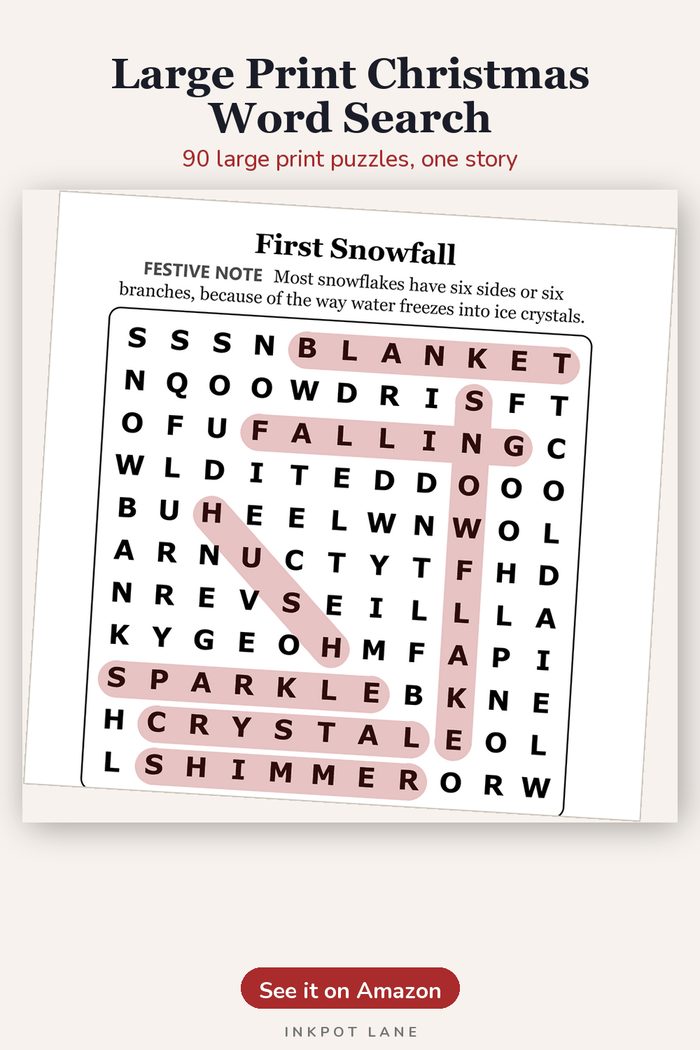
Or let a story arrive a sentence at a time. That's the idea behind our Large Print Christmas Word Search: The Snowy Village Story. Find every word in a puzzle and the leftover letters spell the next part of a story, and all 90 hidden messages join into one 751-word Christmas tale set in Pine Hollow, with Grandma Rose, Grandpa Tom, Lucy, Ben and Pepper the dog. Every page carries a festive note, and the whole story is printed at the end for anyone who wants to read it straight through.
Christmas Eve: looking back
By Christmas Eve the box of cards is empty, and a few have come back the other way. There's a tree in the corner with a story on every branch, a recipe card in the kitchen drawer, and a song everyone sang all the way through. Somewhere, perhaps, a reply from the North Pole is making its way through the mail.
None of it took more than an afternoon. Dad said he didn't need a fuss this year, and there wasn't one. There was just one small thing a week, and at the end of it, a December worth talking about.
Sources
- The first Christmas card, 1843: The first Christmas card, Victoria and Albert Museum.
- Grandparents and distance: AARP grandparenting study, 2018, AARP (an online survey of 2,654 grandparents aged 38 and over, 20 August to 4 September 2018).
- Letters to Santa: Santa letter program and International letters to Santa, Canada Post.
- Jingle Bells: History of Jingle Bells, BU Today, Boston University; the 1857 sheet music, The One Horse Open Sleigh, Library of Congress.
- The 1823 poem: the first printing, transcribed on Wikisource, and its history on Wikipedia.
Frequently asked questions
What are some Christmas activities for seniors in assisted living?
The same four weeks work for a group. Hold a card-writing afternoon with one line per card, an ornament afternoon where everyone hangs one ornament and tells its story, a baking session that ends with a shared recipe booklet, and a sing-along followed by a drive or a walk to see the lights. Keep each session short, and keep the evenings quiet.
What are good Christmas games for seniors?
Finish-the-line with familiar songs (read the first half and let the room sing the rest), Christmas word bingo, a guess-the-year game with old Christmas photos, and large print puzzles. For something harder than a word search, try how to solve cryptograms.
What Christmas crafts can seniors do?
Simple ones with big pieces that can be finished at a table in one sitting: paper snowflakes, cards made by gluing a cut-out picture onto folded card, or a decorated card for the family recipe from week three.
What are some short Christmas stories for seniors?
A Visit from St. Nicholas ("'Twas the night before Christmas") takes a few minutes to read aloud, and the mystery of who wrote it makes a good conversation afterward. Family stories count too: ask for one Christmas story each evening, and write the best ones down.