
There is a particular kind of tiredness that has nothing to do with sleep. It is the feeling of being busy every day and still not quite sure what it is all for. Ikigai, a Japanese word usually translated as "a reason for being", is one of the gentlest ways we know to think about that feeling. You do not need to quit your job or move to a mountain. You need four lists, an evening and the willingness to be honest with yourself.
What does ikigai mean?
Ikigai joins two Japanese words: iki, to live, and kai, worth or value. Put together, it means something like "the thing that makes life worth living." In Japan the word is used in quite an everyday way. Your ikigai might be your grandchildren, your garden, your morning walk or the work you do with your hands. It does not have to be grand.
The four circles
Outside Japan, ikigai is usually drawn as four overlapping circles. This diagram is a more recent, Western way of drawing the idea, but it is a genuinely useful thinking tool:
- What you love
- What you are good at
- What the world needs
- What you can be paid for
Where two circles overlap, the diagram gives each overlap a name: passion (what you love and are good at), mission (what you love and the world needs), vocation (what the world needs and you can be paid for) and profession (what you are good at and can be paid for). Where all four meet, the diagram puts ikigai.
Here is the honest part: very few people find a single thing sitting perfectly in the middle. That is fine. What the circles are really good for is showing you where things repeat.
How to find your ikigai: four honest lists
Take a sheet of paper, or the ikigai page in your planner, and make four lists. Give yourself ten minutes for each. Write fast; do not judge.
1. Things I love doing
Not what you think you should love. What makes you lose track of time? What would you do on a free Saturday? What did you love at ten years old?
2. Things I am good at
Include the small, unglamorous skills. Explaining things simply. Calming people down. Organising a cupboard. Cooking for twenty. Ask a friend if you are stuck; other people often see our strengths more clearly than we do.
3. What the people around me need
Start close to home. Your family, your street, your workplace, your community. What problems do you notice again and again? What do people keep asking you for?
4. What someone would pay me for
Be practical. What have you been paid for before? What do people ask you to help with that others charge for? What could you learn to do that someone would value?
Look for what repeats
Now read the four lists side by side and circle anything that appears, in some form, on more than one. Maybe "explaining things simply" is on your good-at list, and "my niece needs help with maths" is on your needs list, and you love the feeling when someone finally understands. That is an overlap worth noticing.
Write your ikigai, or your best guess at it, as one sentence. It does not have to be perfect. It has to be true enough to act on.
From ikigai to one goal
A sentence about purpose is lovely, but a purpose without a next step stays a daydream. So the last step is to turn the overlap into one goal for the year: something specific you could prove you had done. If your ikigai sentence is about teaching, the goal might be "tutor three students through their exams by March." If it is about making things, it might be "sell my first ten pieces."
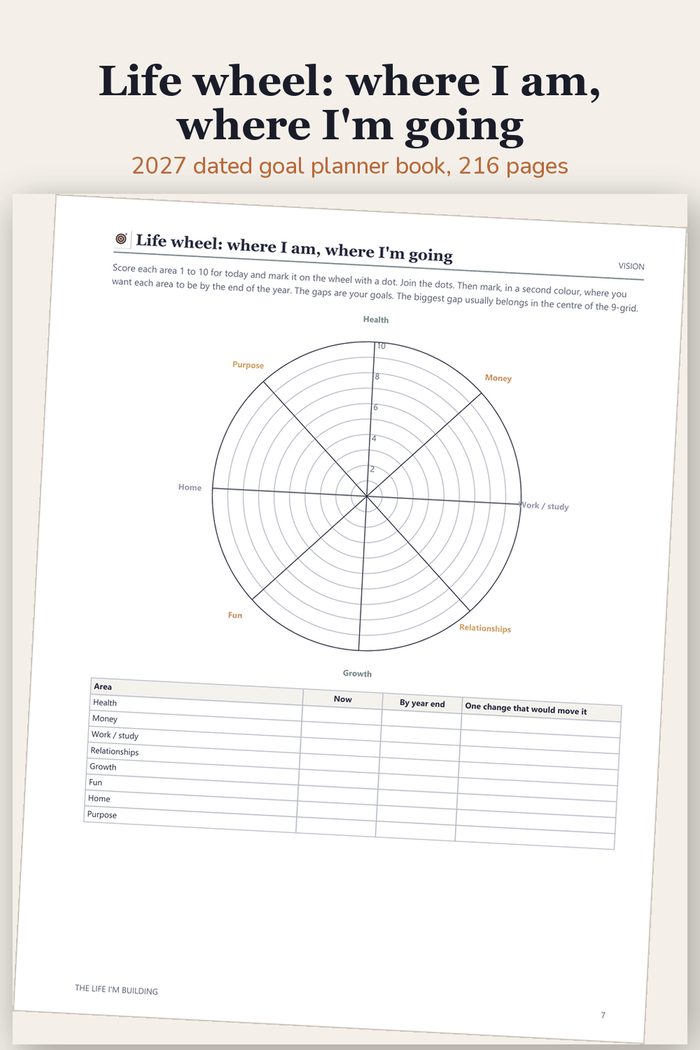
That goal is exactly what goes in the centre of a 9 grid goal chart, where it is broken into eight supports and sixty-four small actions. If you want to know which area of your life needs that goal the most, try a wheel of life assessment first.
Common misunderstandings about ikigai
- It is not only about work. Many people find their ikigai in family, community or a craft, and earn their living elsewhere.
- It is not a destination. Your ikigai can change as your life changes. Revisit your lists every year.
- It does not have to be big. A small daily reason to get up is still a reason.
- You do not need all four circles at once. Most people start with two overlaps and grow from there.
Ikigai in our planner
In The Life I'm Building, the ikigai page sits between "my word for the year" and the 9-grid goal map. It has the four circles, four lists to fill in, and a line at the bottom for your ikigai in one sentence, which you then carry straight onto the next page as your big goal for the year. It is one of the pages people tell us they spend the longest on. There is an undated edition too.
Frequently asked questions
What is ikigai in simple words?
Ikigai is a Japanese idea meaning "a reason for being" or "what makes life worth living." It is often drawn as the overlap of what you love, what you are good at, what the world needs and what you can be paid for.
How do I find my ikigai?
Make four lists: things you love doing, things you are good at, what the people around you need and what someone would pay you for. Circle anything that appears on more than one list, then write your ikigai as one sentence.
Does ikigai have to be my job?
No. In Japan, many people's ikigai is their family, a hobby or their community. It can be connected to work, but it does not have to be.
What are the four circles of ikigai?
What you love, what you are good at, what the world needs, and what you can be paid for. The overlaps are called passion, mission, vocation and profession.