
Looking for short mysteries to solve? Start with a missing snow globe, a kitchen with three doors, and a small wet mark on a windowsill. In the original mystery below, you have exactly the same clues as the solver. Read the story, stop at the question, and decide who took the globe before you check the explanation.
The short answer: A fair-play mystery gives you every piece of evidence you need to reach the answer before it is revealed, and the solution rules out every other suspect rather than just making one look most likely. Try The Snow Globe below, then see how the five fair-play principles and four reading habits further down the page explain exactly how the deduction works.
One to try: The Snow Globe
Here is an original short mystery. Every clue you need is in the story below. Read to the pause, decide, then check the solution further down the page.
On the Sunday before Christmas, Nell's kitchen held a small glass snow globe with a little church inside it. It had belonged to her late mother and stood on the low windowsill beside the stove, on the far wall from the sink. Over lunch, Nell's father, whom everyone called Grandad, had said it was the one thing of his wife's that he could still picture clearly. Nell had told him he was welcome to look at it whenever he liked.
The kitchen had three doors. The scullery door, bolted from the kitchen side since one o'clock; the scullery's own door opened onto the lane, where the log store was. The door from the dining room, which opened beside the sink, under the serving hatch. And the garden door, by the stove, which led only into the walled garden; the only way into that garden was through the kitchen.
At one o'clock, as the plates went out, Nell saw the globe on its sill, church and all. Five other people were spending the afternoon there: her husband Rob, her father Grandad, her niece Priya, her nephew Theo, who was nine, and her brother Ben. Theo was already outside in the walled garden, building a snowman. Priya went out through the scullery to fetch logs from the lane, and Rob bolted the scullery door behind her against the draught.
At five past one, Rob took Grandad into the dining room and began reading him the paper. Grandad fell asleep by ten past, but Rob went on reading aloud until half past because he liked the sound of it. The serving hatch was open above the sink, giving Nell a clear view of both chairs as she worked. Rob stayed in his chair, and Grandad slept in the other without stirring.
At ten past one, Ben opened the far window to let the steam out, and a flurry of snow blew in across the sill. He shut it at a quarter past. Nell looked across to see what the snow had done, and saw a film of melt on the sill with the globe standing in the middle of it, like a church on an island. Ben came back to the sink and washed while Nell dried beside him. The two talked as they worked, with their backs to the far window. Neither left the sink between a quarter past one and half past.
Theo had been in the walled garden since before lunch ended, building a snowman. Ben had seen him through the window at ten past. At twenty past, Theo came in through the garden door, stamping, his mittens soaked, and stood beside the stove and low windowsill for a minute or two. Then he walked past Nell and Ben at the sink, went into the dining room to show Grandad the size of the snowman, found him asleep, and sat down to wait for him to wake up.
At half past one, Nell turned round for the tea caddy and the sill was bare. In the film of melted snow there was a dry circle where the globe had stood and, beside it, one small wet mark the shape of a mitten. The scullery door was still bolted. Priya was still out in the lane; she came back at twenty-five to two, with her arms full of logs, and had to knock to be let in.
Pause and solve. Who took the snow globe, and how can you rule out everyone else? Every clue you need is above. Hint, if you want one: start with the last time Nell saw the globe. Who could reach the sill after that?
What makes short mysteries fair to solve
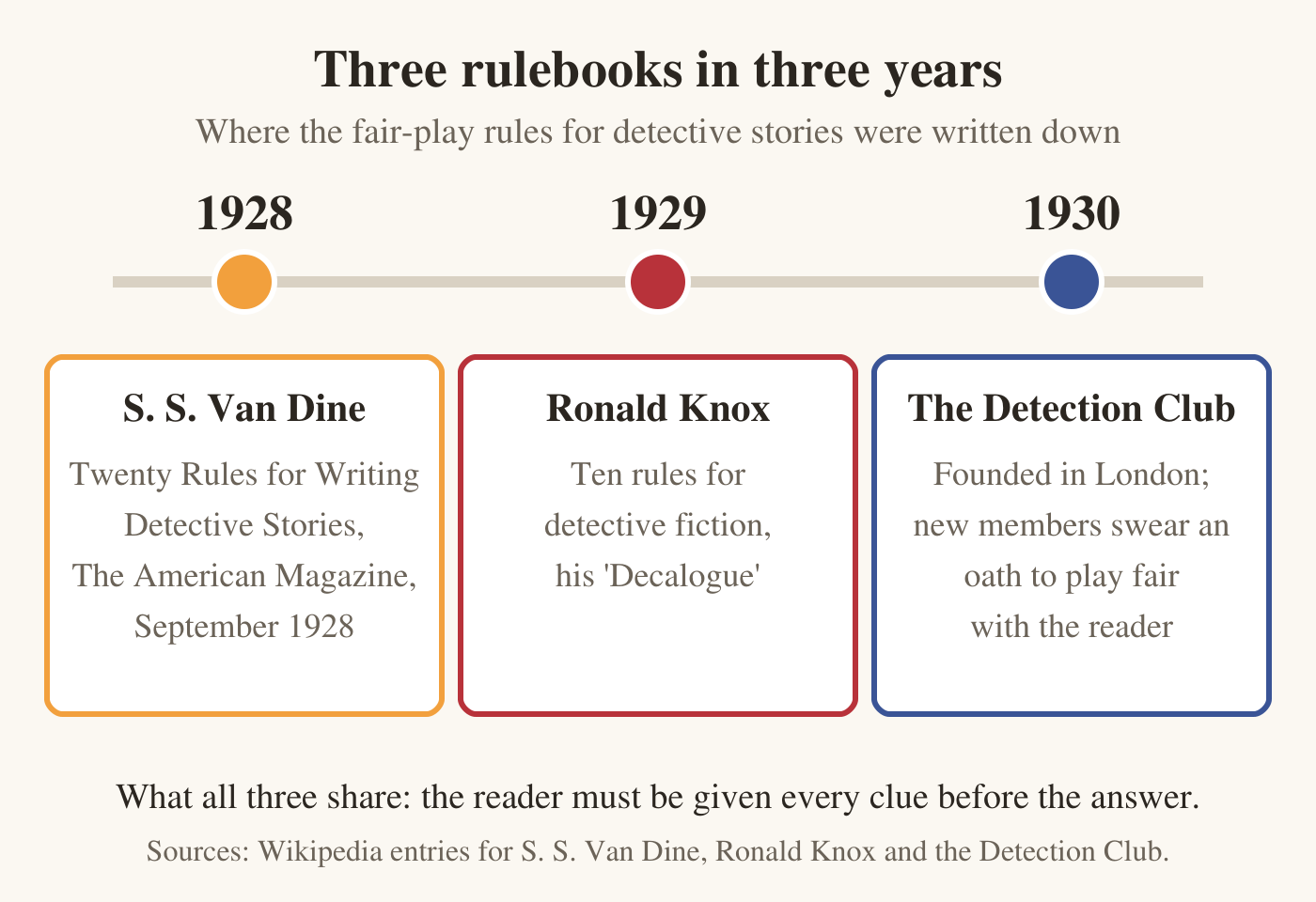
Short mysteries to solve have a rulebook, and it is nearly a hundred years old. In September 1928 an American art critic writing as S. S. Van Dine published "Twenty Rules for Writing Detective Stories" in The American Magazine. A year later, in England, the priest and novelist Ronald Knox set down ten rules of his own. And in 1930 a group of British mystery writers, Knox among them, with G. K. Chesterton as their first president, formed the Detection Club. New members swore an oath that their detectives would solve crimes by their wits, and not by "Divine Revelation, Feminine Intuition, Mumbo Jumbo, Jiggery-Pokery, Coincidence or Act of God."
The old rulebooks contain plenty of restrictions that modern mystery writers no longer follow. Some are outdated, and some are plainly prejudiced; Van Dine even insisted that a detective novel should involve a murder, which the gentle mystery above deliberately does not. But one principle remains useful: the reader deserves a fair chance to work out what happened. For the kind of short solve-along mystery on this page, five principles matter most.
- The culprit is someone you have met. Knox's first rule says the criminal must be mentioned early in the story. A stranger who walks in on the last page is a cheat.
- Every clue is shown to you. Van Dine's first rule gives the reader the same chance as the detective, with every clue plainly stated; Knox says the detective must declare any clue he finds. If the detective smells something, you are told what.
- No magic and no luck. Nothing supernatural, and no lucky accident that hands over the answer. That is what the Detection Club oath is about.
- The solution uses only what you were shown. The answer re-reads the story; it does not add to it. A solution that brings in new evidence is the genre's oldest complaint.
- There is one supported answer. For a fair-play puzzle with a single intended solution, the clues must rule out the alternatives rather than merely make one suspect seem more likely.
In a short mystery these rules matter more, not less. A novel has three hundred pages in which to bury a clue. A story of two thousand words has to put the clue in plain sight and trust that you will read straight past it. That is the whole game: the clue was there, you saw it, and you did not notice it.
How to read a short mystery you mean to solve
Reading to solve is a different habit from reading to find out. Four things help.
- Keep the times. Short mysteries turn on minutes. If the story says the window was shut at a quarter past one, that time is there for a reason. Write the times down if you need to.
- Count the doors. Every way in and out of a room is a line in your reasoning. A door that is bolted, a wall too high to climb, a gate bricked up: each one removes somebody.
- Ask who vouches for whom. An alibi is only as good as its witness. "He was with me the whole time" settles two people at once, but only if the person saying it was in a position to know.
- Listen for what did not happen. In Arthur Conan Doyle's "Silver Blaze" (1892), the dog did nothing in the night-time, and that silence is the clue. The thing that should have made a noise and didn't, the person who should have been surprised and wasn't, is often the key.

The best solve-along stories mark the pause for you. The story runs, every clue in place, and then a box says: stop here, this is the question, here is a hint if you want one. The solution waits somewhere else, so you cannot see it by accident, and when it walks through the clues it points back to where each one appeared. That structure is the fair-play rules made visible. If a story has no pause, make your own: when the detective says "I know who did it," close the book and decide before you open it again.
The solution to The Snow Globe
It was Theo.
First, consider the time. Ben opened the window at ten past one, and snow blew onto the sill. After he shut it at a quarter past, Nell saw the globe still standing in the melting snow. The dry circle shows where it protected the sill from the snow, but Nell's last sighting gives the decisive time: the globe disappeared between a quarter past one and half past.
Now consider who could have reached it. Priya was outside in the lane throughout that interval, and the scullery door was bolted from the kitchen side; the walled garden has no other entrance. Rob remained in the dining room, reading aloud, with Grandad asleep beside him, both visible to Nell through the serving hatch. Nell and Ben remained together at the sink, neither leaving that position between a quarter past one and half past.
That leaves Theo. At twenty past one he came through the garden door and stood beside the stove and windowsill, within reach of the globe, while Nell and Ben faced the other way. He is the only person not accounted for somewhere away from the sill during the interval when the globe disappeared. The wet mitten mark beside the dry circle supports the same conclusion: Theo came in with soaked mittens, and the mark fits what the other clues already establish.
Theo is the only person whose movements allow him to have taken the globe. No confession or newly discovered evidence is required.
After the answer: when Nell asked Theo about the globe, he brought it out from under his jumper. He had wanted Grandad to see the little church. Nell put the globe safely back on its sill, and told Theo they could show it to him together when he woke.
If you got it, you used the four habits: the times, the doors, who vouched for whom, and the mark that should not have been there. If you got it wrong, look for the clue you read past. It is there.
Twelve more nights of this
If you enjoyed stopping at the question and working out the answer, Christmas Mysteries to Solve offers twelve more short mysteries set in Gullcombe, an invented British harbour town, one story for each day from the thirteenth of December through Christmas Eve.
Maud Tremayne, the town's sixty-seven-year-old piano tuner, tunes thirty-one pianos in nineteen days every December. Her work takes her around Gullcombe, where she hears plenty of local conversations; Constable Jowan Kitto is the town's only policeman.
Every story has a Pause and Solve box with a question and an optional hint. The solutions are collected at the back of the Kindle eBook, with links that take you directly to the passages containing the clues. Four stories are marked Easy, four Medium and four Hard, and each of the twelve has been independently checked to confirm the clues rule out every suspect but one.
A thirteenth mystery runs through the book: someone leaves a tangerine on Maud's doorstep every morning, wrapped in a page of old printed music. The question of who leaves them is answered in the final story. There is no gore or violence, and nobody dies. The book is available through Amazon as a Kindle eBook and is included in Kindle Unlimited; you can read it on a Kindle device or in the Kindle app on a phone or tablet.
If you would rather have a grid and a pencil than a story, The Twelve Cases of Christmas is twelve Christmas cases you solve by crossing suspects off a list, and our guide to Christmas mystery books for adults compares the two kinds.
Sources
- Van Dine's "Twenty Rules for Writing Detective Stories", The American Magazine, September 1928, and his real name, Willard Huntington Wright: S. S. Van Dine, Wikipedia.
- Knox's ten rules (1929) and his founding membership of the Detection Club: Ronald Knox, Wikipedia.
- The Detection Club's founding in 1930, its first president G. K. Chesterton and the wording of the oath: Detection Club, Wikipedia.
- The dog that did nothing in the night-time: The Adventure of Silver Blaze (1892), Wikipedia.
Frequently asked questions
What is a fair-play mystery?
A mystery in which the reader is given every clue the detective has, before the solution, so that a careful reader can reach the answer first, and in which the solution rules out every other suspect rather than just naming the most likely one. The idea was written down as rules by S. S. Van Dine in 1928 and Ronald Knox in 1929, and sworn to as an oath by the Detection Club from 1930.
Where can I find short mysteries to solve with answers?
Look for collections that mark a stopping point before each solution and keep the solutions separate from the stories. The best ones explain each solution clue by clue, so you can see where you went wrong. The Snow Globe above works that way, and so does the book described on this page.
Are short mysteries to solve good for a group?
Yes. Have everyone read or listen to the story, stop at the question, and compare answers before checking the explanation. Each person can point to the clues supporting their guess, which makes the discussion part of the fun.
How is a mystery story different from a logic puzzle?
A logic grid puzzle, like the ones in how to solve logic grid puzzles, gives you clues as a numbered list and a grid to mark. A solve-along mystery hides the same kind of clues inside a story, among details that do not matter, and your first job is to find them. The reasoning at the end is the same.