
The note comes home from school: could your child bring in a book about Diwali to share with the class? You go looking for Diwali books for kids and stop at the bookshelf. There are plenty of bedtime stories, but nothing about the lamps, sweets and celebrations your family knows.
That is one reason parents search for them. They want something their child will recognize, something classmates can enjoy too, and a story that fits the age of the children listening. Perhaps you are the teacher choosing a book for the whole class, or a parent introducing Diwali for the first time. The same question matters: which book will help this particular reader?
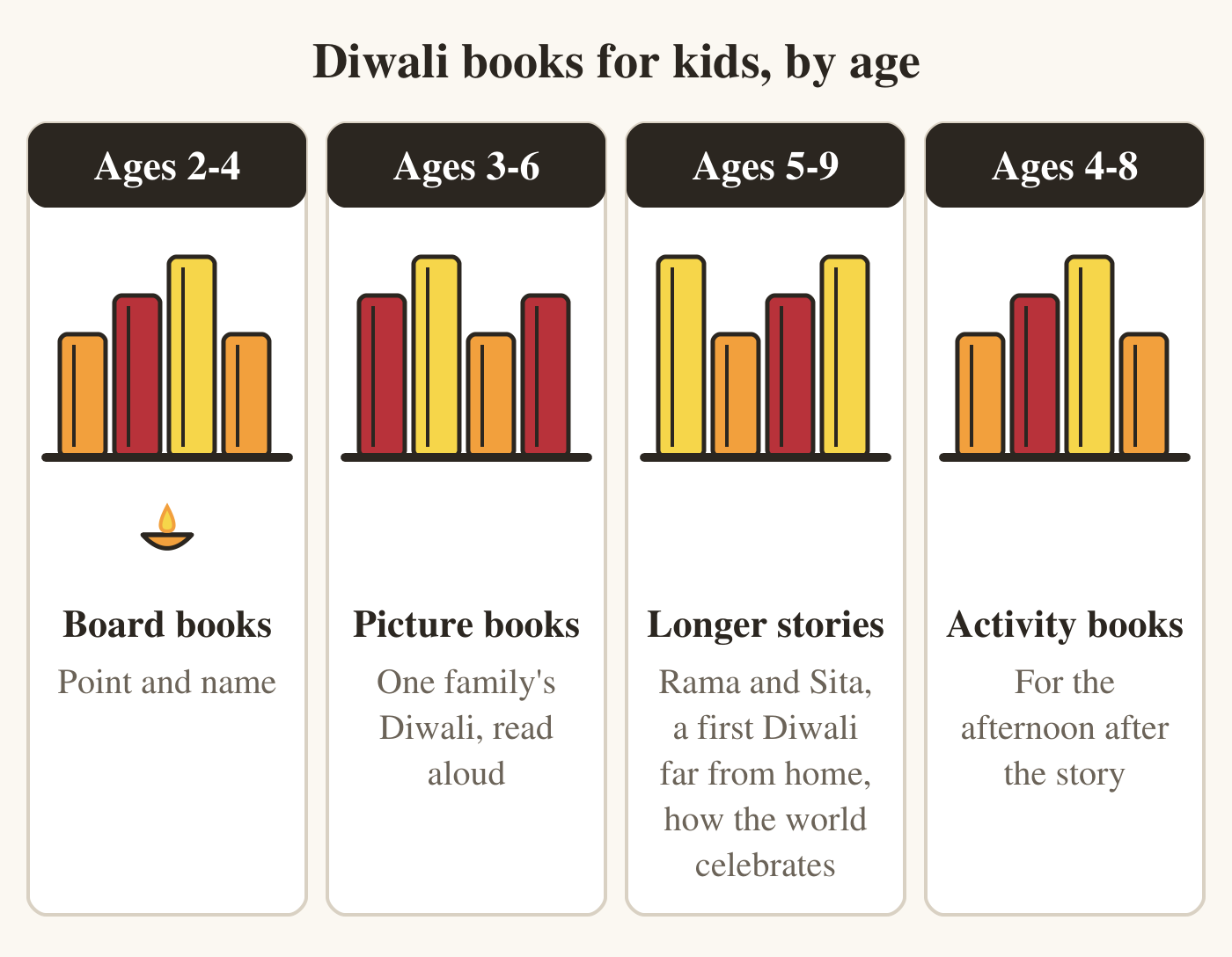
The short answer: Choose Diwali books for kids by age and by the kind of story you want to share. Toddlers may enjoy sturdy board books with familiar festival objects. Children around ages 3 to 6 can enjoy picture books read aloud. Older children may be ready for longer family stories, Ramayana retellings and nonfiction about celebrations around the world. Activity and coloring books offer another way to explore the festival after reading together. These ages are guides, not strict limits.
One book, two kinds of reader
In her 1990 essay "Mirrors, Windows, and Sliding Glass Doors", children's literature scholar Rudine Sims Bishop described how books can show us lives beyond our own, reflect our own experiences, and let us step into another world through imagination. She also warned about what happens when children repeatedly fail to find themselves in books, or meet distorted images of people like themselves.
That matters when choosing a Diwali book. A child who celebrates at home may recognize the lamps, clothes, food or family gatherings. Another child may be meeting those traditions for the first time. The same book can offer recognition, discovery and questions to both.
But no single book represents every family's Diwali. Some focus on an ordinary celebration, some retell religious stories, and others explain the festival through facts. The right choice depends on what you want children to understand. The descriptions below rest on publishers' information and published reviews, with age ranges credited to their sources. Preview a book when you can, especially before reading it to a whole class.
Diwali books for toddlers (ages 2 to 4)
At this age, children often enjoy pointing at pictures, naming familiar objects and listening to a few words at a time. Look for sturdy pages, simple illustrations and objects they may recognize, such as diyas, sweets and rangoli designs.
Diwali by Hannah Eliot, illustrated by Archana Sreenivasan (Little Simon, 2018). This 24-page board book in the Celebrate the World series is listed by its publisher for ages 2 to 4. It presents Diwali as a five-day festival: a time to pray for a good season, to celebrate brothers and sisters, and to celebrate light winning over darkness. Sreenivasan is an illustrator based in Bangalore.
Diwali picture books for kids to read aloud (ages 3 to 6)
Some picture books follow a child through a family celebration. Others use rhyme and storytelling to introduce the traditions and stories behind the festival. Either kind may work for circle time or bedtime, depending on its length, language and the ages of the children listening.
The Best Diwali Ever by Sonali Shah, illustrated by Chaaya Prabhat (Scholastic; first published in the UK in 2021, in the US in 2023). Ariana wants this Diwali to be her best yet, and she means to win the rangoli contest. Her three-year-old brother, Rafi, keeps getting in the way: flour spilled while she makes sweets with her grandmother, handprints on her new clothes. Then he trips and spills powder over her finished rangoli. What Ariana does next is the heart of the book, and it is a good one for any child with a small, eager sibling. Kirkus lists it for ages 3 to 7.
Amma, Tell Me About Diwali! by Bhakti Mathur (2011). In this rhyming book, brothers Klaka and Kiki ask their Amma about the festival. Her answers introduce diyas, the worship of Lakshmi and Ganesha, and the story of Rama's return to Ayodhya. It is listed for ages 2 to 8.
Diwali story books for kids (ages 5 to 9)
Older children can follow a longer story, and they start to ask why. These three answer in different ways: a story about a first Diwali far from home, a retelling of Rama and Sita, and a tour of how the festival is kept.
Lights for Gita by Rachna Gilmore, illustrated by Alice Priestley (1994). Gita's family has moved from New Delhi to a new home far from India, and she is waiting for her first Divali there (the book's spelling). Then an icy November storm arrives. Friends cancel their visits and the fireworks are put off. The family lights small diyas at each window, and then the storm cuts the power. What those little lamps do on that dark street is the turn of the story. Publishers Weekly suggested it for ages 5 and up.
Rama and the Demon King by Jessica Souhami (first published in 1997). The Ramayana, told short: fourteen years in the forest with Sita and Lakshmana, Sita carried off by the demon king Ravana, Hanuman and the monkey army, the rescue and the return. Souhami once ran a touring shadow-puppet company, and her pictures have that bold, cut-paper look. Kirkus suggested it for ages 5 to 9. If your child wants to know why many Hindu families connect Diwali lamps with Rama's homecoming, our Diwali story for kids tells that tradition in six short chapters.
Celebrate Diwali by Deborah Heiligman (National Geographic, 2006). This is nonfiction from the Holidays Around the World series, about how Diwali is celebrated in different places. The back pages hold recipes, a glossary, a card game, a map and a note for parents and teachers from the book's consultant, Dr. Vasudha Narayanan. Colorín Colorado lists it for ages 6 to 9.
Check which Diwali tradition a book represents
Books about Diwali do not all tell the same religious story. Families and communities connect this season with different traditions, and those differences are worth keeping.
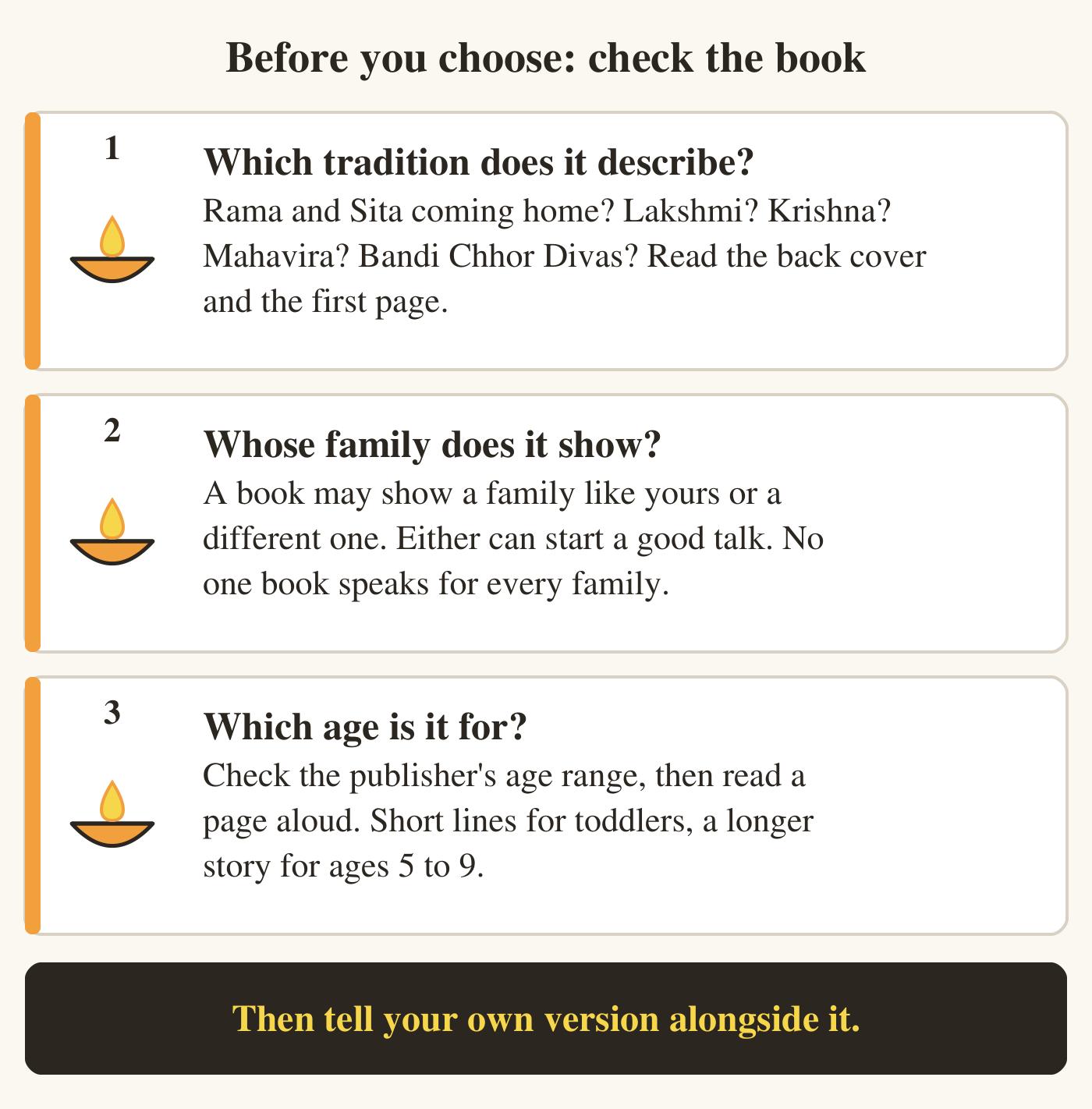
Many Hindu families remember Rama and Sita returning to Ayodhya after fourteen years away, welcomed with rows of lamps. Many worship Goddess Lakshmi during Diwali, and in parts of south India the festival also remembers Krishna's victory over Narakasura. For Jains, Diwali marks the nirvana, or final liberation, of Mahavira. Sikhs observe Bandi Chhor Divas at this time, remembering the release of Guru Hargobind Sahib from imprisonment at Gwalior Fort and his securing the freedom of 52 other prisoners. It has its own Sikh significance and is not another version of Rama's homecoming story.
These observances may fall together, and some customs look familiar across communities, but their religious meanings are not interchangeable. Before choosing a book, ask whose experience it presents, which tradition it describes and whether that is what you want to share. A book about Rama can introduce a child to an important Hindu tradition without matching their own family's main observance.
You can tell your family's story alongside the book. Our guide to Diwali symbols and meanings explains several commonly seen objects and customs, with the reminder that not every family uses them in the same way.
Diwali activity books for kids (ages 4 to 8)
Many families celebrate Diwali over several days. Between preparations, family visits and evening celebrations, children may want a quieter activity. A coloring or activity book can help them recognize festival objects and revisit a story they have heard. It does not have to replace a storybook; it can sit alongside one. A good one for ages 4 to 8 does three things:
- It keeps the story close. A picture of a palace gate means more when your child knows who is coming home through it.
- It suits the age. Big shapes and thick lines for a four-year-old, busier patterns for an eight-year-old.
- It gives you something to talk about. A name under each picture turns "color this" into "who is this, and what happened next?"
Our own Diwali Coloring Book fits here as a coloring book, not a full storybook. It begins with a one-page retelling of Rama and Sita's story, meant to be read aloud with a grown-up. Then come 40 named pictures for ages 4 to 8, including Lighting the Diyas, Hanuman Flies, Grandma's Story, The School Play and Goodnight Diya. Each picture is printed on one side of its sheet, with its name underneath. The opening story follows the Rama-and-Sita tradition; it does not cover every observance connected with Diwali. For more things to do together, see our Diwali activities for kids, with one small activity for each of five festival days.
How to read a Diwali book aloud
Whether it is bedtime at home or circle time in a classroom, a few small things help a Diwali book land.
- Read the book yourself first. Check unfamiliar names (Ayodhya, Lakshmana, Ravana, Narakasura) and any explanations before sharing it with children.
- Pause at a familiar object. A lamp, a rangoli or a plate of sweets gives children something concrete to notice. In a classroom, an adult can show a flameless light with a secured battery compartment.
- Invite experiences, but never require them. A child who celebrates Diwali may want to describe their family's customs, but they should not be expected to explain the whole festival or speak for everyone who celebrates it.
- Ask about the particular story. "What did the lamp mean to this family?" or "What was the child looking forward to?" keeps the talk grounded in the book.
Back at that bookshelf, the choice is easier once you know who the book is for: the group on the carpet at school, the child at bedtime, or the long afternoon in between, while the lamps wait for dark.
Sources
- Books as windows and mirrors, and children who never see themselves in books: Rudine Sims Bishop, "Mirrors, Windows, and Sliding Glass Doors", Perspectives: Choosing and Using Books for the Classroom, vol. 6, no. 3, summer 1990; summarized by Facing History & Ourselves.
- Diwali (Celebrate the World): 24-page board book, ages 2 to 4, the five days, the illustrator: Simon & Schuster.
- The Best Diwali Ever: Ariana, three-year-old Rafi, the flour, the handprints, the spilled rangoli, the rangoli contest, ages 3 to 7, US release 2023: Kirkus Reviews; UK paperback 2021: Scholastic UK.
- Amma, Tell Me About Diwali!: rhyming, Klaka and Kiki, Amma's answers from the diyas to Rama and Sita's return, ages 2 to 8: Beetle Bookshop and Oxford Bookstore; year 2011: TeachingBooks.
- Lights for Gita: New Delhi, the November ice storm, the canceled visits and fireworks, the diyas at each window, then the power failure, ages 5 and up: Publishers Weekly.
- Rama and the Demon King: the story, the cut-paper look, ages 5 to 9, 1997: Kirkus Reviews; Souhami's shadow-puppet company: Reading Rockets.
- Celebrate Diwali: series, back matter, consultant, ages 6 to 9: Colorín Colorado.
- Jain Diwali and Mahavira's final liberation: JAINpedia, "Dīvālī", by Nalini Balbir. Bandi Chhor Divas, Guru Hargobind Sahib and the release of 52 prisoners: RE:ONLINE, "Divali (Bandi Chhor Divas)".
Frequently asked questions
What are good Diwali books for kids?
Choose by age and subject. For toddlers, a board book such as Diwali in the Celebrate the World series. For ages 3 to 6, The Best Diwali Ever follows a family's celebrations, while Amma, Tell Me About Diwali! uses rhyme to introduce festival customs and religious stories. For ages 5 to 9, Lights for Gita offers a longer family story, Rama and the Demon King retells the Ramayana, and National Geographic's Celebrate Diwali introduces traditions through nonfiction.
What is a good Diwali book for toddlers?
Look for a board book with one short sentence a page and pictures of things your toddler will see on Diwali night: a lamp, sweets, a rangoli. Diwali by Hannah Eliot, illustrated by Archana Sreenivasan, is a 24-page board book listed for ages 2 to 4.
Which Diwali book is good to read aloud in a classroom?
The Best Diwali Ever is a family-centered picture book for young listeners, with a rangoli contest and a small brother at the center of the story. Preview whichever book you choose, explain that families observe the festival in different ways, and invite children to contribute only if they wish.
Do all Diwali books tell the same story?
No. Many tell Rama and Sita's return to Ayodhya, but families and communities also connect the season with Lakshmi, Krishna's victory over Narakasura, Mahavira's nirvana (for Jains) and Bandi Chhor Divas (for Sikhs). Before you choose, check which tradition a book describes, and tell your family's own version alongside it.