
On September 1, 1930, a group of puzzle enthusiasts formed the American Cryptogram Association. Their first love was a letter-swap puzzle they called the Aristocrat, with the spaces between the words left in. Members solved under pen names: Gelett Burgess, who wrote "The Purple Cow" and coined the word "blurb," was TWO O'CLOCK, and the puzzle maker Will Shortz signs WILLz. The name sounds grand, but the puzzle is a familiar one: it is the cryptogram in your newspaper or puzzle book today. Easy cryptograms for beginners use exactly the same letter-swap rule as the hard ones. What makes them easy is the help around the code: a few letters given free, short everyday words, and often a line you have heard before.
The short answer: Easy cryptograms for beginners give you a few letters free, leave the spaces between words in place, and use short, familiar language. Recognizing an old saying can help, but you don't need to know the answer in advance. Start with the given letters, look for short words and repeated patterns, and test each guess against the whole line.
What a cryptogram is, in one paragraph
A cryptogram is a short piece of writing in a letter-swap code. Every letter of the alphabet stands for a different letter, and the swap holds all the way through that one puzzle: if Q stands for E once, it stands for E every time. The spaces between words and the punctuation are left alone. You write the real letter under each code letter until the sentence appears. The American Cryptogram Association calls this kind of single-alphabet puzzle an Aristocrat, and its bimonthly journal, The Cryptogram, has printed them since 1932.
Why easy cryptograms for beginners feel easy
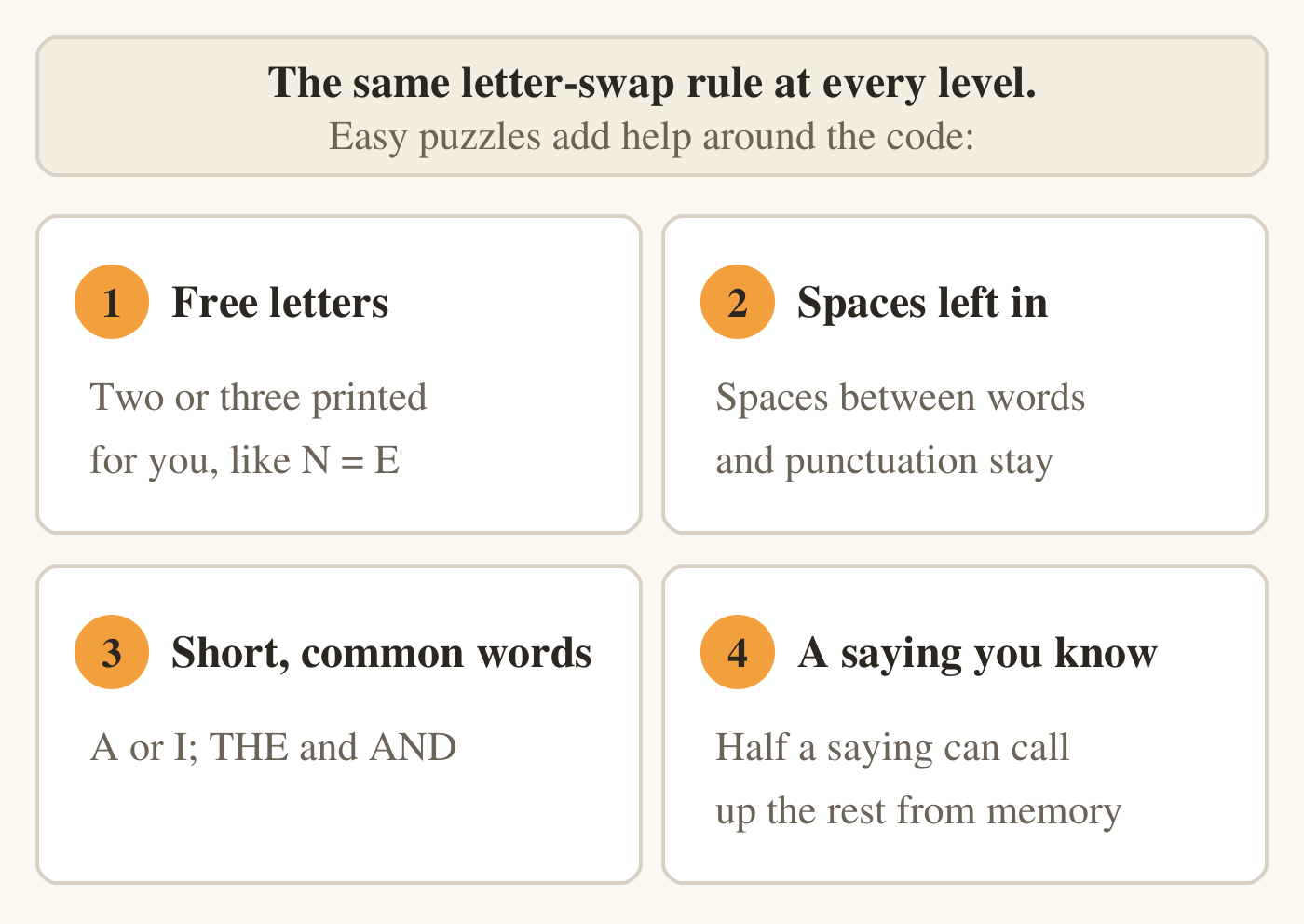
The letter-swap rule is the same in beginner and expert cryptograms. What changes is the amount of help you get, the length of the hidden text, and how familiar its words may be. Three things are especially useful when you're starting out.
Free letters. Many puzzle books print two or three letters for you in the easy puzzles, already written in. Three right letters in a short line are often enough to see a whole word.
Short, common words. A one-letter word is almost always A or I. THE and AND are the commonest three-letter words. A line made of everyday words gives these patterns plenty of chances to show up.
A line you already know. It helps more than you might expect. If the hidden text is a well-worn proverb, you don't have to build it letter by letter. You only have to recognize it. Half a saying is often enough to call up the rest from memory, and then the code simply confirms what you already know.
Watch a proverb crack in four moves
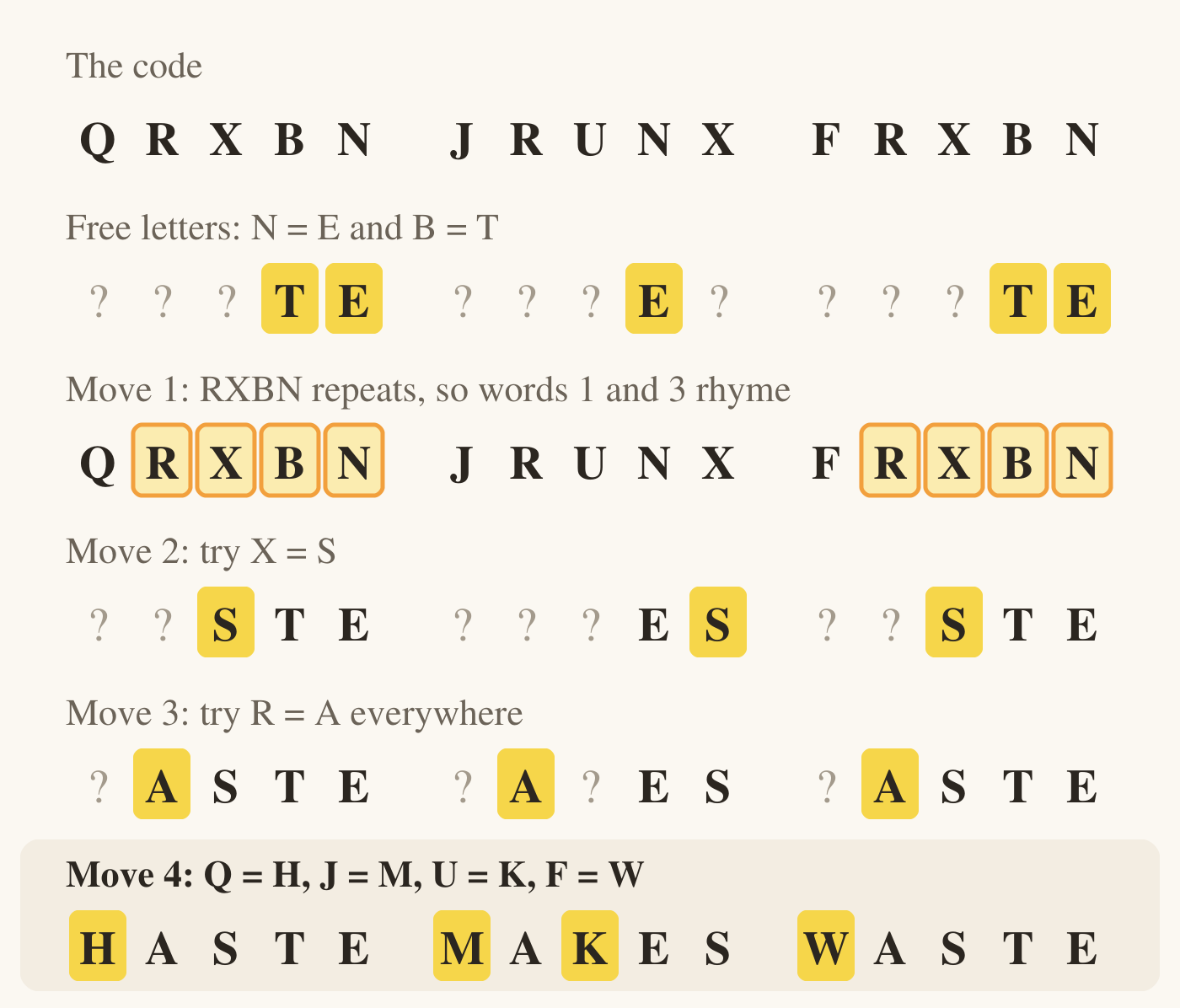
Here is a three-word proverb in code. Two letters are given free: N = E and B = T.
QRXBN JRUNX FRXBN
Write in the free letters and it reads ? ? ? T E ? ? ? E ? ? ? ? T E.
That is exactly how Level 1 of our large print cryptograms book starts you, with three letters already written in.
Move 1: look for a repeated pattern. The first and third words end in the same four code letters, RXBN. Whatever they are, the two words end the same way and differ only in their first letter. That is a strong hint that they rhyme.
Move 2: try a common ending. The second word ends in E and then X. A word ending in E-something is very often a plural or a verb ending in ES, so try X = S. Now the rhyming words end in ?STE, and the middle word reads ? ? ? E S.
Move 3: fill in what the pattern allows. Words ending in -ASTE include HASTE, PASTE and WASTE. TASTE can't fit: B already stands for T, and no other code letter can stand for T as well. Every remaining candidate has an A before the S, so try R = A everywhere. Now the line reads ? A S T E ? A ? E S ? A S T E.
Move 4: let the saying finish itself. Two rhyming words ending in -ASTE, with ?A?ES between them. Does a proverb come to mind? HASTE MAKES WASTE. Check it against the code: Q = H, J = M, U = K and F = W. Every code letter keeps the same meaning, and no two code letters stand for the same real letter. Solved.
The letter-swap rule never changed. You used the given letters, tested the patterns, and recognized a familiar line. That is one useful way into cryptograms. For a line you have never seen before, our longer guide to how to solve cryptograms takes you through Edgar Allan Poe's 1839 method.
Five easy habits for your first cryptograms
- Use a pencil. You will guess, and some guesses will be wrong. That is part of the method, not a failure.
- Fill in a letter everywhere at once. When you decide Q is H, write H under every Q in the puzzle before you do anything else.
- Keep a key. Write each solved pair on a strip of 26 letters. It stops you using one real letter twice.
- Read the line out loud. Half-solved words like "?AKES" often click when you hear them.
- Peek without guilt. If you're stuck, look up one letter in the answers and carry on. The point is the pleasure of the reveal, not a clean record.
A book of small, good thoughts to decode
If you'd like a whole book with starting letters and a warm mix of lines to decode, we made Large Print Cryptograms: A Little Book of Wisdom & Cheer for exactly this kind of beginning. Its 200 puzzles hide 67 sayings, 39 traditional proverbs such as "Rome was not built in a day," 47 reflections and 47 curious facts. They're gathered into 20 short sections on kindness, patience, friendship, hope and more.
It opens with a one-page how-to and a worked example. The first 50 puzzles give you three free letters each, the next 50 give two, then one, and the last 50 give none. If you get stuck in the harder half, a One-Letter Help page gives one more letter for each puzzle and nothing else. Every code letter is printed in 19 point type over its own write-in line, and all 200 answers are at the back. If you would rather have the same given-letter start told as twenty village cases, there is Large Print Cryptograms: The Village Detective's Casebook.
If you prefer fitting words to decoding them, try our guide to how to do fill in puzzles.
Sources
- The American Cryptogram Association (founded September 1, 1930; "The Aristocrat of Puzzles"; noms, or pen names; The Cryptogram since February 1932): ACA history, American Cryptogram Association. Will Shortz as WILLz: 2018 ACA Convention. Burgess as TWO O'CLOCK: American Cryptogram Association, Wikipedia.
- Gelett Burgess, "The Purple Cow" (1895) and the word "blurb" (1906): Gelett Burgess, Wikipedia.
Frequently asked questions about easy cryptograms for beginners
What makes a cryptogram easy?
A short line of everyday words, a few letters given free, and a hidden text you may already know, such as a proverb. The code itself works the same way at every level.
What is the best way to start a cryptogram?
Fill in any free letters everywhere they appear. Then try the one-letter words (A or I) and the three-letter words (THE, AND), and look for repeated patterns across words.
What is an Aristocrat cryptogram?
It is the American Cryptogram Association's name for a single-alphabet letter-swap puzzle, with the spaces between words kept. It is the kind of cryptogram most puzzle books and newspapers print.
Is it cheating to look at the answers?
No. Looking up one letter when you are stuck is a normal way to learn, and many books include a hint page for exactly that.
Are cryptograms good for older adults?
Many older adults enjoy them as a quiet puzzle to do at their own pace. For easier reading, look for a large print book with free letters in the early puzzles and the answers at the back.