
In 1924, Richard Simon's aunt, a crossword enthusiast, asked him whether anyone had collected the New York World crosswords in a book. No one had. So Simon and his friend Max Schuster pooled $8,000 and started a company to publish crossword puzzles. That company was Simon & Schuster, and it began because one puzzle lover wanted something to fill in. More than a century later, the fill-in puzzle offers a different sort of pleasure: every word is already on the page, and the puzzle is finding where each one belongs. If you've wondered how to do fill in puzzles, this guide walks through a small four-word grid with you, one move at a time.
The short answer: Count the words and the empty slots of each length. When a word is the only one of its length, it has only one slot to go in, so place it first. When several words share a length, use letters from the crossing words to narrow the choice: where an across word and a down word share a square, they must share a letter. Work in pencil, cross off each word as you place it, and when you're stuck, look for a slot with several letters already filled in.
A crossword with the answers printed underneath
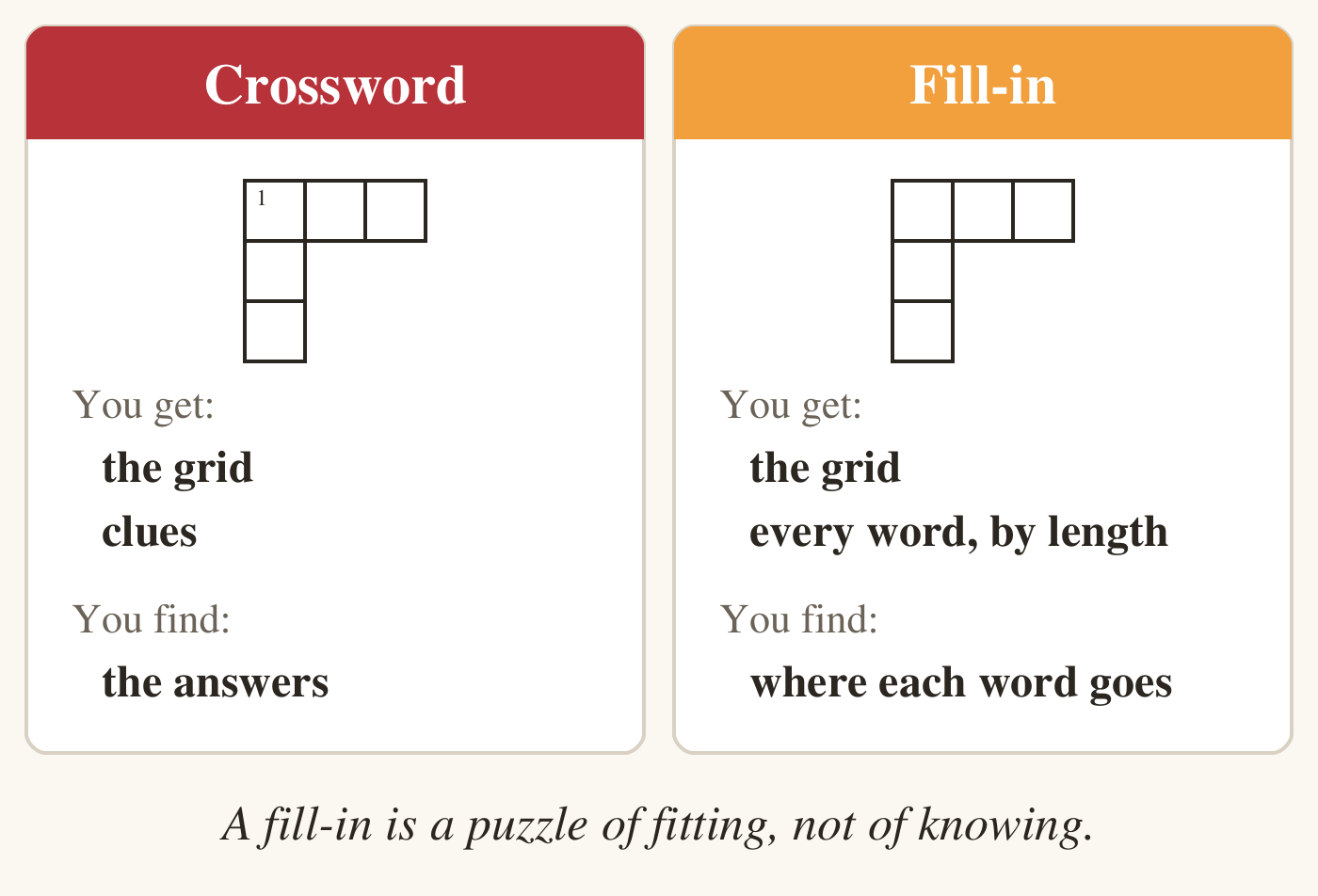
The crossword itself was about ten years old when Simon's aunt asked her question. On December 21, 1913, a Liverpool-born journalist named Arthur Wynne published a "word-cross" in the New York World, and it's usually cited as the first crossword puzzle. A crossword gives you clues and a grid. You have to know, or work out, the answers.
A fill-in turns that around. You get the grid and the full list of words, usually grouped by length, and no clues at all. Some people call it a word fill-in, a fill-it-in, a criss-cross or a word-fit puzzle; the idea is the same. You don't need to know any trivia or remember a word on the tip of your tongue, because every answer is printed on the page. The only question is where each word goes so that every crossing agrees.
That makes a fill-in a puzzle of fitting, not of knowing, and it's why the method matters more than your vocabulary.
How to do fill in puzzles: one small grid, solved together
Here is a tiny grid. Each square is a letter box; the blank cells are not part of the grid. Rows are numbered and columns lettered so we can talk about them.
| A | B | C | D | E | |
|---|---|---|---|---|---|
| 1 | ☐ | ☐ | ☐ | ☐ | ☐ |
| 2 | ☐ | ☐ | |||
| 3 | ☐ | ☐ | ☐ | ☐ | |
| 4 | ☐ |
There are four slots: five squares across row 1, three squares down column A, four squares down column E, and three squares across row 3. The words to fit are:
- 3 letters: BED, DEW
- 4 letters: MINT
- 5 letters: BLOOM
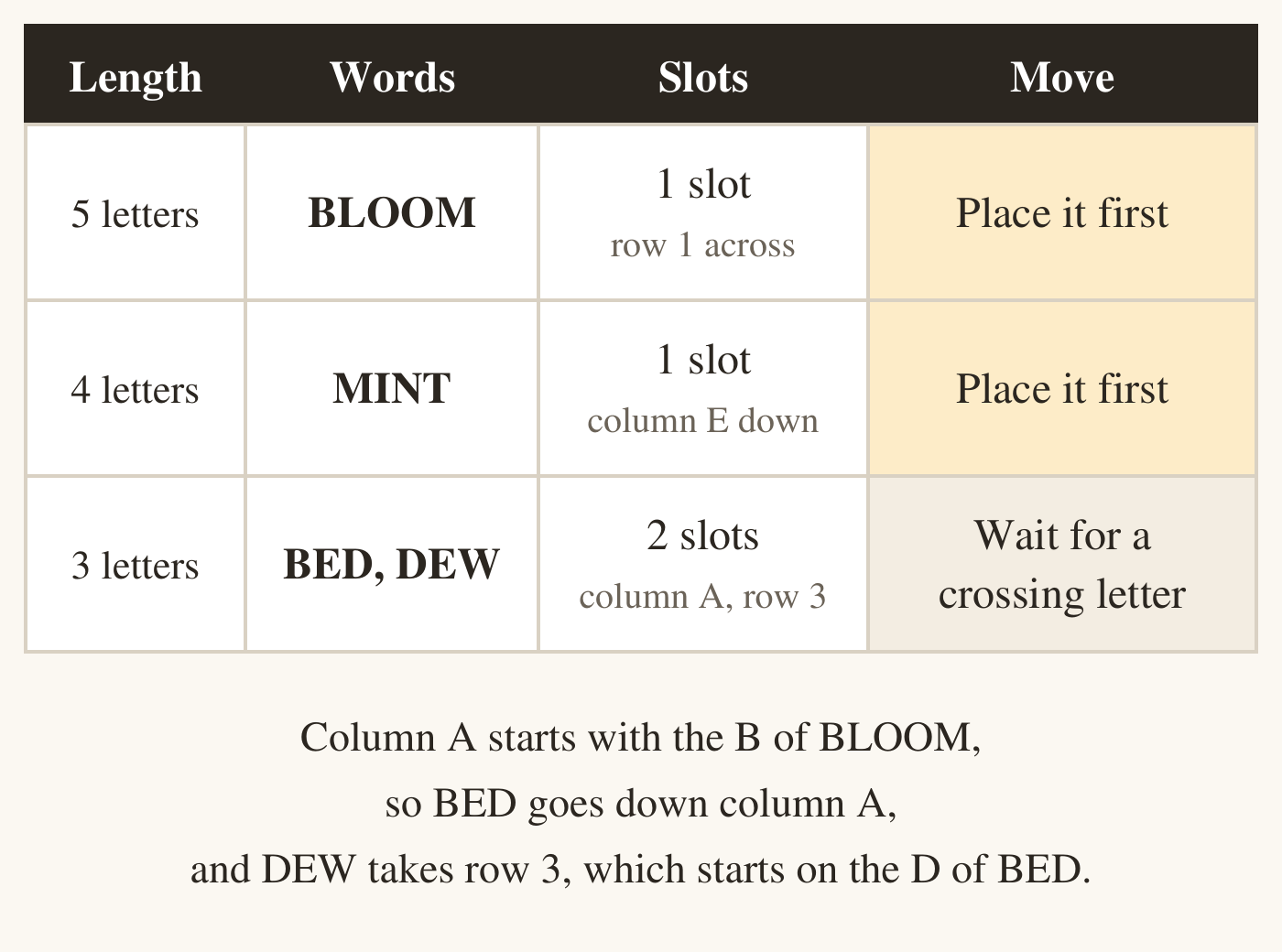
Move 1: place the lengths that appear only once. There is one 5-letter word and one 5-letter slot, so BLOOM goes across row 1. There is one 4-letter word and one 4-letter slot, so MINT goes down column E. Check the crossing: the top-right square is the last letter of BLOOM and the first letter of MINT. Both are M, so they agree.
Move 2: use a letter you've placed to choose between look-alikes. Two 3-letter words, two 3-letter slots. Guessing would be a coin toss, but you don't have to guess. The slot down column A starts in the top-left square, which already holds the B of BLOOM. Only BED starts with B, so BED goes down column A.
Move 3: let the last word fall into place. The slot across row 3 starts in the square that holds the D at the bottom of BED. DEW starts with D, and it's the only word left. Every crossing agrees, and the grid is solved:
| A | B | C | D | E | |
|---|---|---|---|---|---|
| 1 | B | L | O | O | M |
| 2 | E | I | |||
| 3 | D | E | W | N | |
| 4 | T |
Notice what never happened: no guessing. Lengths placed the first two words, and crossings placed the rest. A bigger puzzle has many more words, but the same approach applies: start with what you can place for certain, then let the crossings narrow down the rest. Now and then you may need to try a word in pencil and change it if a later crossing disagrees.
Five habits for full-size fill-ins
1. Make a quick count. Before you write anything, note how many words there are of each length, and how many slots of each length the grid has. They must match. If a book groups the list by length, most of this is already done for you. The word lists in Large Print Word Fill-Ins are grouped by word length and printed in 16 pt, matching the counting method used here.
2. Start where a length is rare. When only one word and one slot share a length, the placement is certain. When two words share a length, check the crossing letters you already have before you choose. Leave the crowded lengths, often the three- and four-letter words, until other words have given you letters to work with.
3. Read every crossing you create. Each word you place hands letters to the words that cross it. After every placement, look at the slots it touched and ask which words in the list could still fit there. Often only one can.
4. Work in pencil and cross words off. A fill-in rewards second thoughts. Try a word, follow its crossings, and if they lead to a dead end, rub it out. Strike each word off the list as you place it, so you always see what is left.
5. Build out from starter letters. Some puzzles print a letter or two in the grid to begin with. Treat them like a word you have already placed, and work outward from there.
When a fill-in puzzle stops moving
Every solver hits a point where nothing seems to fit. Three things usually get it going again.
- Find the most filled-in slot. Look for a slot that already has several letters written in, then compare the unused words of that length. More fixed letters usually mean fewer possibilities. If several words still fit, leave the slot open and work on one that crosses it.
- Watch for a leftover. If a word remains on the list but every slot of its length is full, check that each word has been used exactly once. Then revisit any placement you made before its crossings were clear, and test the alternatives against the letters around them.
- Rest your eyes. Put the puzzle down, come back later, and start from a different corner. An overlooked crossing is often easier to spot with fresh eyes. If you're still stuck, retrace your most recent placement and check each shared letter.
Fill-ins for a quiet afternoon
If you'd like a whole book of them, we made Large Print Word Fill-Ins: A Cozy Collection of Criss-Cross Puzzles for exactly this kind of unhurried solving. It opens with a one-page how-to and a worked example, like the one above, then gives you 112 puzzles, one to a page, across sixteen cozy themes, from In the Garden and Tea Time to Books and Reading and A Country Fair.
Every theme runs from easy to hard: two Easy puzzles, two Gentle, two Steady and one Tricky. The word lists are grouped by length in 16 point type, the answer grids at the back use 16 point letters, and every grid was filled and then re-solved by computer to confirm it has exactly one answer. The completed grids at the back let you check your work whenever you like.
If you like puzzles where logic beats knowledge, you may also enjoy how to solve cryptograms, where Edgar Allan Poe's method cracks a letter-swap code.
Sources
- Simon & Schuster's start in 1924 (Richard Simon's aunt, the New York World crosswords, the $8,000): Simon & Schuster, Wikipedia.
- Arthur Wynne's "word-cross" of December 21, 1913, and the fill-in crossword: Crossword, Wikipedia.
Frequently asked questions about fill in puzzles
What is a fill in puzzle?
A crossword-style grid with no clues. You are given the complete list of words, usually grouped by length, and you fit each one into the grid, across and down, so that every crossing square shares the same letter.
Where do you start a fill in puzzle?
By matching the lengths of the listed words to the empty slots. If a word is the only one of its length, it has one matching slot. Place it there, then use its letters to narrow down the words that cross it. When several words have the same length, wait for a crossing to help you choose.
Do you need a big vocabulary to do fill in puzzles?
No. Every word is printed on the page, so a fill-in tests fitting, not knowing. Patience and a pencil matter more than vocabulary.
What if two words could fit the same slot?
Check the crossings for each option. If neither word can be ruled out yet, leave that slot and solve somewhere else. If you're still stuck, try one word in pencil and follow its crossings. If it creates a conflict, erase it and test the other.
Is a fill in puzzle the same as a crossword?
They use the same kind of grid, but a crossword gives you clues and asks for the answers, while a fill-in gives you the answers and asks where they go.