
Some goals get written down more than once. They appear on a list in January, in the front of a new notebook in March, and again on the back of an envelope in September, in almost the same words each time. Nothing is wrong with the goal. What is missing is everything between the goal and Monday morning — which is exactly what this guide is about: how to break down a goal into steps small enough to start, and honest enough to finish.
The short answer: Write the outcome so you would know, without arguing, that you had reached it. Then look for up to eight areas the goal depends on — skills, habits, people, systems, resources, place, energy, mindset — rather than jumping straight to the tasks you already have in mind. Turn each area into small actions, test each action against five pass/fail checks plus a dependency flag, and start only five to eight of them. Review after four weeks and let the evidence change the plan.
Why the list usually comes out wrong
A common way to break a goal down is to write a list of steps. The trouble is the assumption a list can hide: that you already know what the goal depends on. The parts that go missing can be the ones you were not thinking about in the first place.
The workbook's own illustration is a career move planned entirely as a course and an application, with nothing for the introductions, the protected evenings or the interview practice it also rests on. A small business planned as a product, with nothing for pricing, delivery or rest, has the same shape. The list is not wrong. The risk is that it stays inside the part you were already comfortable in.
So the order matters. Before you write a single step, ask what the goal rests on.
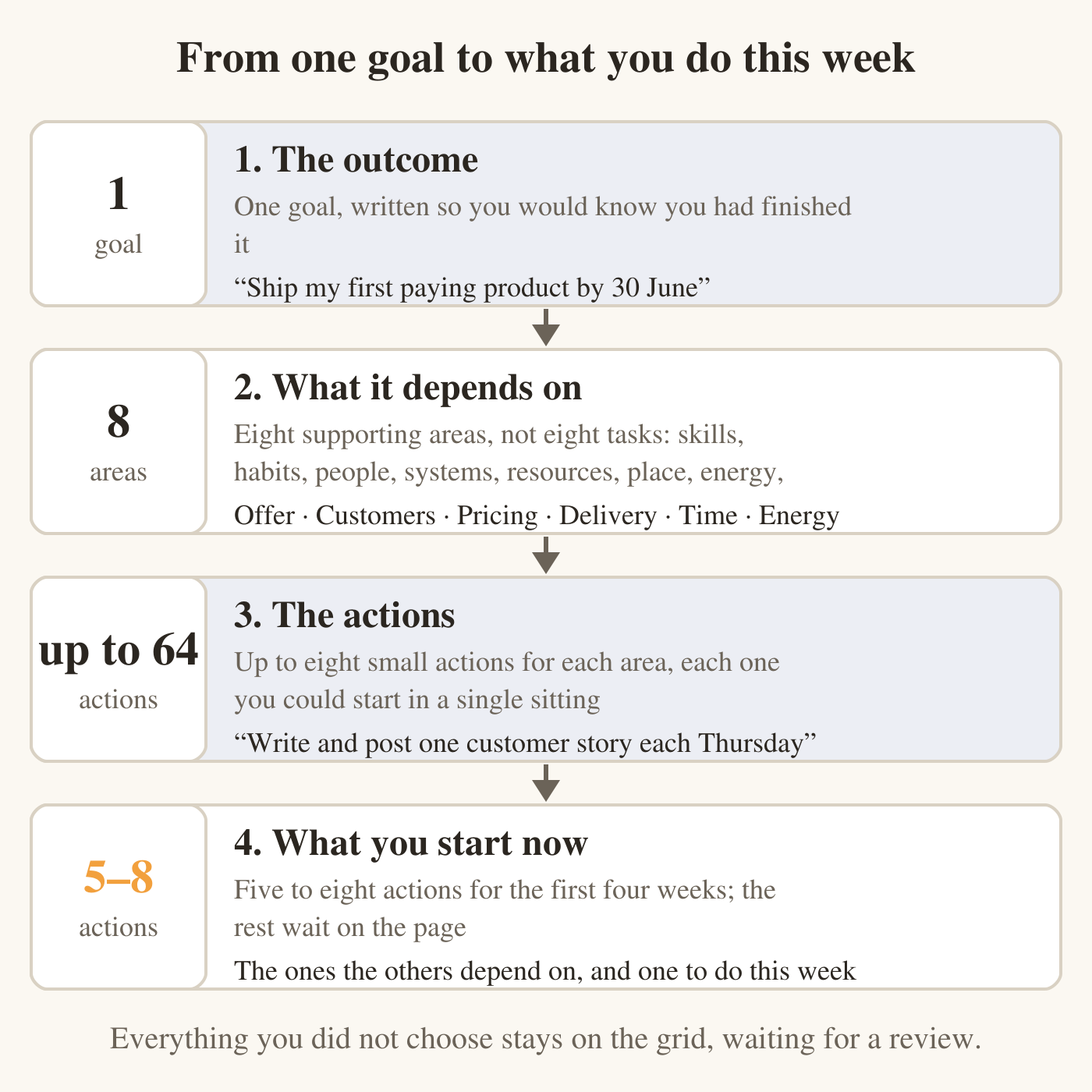
Step 1: Write the outcome, not the activity
A goal you can break down is a result, not a direction. "Get better at Spanish" has no end; "pass the B1 exam in June" does. The test is simple: would you know, without doubt, that you had finished? If two reasonable people could disagree about whether you had reached it, the goal is still a direction.
Three small fixes do most of the work:
- Give it a finish line. A number, a date, a finished thing. Not "grow the business" but "ten paying customers by 30 June".
- Know which part is yours. Plenty of goals worth having depend partly on someone else's decision — being hired, being chosen, being published — and that is fine; the areas and actions underneath are where you keep control. But if the outcome is completely out of your hands, move it to the nearest result you can drive yourself: "win the competition" becomes "enter three competitions with work I am proud of".
- Pick one. Three goals at once is really three plans competing for the same Tuesday evening. Choose the one that matters most for the next three months; the others keep.
Step 2: Ask what it depends on, not what to do first
This is the step a simple task list can miss, and it is where a plan either becomes complete or stays lopsided. Instead of asking what do I do first, ask what would have to be true for this to happen?
The 9x9 layout gives you room for eight supporting areas, so treat eight as capacity rather than a quota. Use the extra room as a prompt to widen the brainstorm, then keep only the areas that genuinely belong to your goal:
| Kind of area | What it covers |
|---|---|
| Skill | What you need to be able to do that you can't yet |
| Habit | What has to happen regularly rather than once |
| People | Who could help, teach, introduce, buy or decide |
| System | The tools, files, trackers and routines that carry it |
| Resources | Money, equipment, materials, information |
| Place | Where the work actually happens, and what it needs |
| Energy and rest | What keeps you able to do it in week nine |
| Mindset | What you will do when progress is slower than expected, or a setback happens |
Write the areas you have, then check them against each other. If two of them could hold the same action — "skills" and "learning", say — they may be one area wearing two names. Merge them, then ask whether the freed square belongs to something genuinely different, or should stay empty.
Step 3: Turn each area into actions, and test them
Now the steps. Under each area, write a handful of small things you could do — up to eight, if the area needs them. The challenge is not filling the squares; it is making each action specific enough to start, track and review. There is a quick test for that.
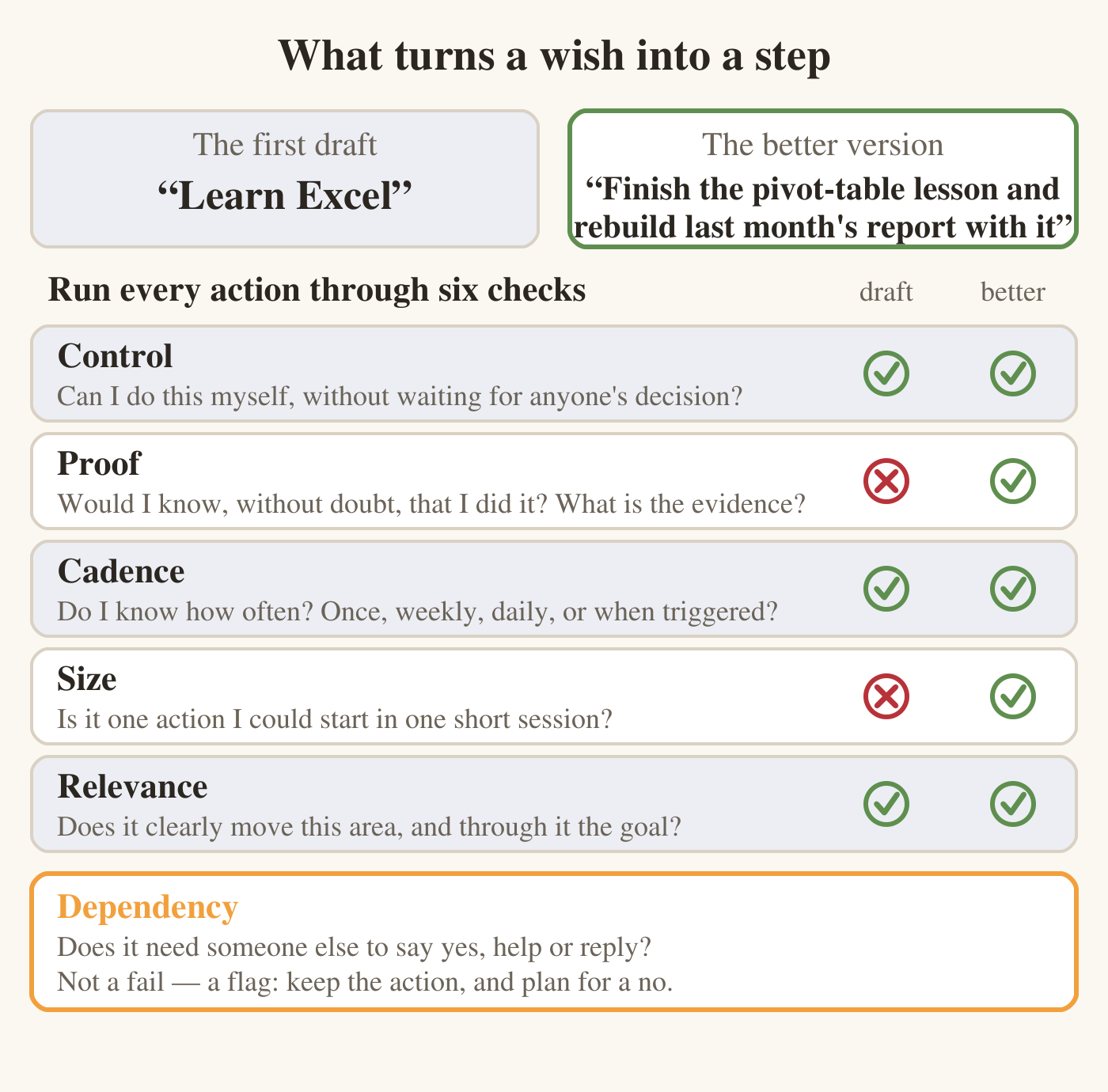
Run each action past six questions. The first five are passes; the sixth is a flag:
- Control. Can I do this myself, without waiting for anyone's decision? If not, rewrite it as the part you do: "get the job" becomes "send the application".
- Proof. Would I know, without doubt, that I did it? Add a finished thing or a count: "read about marketing" becomes "read one chapter and write three notes".
- Cadence. Once, weekly, daily, or when something happens? "Practice scales" becomes "practice scales for 15 minutes, Monday to Friday".
- Size. Could I start it in one short session, or is it a hidden project? "Build a website" becomes "choose a website builder".
- Relevance. Does it clearly move this area, and through it the goal? Busy is not the same as useful.
- Dependency — the flag. Does it need someone else to say yes, help or reply? That is not a reason to drop it. Keep it, make the asking its own action, and plan for a no.
Our workbook prints these six checks with every action block, so the test runs as you write.
Here is what the test does to ordinary first drafts:
| First draft | Fails or flags | Better |
|---|---|---|
| Learn Excel | Size, Proof | Finish the pivot-table lesson and rebuild last month's report with it |
| Be more visible at work | Proof, Control | Share one useful update in the Monday team meeting each week |
| Network | Size, Proof | Send two short catch-up messages to old colleagues every Friday |
| Improve my writing | Proof | Rewrite one old paragraph a day and keep the before and after |
| Get feedback | Dependency flag | Ask two readers for notes by the 15th, and offer them a date |
Notice that the better versions are not longer for the sake of it. They are clearer about what you will do, how you will know, and how often.
Step 4: Start five, not fifty
A full breakdown of a goal can easily reach fifty or sixty possible actions, and that is a good thing — right up until you try to do them. The plan only becomes real when you choose a small active set.
Pick five to eight actions for the first four weeks: the ones the others depend on, plus at least one you can do this week. Keep only three to five repeating actions among them, because recurring commitments crowd a week before it has started. Everything you did not pick is not deleted; it sits on the page, waiting its turn.
If choosing is hard, sort the rest into two piles — the ones first in line for the next review, and the few you most want to reach later. Writing one or two sentences on why these first is worth more than it sounds; in four weeks it tells you whether the reasoning held.
Step 5: Run it for a fixed stretch, then let the evidence rewrite it
Plans go stale, so give the plan a fixed review date rather than relying on remembering.
Our workbook uses twelve weeks as its cycle, with reviews at weeks 4, 8 and 12. At the start of each week you write the plan; at the end you record the evidence — and evidence is kept strict. It is something you could show someone: a finished page, a sent message, a booking, a number. "I thought about it a lot" is not evidence; the gap between what you planned and what left a trace gives each review something concrete to work with.
At each review, go action by action: keep it, make it smaller, mark it done, remove it, replace it, or move one up from the queue. Keep the active set at five to eight so it still fits a week.
A review can also say something bigger: that a whole area no longer fits, or that the goal itself has changed. That is information rather than failure, and it is the reason to write the plan in pencil.
How to break down a goal into steps: one example, end to end
Take a language exam — one of the four worked examples in our workbook. Everything below is an illustration from the book, not a result anyone achieved.
- Outcome: pass a B1-level Spanish exam within twelve months. The proof is a results letter from a public exam aligned to the CEFR, which a stranger could check. "Get better at Spanish" could not be checked by anyone.
- Eight areas: a daily study habit, listening, speaking with people, reading and writing, a vocabulary system, grammar, exam readiness, and a study environment. The area layer is what widens the plan beyond a single subject, study tool or routine.
- Actions, tested: "learn Spanish grammar" fails Size, Proof and Cadence, and becomes "study one grammar point each week". "Speak more Spanish" fails Proof and Cadence, and becomes "record a two-minute voice note daily". "Go to a language school abroad" fails Size and Control, and becomes "join one local Spanish meetup each month".
- Start six, not sixty-four: the daily twenty minutes, the fallback lesson for busy days, choosing the exam and noting its dates, a full practice test to find the real level, one online tutor session a week, and ten minutes of flashcards. The other fifty-eight actions are not abandoned; they are queued.
- Evidence: days studied, a practice-test result, voice notes recorded, tutor sessions held, the exam booking.
- The illustrative week-4 review: in the book's example, study appears on 21 of 28 days, helped mostly by the five-minute fallback lesson. The plan's central assumption also changes: it began with grammar as the weakest area, and the illustrative practice test points to listening instead. So the commute podcast moves up into the active set, flashcards shrink, and a new action makes sure new words actually get used.
The goal did not change at week four. The plan did. That is the advantage of treating a plan as something you review, rather than a list you write once.
The workbook that does this on one page
The core of the breakdown — the goal, its areas and their actions — fits on a single sheet, which is the point of the layout we build around: a grid of nine blocks of nine squares, with the goal in the middle, up to eight areas around it, and each area's actions out at the edges. Our 9x9 grid for goal setting article shows the blank layout and where everything goes, and the Ohtani goal chart and its history covers Shohei Ohtani's school goal chart and where the layout came from. The testing, the weekly evidence and the reviews are what will not fit on one page.
We wrote 9x9 Grid for Goal Setting because the layout on its own is not the hard part. It is a 130-page write-in workbook that takes one goal through every step on this page: four short chapters on choosing the goal, finding the eight areas and testing the actions; the full six-check quality test with twenty first drafts rewritten; four complete worked examples, including the Spanish exam above; a guided build of your own grid with a roomy page for each area; twelve weeks of plan-and-evidence spreads with reviews at weeks 4, 8 and 12; and a repair clinic for eight ways a grid can stall.
If what you need is the year around the goal rather than the goal itself, The Life I'm Building is the planner version: a 9-grid map at the front, then fifty-three weeks to run it through.
Frequently asked questions
How many steps should a goal be broken into?
A full breakdown can reach fifty or sixty possible actions across eight areas, but you should be working on only five to eight at one time. The longer set gives you options and helps you see more of what the goal may depend on; the short active set is what you actually work on.
What is the difference between a goal, an area and an action?
A goal is the result you want. An area is something the goal depends on — a skill, a habit, the people involved, the system that carries it. An action is a single thing you could start in one sitting and would know you had done. The middle layer is there to stop you jumping straight from one big outcome to an unsorted list of tasks.
How do I break down a goal that depends on other people?
Separate the asking from the waiting. You cannot control whether someone says yes, but you can control sending the message, offering a date, and preparing a plan for a no. In the test above, a dependency is a flag rather than a failure: keep the action, add the ask as its own step, and decide in advance what happens if the answer never comes.
What if I can't think of eight areas?
First check whether the goal is still a direction rather than a result. Sharpening the outcome can make the supporting areas easier to see. If it is already clear and you reach six honest areas while the last two would only be padding, leave them empty — an empty square is a question to come back to, not a gap to fill.
How often should I review the steps?
Our workbook uses a four-week review rhythm, with a weekly look at what actually produced evidence. Fixed reviews give you regular points at which to keep, shrink, replace or retire an action, instead of rewriting the plan every day.