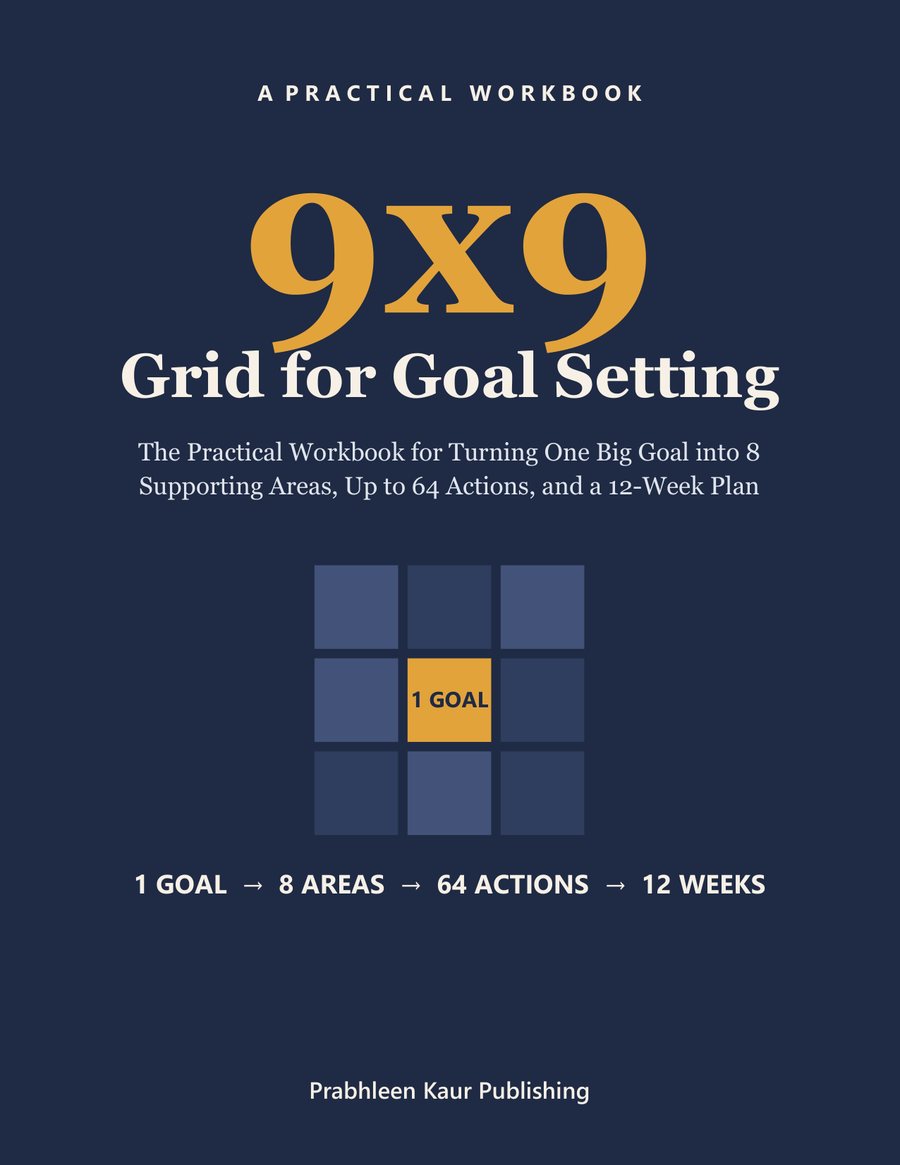
Who this 9x9 grid goal setting workbook is for
Have one goal that you keep rewriting, and that still has no clear first step? This write-in 9x9 grid goal setting workbook is for any adult working on one goal over the next three to twelve months: a career move, a small business, a skill, a creative project or a home project. You need no experience with goal grids, and nothing beyond a pencil.
As the book's own first page puts it, writing it down was never the hard part. It is the goal you have carried around for a while — on a list in January, in the front of a planner, on the back of an envelope. This book is about what comes next: seeing what the goal depends on, turning those areas into concrete actions, choosing which of them come first, and reviewing the plan over twelve weeks as the evidence comes in.
What's inside
- Four short teaching chapters. What the grid does and what it is not; how to choose a goal you could prove you had finished; how to find up to eight areas that genuinely support the goal; and how to turn those areas into actions specific enough to schedule, track and review. Each chapter ends with something to try.
- The 64-Action Quality Test. Six checks for every action — Control, Proof, Cadence, Size and Relevance, which an action should pass, plus a Dependency flag for anything that needs someone else to say yes. Each check has a question and a simple fix, and twenty first drafts are rewritten in front of you ("Learn Excel" becomes "finish the pivot-table lesson and rebuild last month's report with it").
- Four fully worked examples, six pages each, from four different kinds of goal: a career move, a small business, a language exam and a finished novel. Each one shows the filled 9x9 overview, two action blocks at full size, four first drafts put through the quality test, the Now/Next/Later choice and an illustrative week-4 review.
- A guided build of your own first grid. A goal page, a brainstorm, the Area Check, the 9x9 overview, then eight roomy action pages — one per area, up to eight actions each, with a small row of boxes for the six checks beside every action — and a Now/Next/Later chooser.
- Twelve weeks of plan-and-evidence pages. Every week is a facing spread: a plan page with one priority, your active actions and a day-by-day row, and an evidence page for what actually happened, the obstacle you met and the best moment of the week. Reviews come at weeks 4, 8 and 12, each over two pages, and week 12 ends by building grid version 2.
- The Grid Repair Clinic. Eight named ways a grid stalls — overlapping areas, not being able to think of eight, every action a habit, actions that wait on other people, a grid that looks good while nothing gets done, a goal that changed halfway, sixty-four actions that feel unmanageable, and simply not looking at it any more — each with its symptom, why it happens, the fix and a before-and-after.
- Libraries to borrow from. An Area Library with starting sets of eight for ten common kinds of goal, and an Action Library of ninety-six example action starters, twelve for each kind of area.
- Two spare grid packs at the back: one for version 2 of the same goal, one for a second goal.
How to use it
- Read chapters 1 to 4 first. They take about an hour, and they are what makes the rest of the book worth filling in.
- Use a pencil. A grid is a draft. You will change it, and that is the point.
- One goal at a time. If you have three, choose the one that matters most for the next twelve weeks. Grid pack 3 at the back is there for a later goal.
- Choose five to eight actions for NOW, not sixty-four. Everything else stays on the grid, waiting for a review. Keep only three to five repeating actions active at once.
- Fill the evidence page at the end of each week. Evidence is anything you could show someone: a finished page, a sent message, a booking, a number.
- Let the reviews rewrite the plan. At weeks 4, 8 and 12 you decide, action by action: keep, make smaller, done, remove, replace, or move one up from the queue.
New to the layout? Our article on the 9x9 grid for goal setting shows the blank grid and where everything goes, and how to break down a goal into steps walks through the whole method on one example.
How it compares
The 9x9 goal grid appears in discussions of planning methods, but an empty grid alone offers little guidance on what to do next. This workbook combines the explanation with guided practice. It teaches the grid in four short chapters, shows it filled in for four different kinds of goal, and introduces six checks to use before committing to an action. Then it keeps going where a blank grid stops: twelve weeks of plan-and-evidence spreads, reviews at weeks 4, 8 and 12, and a repair clinic for eight ways a grid stalls.
Frequently asked questions
Do I have to fill in all 64 squares?
No. Sixty-four is room to think, not a quota, and the book is explicit that you will never work on all of them at once. You choose five to eight actions to start with, and the rest wait on the page for a review.
Is this the Harada Method or a Mandala Chart?
No. This is an independent workbook and is not affiliated with, sponsored by or endorsed by the owners of those methods. Chapter 1 tells the published history of the 81-square layout honestly — Yasuo Matsumura's Mandala Chart® (1979), Hiroaki Imaizumi's Mandal-Art (1987), Takashi Harada's Open Window 64, and the school sheet Shohei Ohtani filled in, with both published accounts of who taught it to him — and then the book simply calls the shape a 9x9 goal grid. The Quality Test, the twelve-week structure, the review pages, the Repair Clinic and the worked examples are original to this workbook.
Is it a planner?
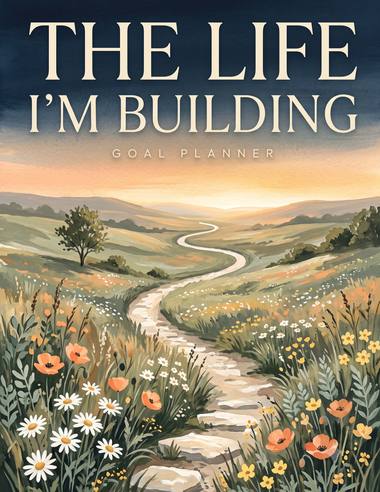
No, and the difference matters. This workbook designs one goal: what it depends on, what the actions are, and which come first. Our goal planner, The Life I'm Building, gives you a full year of weekly planning pages. The two books do different jobs, and can be used separately or together.
How long does the twelve-week part take?
Twelve weeks from whenever you start — the pages are undated, so there is no wrong week to begin. Each week has a plan page at the beginning and an evidence page at the end; how long you spend on them is up to you.
What if my goal changes halfway through?
That is one of the eight entries in the Grid Repair Clinic, and the book treats it as information rather than failure. The week-12 pages are built around making version 2: the same goal or a sharper one, the areas that earned their place, and the actions that produced the most evidence.
Is there enough room to write?
The book is 8.5 x 11 inches, and each of the eight supporting areas gets a full action page rather than only the small overview square. Each action page has room for up to eight actions, with the row of six check boxes beside each one. The overview grid is there to see the whole plan at once; the action pages are where you actually write.
Does it promise results?
No. The book says so in plain words on its own first page: it is a practical workbook for planning and reflection, not professional, medical, legal or financial advice, and it cannot promise any particular outcome. It is designed to support clear planning, deliberate action and reflection on what happens.
How big is the book?
8.5 x 11 inches, 130 pages, printed in black ink on white paper with a matte cover.
See it on Amazon