
There is a particular kind of goal that lives in your head for years. You say it at New Year, you say it again on your birthday, and it never gets any closer, because it was never broken into anything you could do on a Tuesday. A 9x9 grid for goal setting is a one-page answer to that: 81 squares that turn one large wish into 64 small, specific actions.
The short answer: Put your main goal in the center square. Write eight supporting goals in the eight squares around it. Copy each supporting goal into the middle of the matching outer block, then use the eight squares around it for concrete actions. In this how-to, that gives you one main goal, eight supports and 64 action slots on a single page.
The blank 9x9 grid
Here is the layout. Save the image, or draw it yourself: a large square divided into nine blocks, each block divided into nine squares.
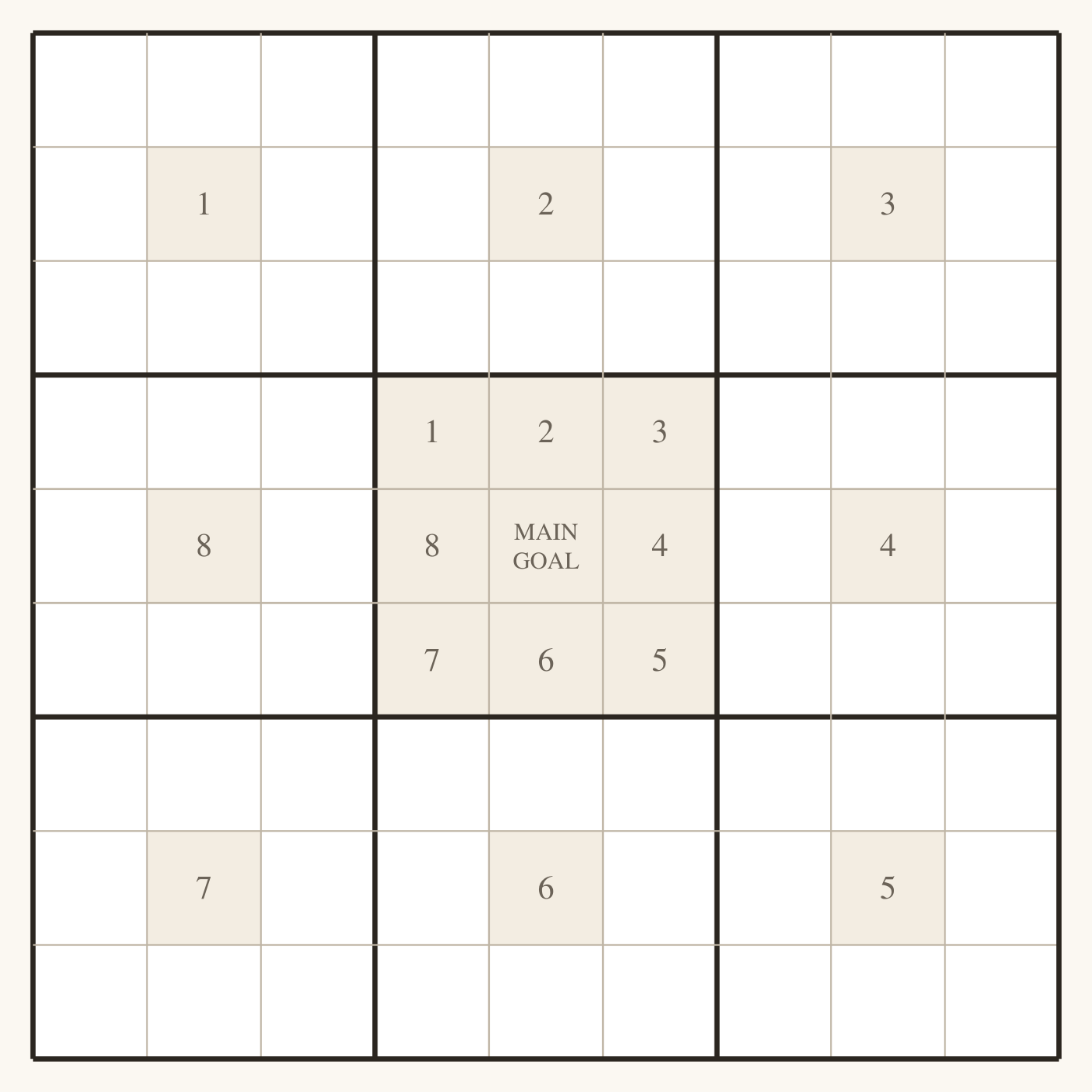
The shaded squares are the skeleton of the chart. Everything white is for actions. If you print it, use a whole sheet of letter paper so each square is big enough for a few words in pencil.
How the 81 squares are laid out
The grid works because every number appears twice.
- The center square holds your main goal. There is only one.
- The eight squares around it, numbered 1 to 8 here, hold your supporting goals: the areas or sub-goals that would most help the main goal happen.
- Each outer block takes one supporting goal into its own center square, in the same position. Support 1 sits top left in the middle block, so it moves to the center of the top-left block. Support 4 sits to the right of the main goal, so it moves to the block on the right.
- The eight white squares around each copied support hold its actions. Eight blocks of eight gives you 64.
Read from the middle outward, the page goes from why to what to what I'll do this week.
How to fill in a 9x9 grid for goal setting
Set aside one quiet sitting for a first pass. Fill it in this order, but do not force all 64 action squares at once; it is fine to leave blanks and return to them.
Step 1: Write one main goal you could prove
Write it so that a stranger could check whether you did it. "Get fit" can't be checked. "Run 5 km without stopping by September 30" can. If you are torn between two goals, pick one; the other can have its own sheet later. If you can't find the goal at all, a wheel of life assessment is a good place to start.
Step 2: Choose eight supports, not eight skills
Ask: which eight areas would most help this goal happen? Skills are only part of the answer. A useful starting set is skill, body, money, mindset, habits, people, tools or place, and rest. Cross out any that don't fit your goal and replace them; merge any two that are really the same thing. The workbook gives each of the eight areas a full page of its own, with the six checks beside every action.
Step 3: Turn every support into eight concrete actions
For this practical version of the grid, use the outer squares for behaviors you can actually do, not vague outcomes. Aim for actions small enough to start in one short session. "Walk 15 minutes after dinner" is an action. "Be fit" is a result. If an action still feels too large, break it into a smaller first step.
Step 4: Tick, repeat, and look at it every week
Tick a square the first time you do it. Some actions are one-offs; others are worth repeating all year. Then keep the page where you will see it every week: in a planner, on a wall, or folded inside the cover of the notebook you already use.
A worked example: opening a small online shop
Say the main goal is open a small online shop by March 31, and one of the eight supports is learn product photos. That support goes in the middle of its outer block, and its eight actions might be:
- Watch one 10-minute lighting video
- Photograph one product from five angles
- Edit one photo start to finish
- Copy the style of a shop you admire
- Clear and light the table top
- Ask one person which photo is better
- Write down your three camera settings
- Reshoot last week's worst photo
Each item is concrete enough to act on without having to rethink the whole goal. That is the point: the grid turns a large goal into visible next steps.
Four mistakes that leave a grid half empty
- Two goals in the center. The center square holds one goal. A second goal splits every support in two, and the outer blocks fill with half-actions for both.
- Results where actions should be. "Lose 10 pounds" in an outer square is a second goal, not an action. Ask what you would actually do this week, and write that.
- Trying to fill all 64 in one go. It is fine to leave squares empty for a few days. A blank square you come back to is better than a filler you will never do.
- Filing it away. A carefully filled grid stops helping once you stop seeing it. Keep it somewhere you will revisit during your weekly planning.
Where the 9x9 grid came from
Yasuo Matsumura developed the Mandala Chart® method in 1979; its expanded B-type uses a 9x9, 81-cell arrangement (Mandala Chart Association). Takashi Harada, a former junior-high teacher in Osaka, later devised Open Window 64 (OW64) as one tool in his Harada Method (President Online). Shohei Ohtani wrote a filled-in 9x9 goal sheet as a first-year high-school student; the story of the Ohtani 9x9 grid, including the competing accounts of how he learned it and the goal that didn't come true, is told in full on its own page.
Mandala Chart® is a registered trademark of the Mandala Chart Association.
From one sheet to a plan you can run
A single sheet is the right size for seeing the whole goal at once. It is the wrong size for writing the actions out properly, testing them, choosing which five come first, and reviewing them over the weeks that follow.
That is what we built 9x9 Grid for Goal Setting to do: a 130-page write-in workbook built around this exact layout. It gives each of the eight supports a full page rather than a small square, puts every action through six checks, then turns the grid into twelve weeks of plan-and-evidence pages with reviews at weeks 4, 8 and 12. Four worked examples show finished grids first, and a repair clinic covers the eight ways a grid usually stalls. Our guide to breaking a goal down into steps walks through the same method on one example.
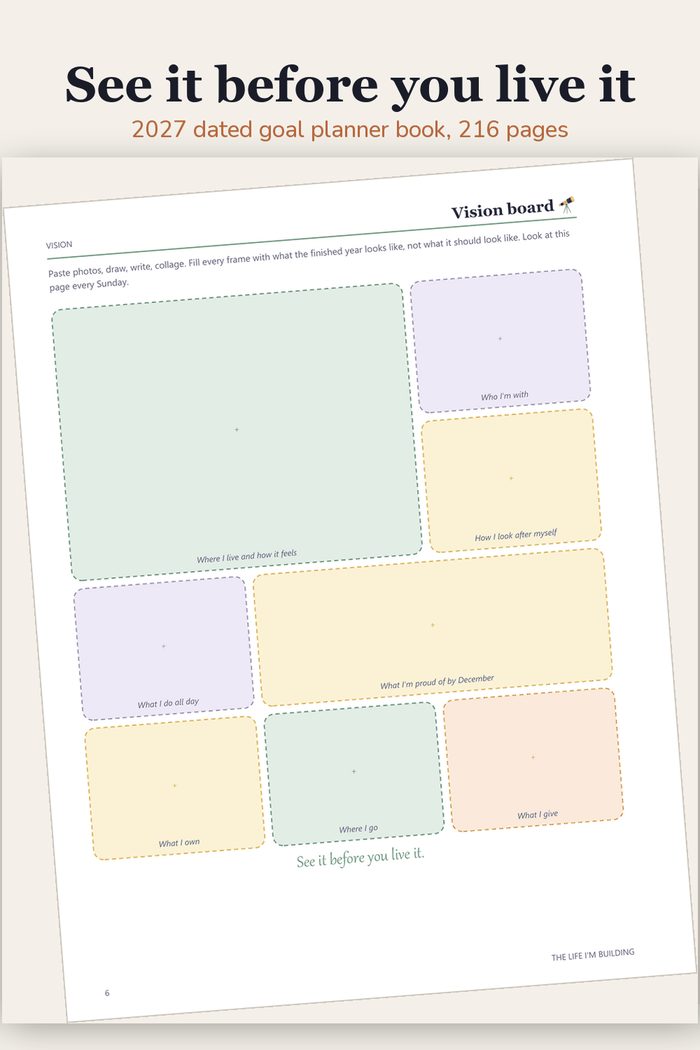
If it is the whole year you want to plan around the goal, rather than the goal itself, The Life I'm Building is the planner version. Its 9-grid goal map is spread over four pages, and each of the eight supports then gets its own goal ladder: quarter milestones, monthly mini-goals, a weekly habit and a daily ten-minute action. The 2027 edition runs 53 dated weeks; if you would rather start on any Monday, there is an undated edition too.
Frequently asked questions
How long does it take to fill in a 9x9 grid?
There is no fixed time. You can draft the main goal and eight supports in one sitting, then fill the action squares as ideas become clear. It is normal to leave a few squares empty and come back to them over the next week.
Do I have to fill all 64 squares?
No. The 64 squares are room to think, not a test. Fill the ones you can, and treat an empty square as a question to come back to.
What is the difference between a 9x9 grid and a mandala chart?
They overlap substantially rather than being completely different systems. Yasuo Matsumura developed Mandala Chart® in 1979 as a 3x3 thinking framework, and its expanded B-type uses 81 cells to move from a central theme or goal to eight related elements and then smaller goals or actions. Takashi Harada's Open Window 64 is a separate tool within the Harada Method that also uses an 81-cell structure for goal setting.
Can I use a 9x9 grid for work or school goals?
Yes. The grid can be adapted to many work, school and personal goals that can be stated clearly enough to check progress, from a sales target to an exam plan or a first marathon.