
In 1559 the Flemish painter Pieter Bruegel the Elder finished a painting on an oak panel that people have been squinting at ever since. At first glance it is a crowded village: roofs, walls, doorways and dozens of busy people. Look longer and the village starts to misbehave. A man is banging his head against a brick wall. Another is filling in the well after the calf has drowned. Someone is throwing roses before swine. The painting, now in the Gemäldegalerie in Berlin and known as Netherlandish Proverbs, holds at least 100 identifiable proverbs and sayings, and none of them is labeled. It simply teases the viewer into looking. That, more than any rule, is what seek and find for adults is about: the old pleasure of looking slowly until a busy picture gives up its secrets.
The short answer: A seek and find puzzle hides a list of things in one detailed picture. A useful way to search is not to stare harder but to change how you look: search for shape and color instead of the word, think about where the thing would naturally sit, sweep the picture in bands, and look for part of an object rather than the whole.
A painting you read like a puzzle
Bruegel did it again a year later. His Children's Games of 1560, which hangs in the Kunsthistorisches Museum in Vienna, fills a town square with small figures at play, and scholars have identified more than 80 different games in it: hoops, stilts, leapfrog, blind man's buff and many more. Nobody hands you a list; the reward is the small jolt when a cluster of shapes suddenly becomes a game you played yourself.
Those paintings were not made as puzzles, and nobody knows exactly how Bruegel's first viewers used them. But anyone who has stood in front of one knows the feeling, and it is the same feeling a good hidden-object page gives: the picture is full, the thing is in there somewhere, and it is entirely up to you to see it.
Why seek and find for adults is harder than it looks
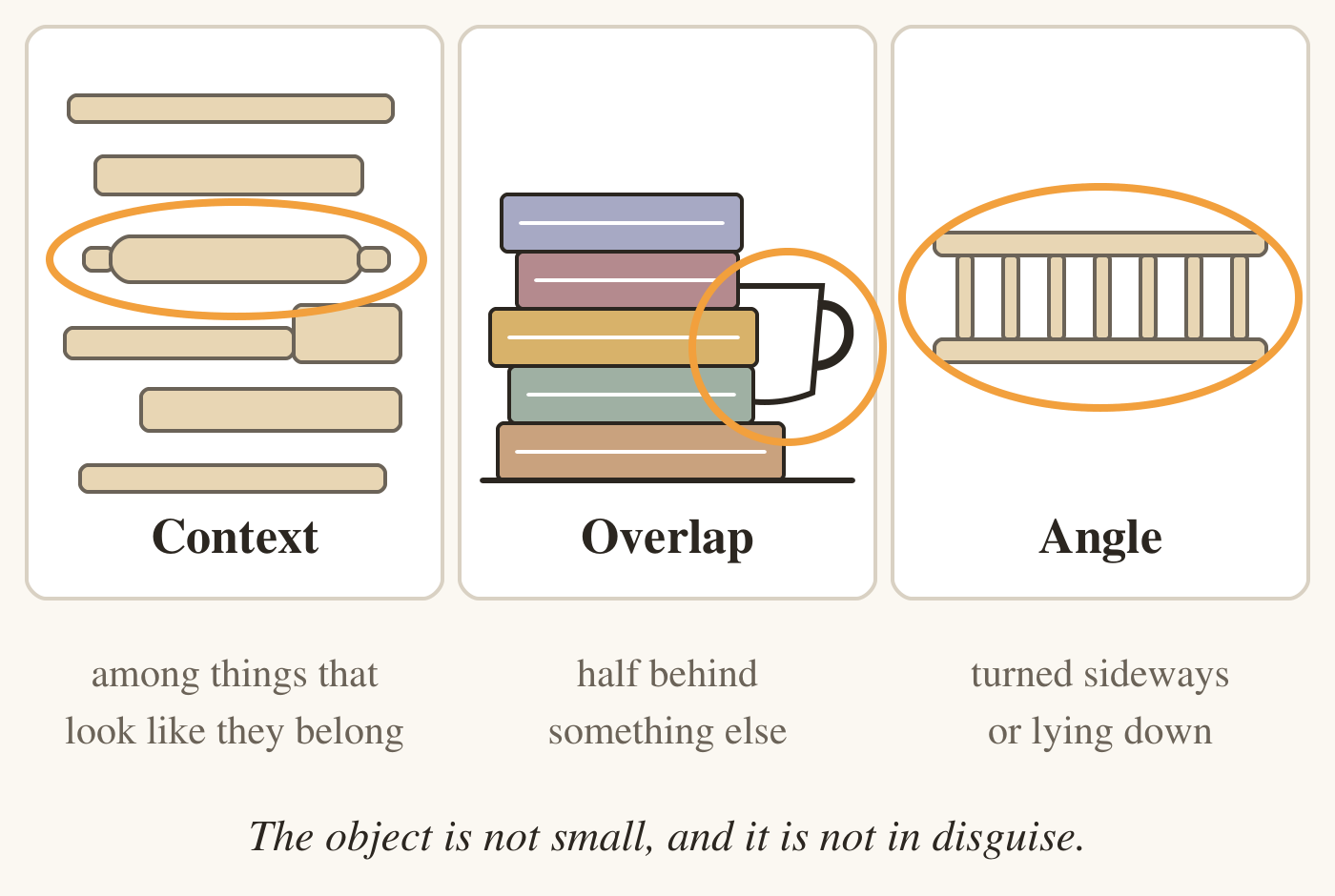
A seek and find puzzle can make something hard to spot without making it microscopic. A rolling pin can disappear into a bakery among a dozen other long, pale, wooden things. A teacup can sit half behind a stack of books. A watering can can turn sideways. The object is not small, and it is not in disguise. The challenge comes from context, overlap and angle: it is surrounded by things that look like they belong, because they do.
That is why "look harder" is poor advice. What helps is changing how you look.
Eight habits for finding what hides
1. Search for a shape, not a word
When you read "umbrella," your mind pictures the umbrella you know: open, dark, with a curved handle. The one in the picture may be closed, red and leaning in a corner. Before you start, spend a few seconds on the shape and color of the thing you are after. If your puzzle shows a small picture of each object, look at that picture, not the name underneath it.
2. Let color do the first pass
Color can be a useful first pass. If the target is a blue jug in a shop full of brown wood, sweep the whole picture looking only for that blue. Ignore everything else. You will usually land on a few candidates, and one of them is the jug.
3. Ask where it would live
A rolling pin lives on a counter, not a ceiling. Gloves lie near tools. A kettle sits near a stove. When a scene uses plausible hiding places, think like the shopkeeper before you think like a searcher. Start where the thing belongs, and widen the circle from there.
4. Look for part of it
Many objects are tucked, not missing. Look for the handle of the teacup, the tip of the umbrella, the corner of the seed packet sticking out from behind a pot. Once you have decided that you are searching for a piece rather than the whole, a lot of "impossible" objects appear.
5. Turn it in your mind
We tend to picture things upright. A ladder may be lying down. A broom may be hanging head-first on a hook. If the upright search fails, imagine the object tilted, on its side, or seen from above.
6. Sweep in bands
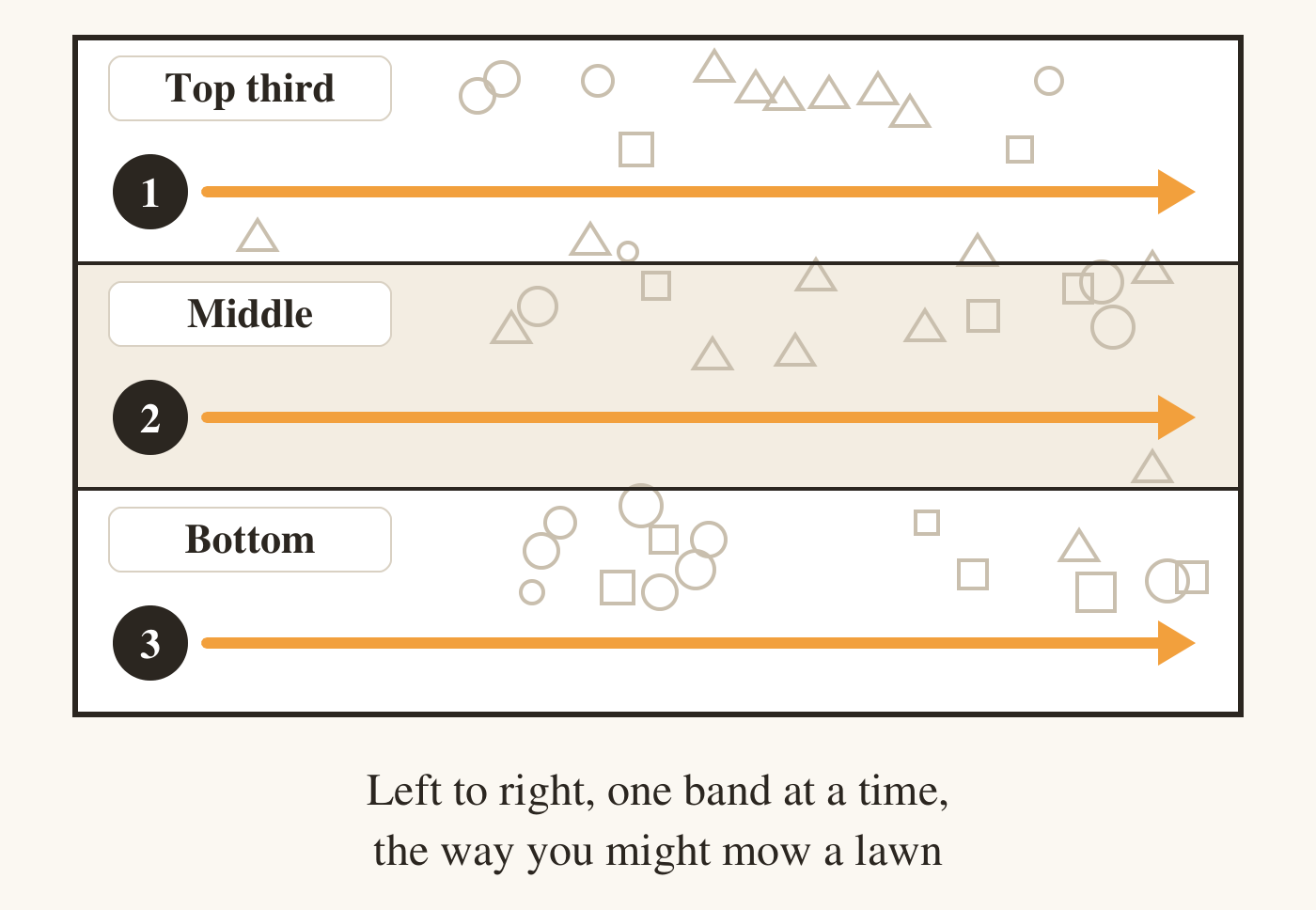
Eyes love to jump to the interesting bits of a picture and skip the rest. To stop that, cover the picture in strips: left to right along the top third, then the middle, then the bottom, the way you might mow a lawn.
7. Don't forget the big things
It sounds odd, but large objects are easy to miss, because we are braced to hunt for something tiny. A sled leaning against a wall or a quilt hanging on a ladder can hide in plain sight simply because it looks like part of the room. Once in a while, step back and look at the picture as a whole.
8. Rest, then come back
If you have been staring at the same corner for a while, stop. Put the puzzle down, make a cup of tea, and come back later. When you return, start from a different part of the picture. There is no prize for speed. Part of the pleasure of a hidden-object picture is that it waits for you.
What makes a good seek and find page for grown-ups
Choosing a puzzle book, for yourself or as a gift? Those habits suggest what to look for:
- Big, clear pictures. A full page per scene gives the eye room to work.
- A picture of each thing to find, not just a tiny list of words.
- Objects that belong in the scene, so the search rewards thinking as well as looking.
- Honest difficulty. Harder should mean busier or more tucked away, not microscopic.
- Answer keys that show the real picture, so when you check, you see exactly where the thing was.
- Large print for the words, so the puzzle is about the picture, not the reading.
That is the layout Cozy Main Street Seek & Find uses: a picture card for each object on the left-hand page, the whole scene on the right.
If word puzzles are more your thing, the same big-print thinking runs through our look at the cozy mystery word search.
A year of pictures to look at slowly
We built Cozy Main Street Seek & Find around exactly that list. It has 48 full-color scenes of one small, fictional town called Mapleberry, 12 for each season: tulips at the florist and rain on the bookshop glass in spring, the fair and the fruit stand in summer, the quilt shop and the pie bakery in autumn, the toy-shop window and the tree farm in winter.
Each puzzle is two pages. On the left are picture cards of everything to find, each one cut from the scene itself, so it looks exactly as it does in the picture; on the right, the scene has a whole page to itself. Easy puzzles have 8 objects, Medium 10 and Tricky 12, which adds up to 472 things to find, and each one belongs where it sits: a watering can and a seed packet at the florist, a pincushion and a button jar at the quilt shop. Every word in the book is 16-point type or larger, and the answer keys at the back show each scene with every find circled and numbered.
The welcome page says it best: there is no clock and no score. The pleasure is in looking.
Sources
- Bruegel's Netherlandish Proverbs (1559; Gemäldegalerie, Berlin; the museum counts 100 proverbs, Wikipedia lists about 126): Netherlandish Proverbs, Wikipedia; the museum's catalog entry, Staatliche Museen zu Berlin.
- Bruegel's Children's Games (1560; Kunsthistorisches Museum, Vienna; the museum counts 83 games, Wikipedia over 90): Children's Games (Bruegel)), Wikipedia; the museum's collection entry, Kunsthistorisches Museum.
Frequently asked questions about seek and find for adults
What is a seek and find puzzle?
A detailed picture with a list of things hidden somewhere inside it. You search the picture, find each object and tick it off. Some books list the objects as words; others, like ours, show a small picture of each one.
Are seek and find puzzles only for kids?
No. Seek and find books are also made for adults, and their styles and difficulty vary. Cozy Main Street Seek & Find uses detailed full-page scenes, picture cards for the objects, and type set at 16 point or larger. It suits anyone who enjoys a quiet picture puzzle.
How do you get better at hidden object puzzles?
Search for the object's shape and color rather than its name, start where it would naturally sit, look for part of it rather than the whole, sweep the picture in bands, and take a break when you get stuck.
What is the difference between seek and find and spot the difference?
In spot the difference you compare two nearly identical pictures and look for what has changed. In seek and find there is one picture and a list of things to locate inside it.
Is a seek and find book a good gift for an older adult?
It can be, especially one with large, clear pictures, a picture of each object, and large print. Our Cozy Main Street Seek & Find sets every word at 16 point or larger and gives every scene its own page.