
Two cats are asleep on one armchair and a third is arriving, so you reach for your phone to settle a small question: what is a group of cats called? Search it and you quickly meet a whole litter of answers. A clowder. A clutter. A glaring. A pounce. A nuisance. A destruction, apparently, if they are wild. Which of those can actually be traced? We went and looked: first at the 1486 book that sits behind many famous animal-group names, and then at a modern dictionary, to see which of these words anybody really wrote down.
The short answer: A group of cats is a clowder. Merriam-Webster gives clowder its own entry and defines it as "a group of cats." A group of kittens born together is a litter. The other familiar terms — glaring, pounce, clutter, nuisance — are less straightforward: some turn up in other word lists and dictionaries, but Merriam-Webster does not record any of them as a standard word for a group of cats.
What is a group of cats called, according to a dictionary
Start with the word that survives a proper look.
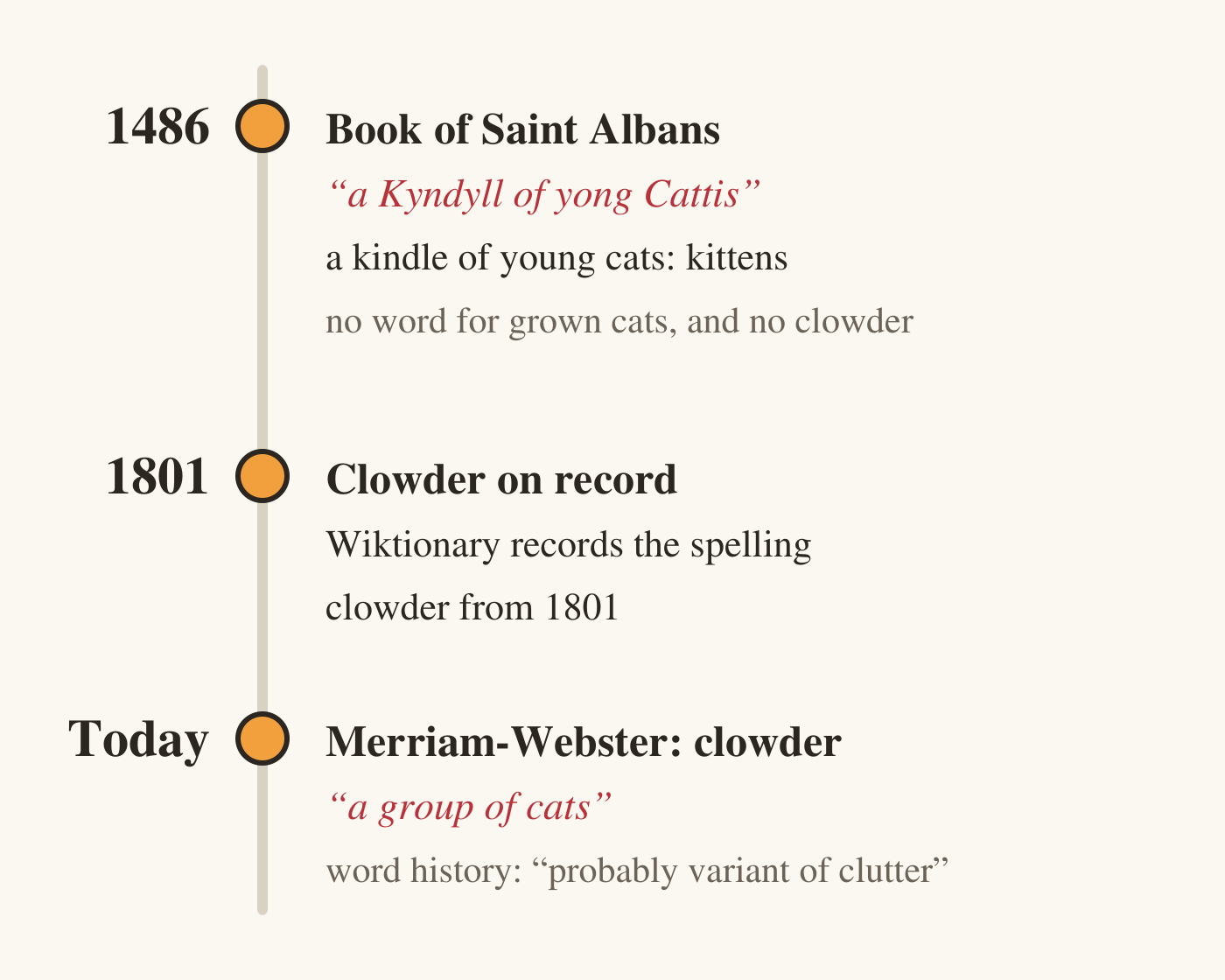
Merriam-Webster gives clowder its own entry, defines it as "a group of cats," and offers one line of word history: it is "probably variant of clutter." Wiktionary records the spelling from 1801, which puts the attested form in the age of Jane Austen rather than the age of falconry, and more than three centuries after the list we are about to open.
That is worth sitting with, because clowder is often presented as an old hunting term, recovered from a lost age of falconry and venery. The source trail points somewhere much plainer: Merriam-Webster takes it back to clutter, the ordinary word for a crowded or confused mass.
The 1486 list behind the tradition
The lists do have a real ancestor. In 1486 a press at St Albans printed a volume of essays on hawking, hunting and heraldry, known ever since as the Book of Saint Albans and attributed to Dame Juliana Berners, though how much of it she wrote rather than compiled is still argued over. Tucked into it is a section headed, in the spelling of the day, "The Compaynys of beestys and fowlys" — a long list of the proper words for groups of things.
It is one of the most influential early printed sources for English company terms. Its list includes a pride of lions, a sleuth of bears and a gaggle of geese. It is also where the joke lives: a clattering of choughs and an unkindness of ravens sit among the birds, and then, once the animals run out, the list keeps going and starts handing out terms for people, so that a little below the lions you find a superfluity of nuns.
Here is the part the graphics never mention. Scroll that list for cats and you find exactly one entry, sitting between a litter of whelps and a singular of boars:
a Kyndyll of yong Cattis
A kindle of young cats. Kittens. In the whole 1486 list of company terms there is no word at all for a group of grown cats, and clowder does not appear anywhere in it. Wiktionary records clowder from 1801, more than three centuries later.
Checking the rest of the list, one word at a time
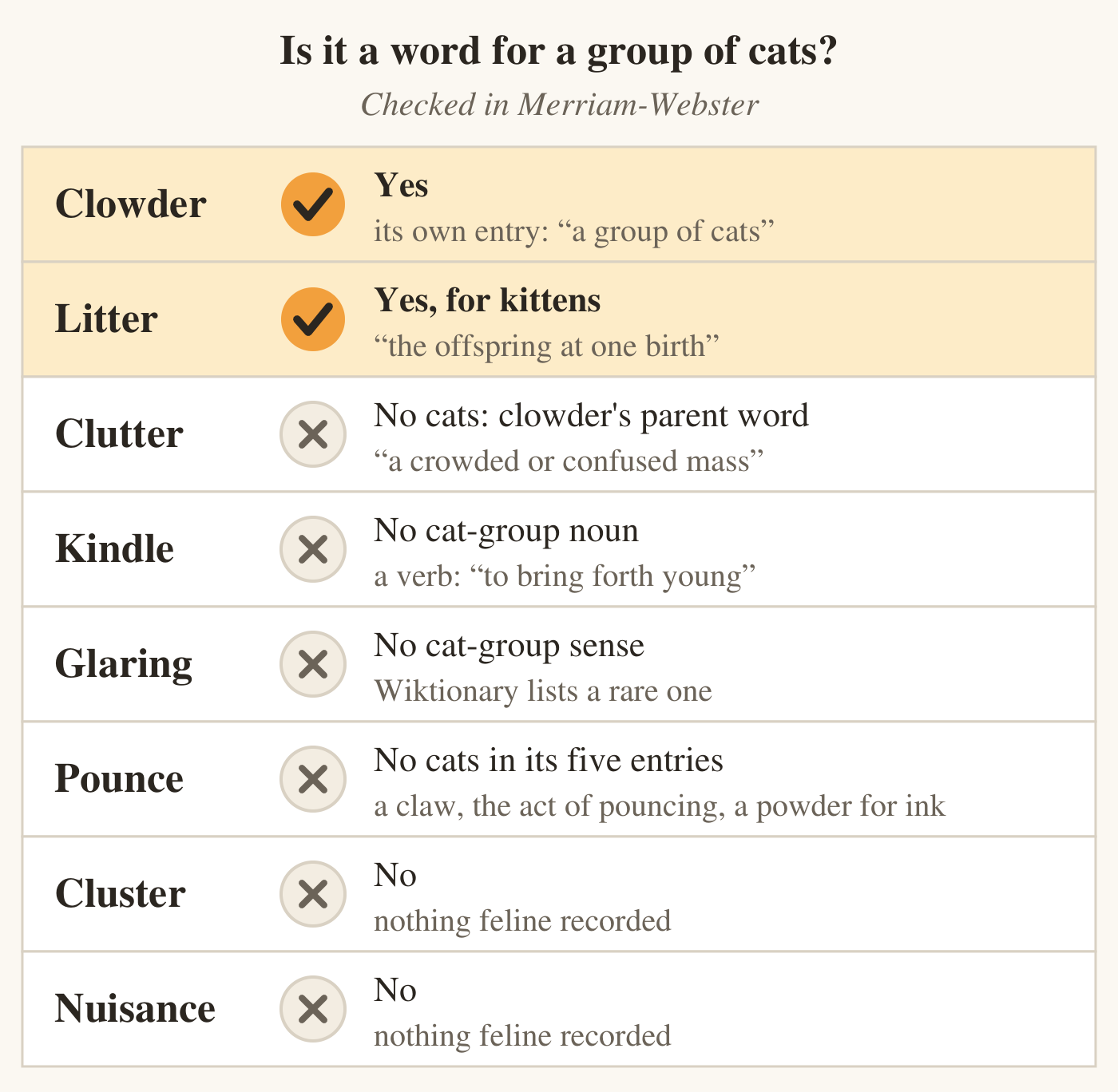
So we looked up each of the popular cat terms in Merriam-Webster and asked a plain question: does this word have an entry, and does that entry say anything about cats?
- Clowder — yes. Its own entry: "a group of cats."
- Litter — yes, for kittens: "the offspring at one birth of a multiparous animal."
- Clutter — entry, but no cats. The noun means "a crowded or confused mass or collection." It is clowder's parent word, not a cat word in its own right.
- Kindle — no cat-group noun. There is a separate verb entry meaning "to bring forth young," used especially of a rabbit, but the 1486 cat word is not recorded there as a modern collective term.
- Glaring — no cat-group sense: the entry covers the adjective (a fixed look of hostility, or an obvious error) and the present participle of glare. Wiktionary, which is more inclusive, does list a rare collective sense, "a group of cats."
- Pounce — five entries, and still no cats. A pounce is the claw of a bird of prey, the act of pouncing, or a fine powder once used to stop ink spreading.
- Cluster and nuisance — ordinary words, with nothing feline recorded in either.
One clear survivor, plus litter for the kittens, and one word that depends on which dictionary you open. That is the honest answer.
Why there are so many words for one thing
None of this makes the other terms fraudulent. They are just a different kind of thing from what they are usually presented as.
The 1486 material is a mixture. The hunting text around the list teaches genuine specialist vocabulary for the chase and for working with hounds, and some of it was real field language. The company list itself then stretches well past the animals into social display and wordplay, which is how abbots, ale-makers and nuns ended up with terms of their own. So it is too simple to call the whole thing either serious field vocabulary or pure invention.
Modern lists add another layer. Writing for Audubon in 2015, Nicholas Lund asked researchers whether they used the elaborate group terms attached to the species they study. A vulture researcher: "No, I have not." A woodcock researcher: "I sure as hell would never say it, nor have I heard it said." That does not make every unusual collective noun false. It is a good reason not to treat a circulating list as an official vocabulary.
A glaring of cats is a lovely phrase, and sources disagree about its standing: Wiktionary lists it as rare, Merriam-Webster does not record it at all. Clowder remains the clearest dictionary answer.
The cat words that people really do use
Here is the cheerful part. The vocabulary cat people actually share is far larger than the collective-noun list, and nearly all of it is solid.
There are the sounds: a purr, a meow, the trill that a cat uses coming round a doorway, the chirp aimed at a bird through glass. There are the behaviors: to knead, to prowl, to stalk, to pounce — the verb is entirely real, whatever the noun is doing. There are the coat and color words you hear in every conversation about cats: tabby, calico, tortie, tuxedo, ginger.
And then there are the breed names: Siberian, Havana, Singapura, Turkish Angora, Turkish Van, Balinese, Somali, Burmese, Siamese, Abyssinian, Chartreux, and the newer coinages — Ragdoll, Snowshoe, Munchkin, Toyger, Nebelung, Ragamuffin. Be careful reading them as geography, though. The Balinese is not from Bali and never was: its breeder thought "long-haired Siamese" too cumbersome and named it for the grace of Balinese dancers.
That is a richer answer to "what do we call cats" than any single noun. The words we really use for cats are the words for how they sound, how they move and how they look, and there are hundreds of them.
Where the cat words become the puzzle
If you like cat words enough to have read this far, they turn out to be very good puzzle material, and we made a book out of exactly that. Large Print Cat Lover's Word Search is built from real cat vocabulary: every breed name listed above is in its word lists, along with purr, trill, chirp, knead, prowl, tabby, calico, tortie and tuxedo.
It has 90 puzzles, one to a page, in three levels: 30 easy 11 x 11 grids, 30 medium 12 x 12 grids, then 30 harder 13 x 13 grids. The grid letters run from about 20.5 point in the hardest section to 24.3 point in the easiest, the word lists are 16 point, and the answers at the back are 16 to 18 point.
The twist is the hidden message. When every word in a puzzle is circled, the leftover letters spell a short line about life with a cat. The first one reads: "Some homes are simply waiting for a cat to arrive." Read in order, the ninety lines become one quiet keepsake — "First comes a slow stretch, then a wide yawn," "A sunbeam is just a bed the cat has not claimed yet," "The window is a whole wide story to a curious cat," "A warm cat on the lap makes the world wait a while" — and the whole thing is gathered on five pages at the back of the book to read straight through.
Sources
- The 1486 list, read in facsimile: The boke of Saint Albans, William Blades's reprint of the 1486 St Albans edition, Internet Archive. The cat entry appears in "The Compaynys of beestys and fowlys."
- The book itself: Book of Saint Albans, Wikipedia.
- Dictionary entries: clowder, litter, clutter, kindle, glaring, pounce, Merriam-Webster.
- The 1801 dating, and the rare collective sense of glaring: clowder, glaring, Wiktionary.
- Researchers on whether they use these terms: Nicholas Lund, "No, It's Not Actually a Murder of Crows", Audubon, 2015.
- The modern lists and the doubts about them: List of English terms of venery, by animal, Wikipedia.
- How the Balinese got its name: Balinese cat, Wikipedia.
- Colonies of outdoor cats: Feral cat, Wikipedia.
Frequently asked questions about what a group of cats is called
What is a group of cats called?
A clowder. It is the term with its own dictionary entry: Merriam-Webster defines clowder as "a group of cats."
Where does the word clowder come from?
Merriam-Webster calls it "probably variant of clutter," the ordinary word for a crowded or confused mass. Wiktionary records the spelling from 1801, so it is not a medieval hunting term.
What is a group of kittens called?
A litter. The 1486 Book of Saint Albans gives "a Kyndyll of yong Cattis" — a kindle of young cats — and that is the only cat entry in its whole list of company terms.
Is a group of cats really called a glaring?
You will see glaring used that way, and Wiktionary lists it as a rare collective noun for cats. Merriam-Webster does not record that sense at all. Treat it as a rare or playful alternative rather than the standard answer.
Is a group of cats called a pounce?
Not in Merriam-Webster. Its entries for pounce cover the claw of a bird of prey, the act of pouncing, the related verbs, and the old powder used with ink — but not a group of cats.
What do you call a group of feral cats?
A colony. Feral cats commonly live in groups called colonies, usually close to food and shelter, and that is the word used in practice. "A destruction" turns up on novelty lists for wild cats, but it is not the working term for outdoor domestic cats.
Are these cat words in the Large Print Cat Lover's Word Search?
Yes. Every breed named in this article appears in the book's word lists, along with purr, trill, chirp, knead, prowl, tabby, calico and tortie.