
Open an old carol book and you may find "Away in a Manger" printed under a confident little label: "Luther's Cradle Hymn." The story that comes with it is a good one — that the great German reformer Martin Luther wrote this gentle lullaby for his own small son, four centuries ago, and it has been sung at bedsides ever since. Who wrote Away in a Manger is a question with a real, documented answer, and "Martin Luther" is not it.
The short answer: Nobody knows who wrote the words of "Away in a Manger." The earliest known printing is from 1868, in an American church newspaper, with no author named. Sometime in the early 1880s, around Luther's 400th birth anniversary, the carol picked up his name in magazine reprints, with no evidence behind the claim. James R. Murray's popular 1887 songbook repeated that existing claim; he did not start it. The carol is not in any of Luther's own hymn collections, and no German original has ever been found.
Who wrote Away in a Manger? What the early record actually shows
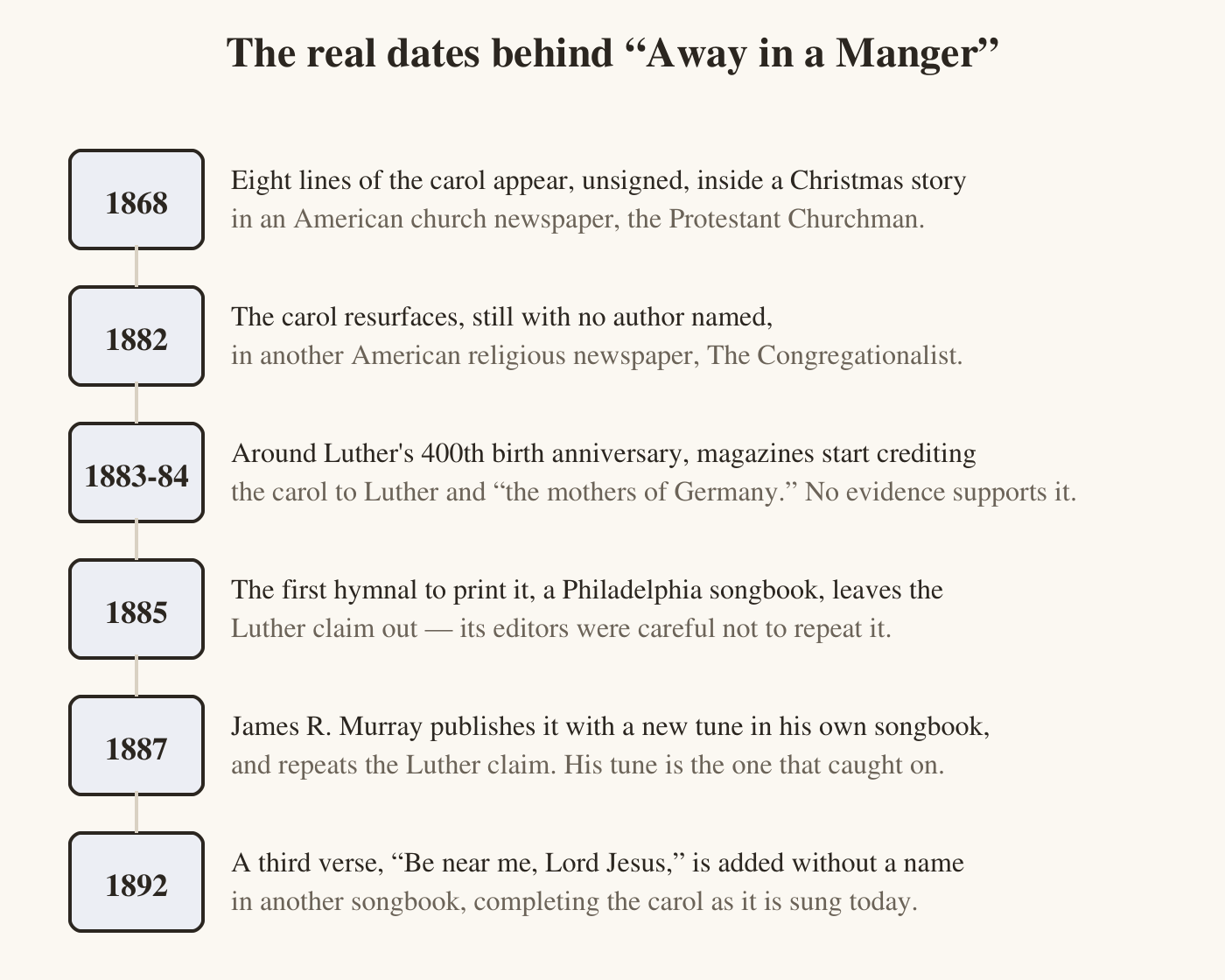
The earliest known appearance of this carol in print is in the Protestant Churchman, an American church newspaper, on 24 December 1868. Eight lines of the carol turn up inside a Christmas story, quoted as though readers might already know them — a sign the verses were already circulating by ear before anyone wrote them down. No author is named, and the lines run in a different order from the version sung today.
The carol then disappears from the known printed record for over a decade, before resurfacing, still unsigned, in January 1882 in another American religious newspaper, The Congregationalist.
Enter Luther
1883 marked four hundred years since Martin Luther's birth, an anniversary that stirred fresh interest in his life and his own hymns. Around this time, the little carol reappeared in American magazines, and somewhere in the retelling it picked up his name. A magazine called The Myrtle credited it to Luther in 1884, and connected it to "the mothers of Germany."
There is no evidence for any of it. The carol does not appear in any of Luther's hymn collections, and it is not known to have existed in German before it showed up in English. It is an American carol, start to finish.
The first hymnbook to print it was a Lutheran one, printed in Philadelphia in 1885 — and its editors were careful not to repeat the Luther story. Others were less careful. In 1887, the songwriter James R. Murray published the carol with a new tune of his own and repeated the claim about Luther and the German mothers. Murray's tune is the one that caught on; it was later mislabeled "Mueller," after a composer who appears to have had nothing to do with it.
Luther did write a Christmas hymn. It just is not this one.
Here is the part of the story that is almost true, which is probably why it stuck. Martin Luther really did write a Christmas hymn for his own household, in Wittenberg, in 1535: "Vom Himmel hoch, da komm ich her," known in English as "From Heaven Above to Earth I Come." It is a real, documented piece of Christmas theater, written for his own children, with one voice taking the part of the announcing angel and the rest of the household answering as the shepherds. Catherine Winkworth translated it into English in 1855. It shares nothing with "Away in a Manger" beyond the season it was written for.
Confusing the two carols is an old and understandable mistake. "Away in a Manger" is shorter and gentler, written for very young children rather than sung as a household drama, which may be part of why it has outlasted the name that was first pinned to it.
One more small correction: the third verse
The familiar third verse, "Be near me, Lord Jesus," is not from the original carol either. It first appears, again without a name attached, in an 1892 songbook compiled by Charles H. Gabriel. A story told decades later credited it to a Methodist official named John T. McFarland, but the verse was already in print years before that story's own timeline begins — so whoever wrote it, the later story does not hold up.
Why a small myth like this is worth clearing up
None of this makes "Away in a Manger" a lesser carol. If anything, the true story is the better one: an anonymous lullaby that passed from a newspaper story to a magazine to a Sunday-school songbook, sung by generations of children who never asked who wrote it, and credited for a while to a famous man who almost certainly had nothing to do with it. Most of the carols sung every December carry a story like this somewhere in their history. Separating what is documented from what is only repeated is most of the work of telling a carol's real history — and it is usually more interesting than the version that goes unchecked.
Twenty-five carols, told the same way
Stories Behind the Christmas Carols tells twenty-five carols' real histories this way, one chapter a day from the first of December to Christmas Day, including a full chapter on "Away in a Manger" and its Luther myth, alongside the documented stories of "Silent Night," "O Holy Night" and "The Holly and the Ivy." Each chapter closes with a short reflection, and sources for every chapter are listed at the back. It is a Kindle eBook, included in Kindle Unlimited.
Sources
- Chris Fenner, "Away in a manger," Hymnology Archive (5 December 2018, revised 28 December 2023): hymnologyarchive.com/away-in-a-manger.
- Martin Luther's 1535 household Christmas hymn "Vom Himmel hoch, da komm ich her" ("From Heaven Above to Earth I Come") and Catherine Winkworth's 1855 English translation: Hymnary.org.
Frequently asked questions
Who wrote Away in a Manger?
Nobody knows. The earliest known printing, from 1868, names no author, and none of the carol's early nineteenth-century appearances do either. The writer has never been identified.
Did Martin Luther write Away in a Manger?
There is no documented evidence that he did. The carol is not in any of his own hymn collections, and no German original has ever been found. Luther did write a different Christmas hymn, "From Heaven Above to Earth I Come," in 1535, for his own household.
Why is it sometimes called "Luther's Cradle Hymn"?
The name was already attached to the carol in American magazines by the mid-1880s, around the four hundredth anniversary of Luther's birth. James R. Murray's popular 1887 songbook repeated that existing claim rather than starting it; it just happened to be the version that caught on.
When was the third verse, "Be near me, Lord Jesus," added?
It first appears without an author's name in an 1892 songbook. A later story crediting it to John T. McFarland does not hold up against the 1892 printing date, so its writer is also unknown.