
It is the first quiet Sunday of January. The kitchen table is covered in magazines, there is a glue stick with its lid off, and the board you bought before Christmas is leaning against the chair. You find a picture of a calm, sunlit kitchen and cut it out. Then you turn the page over and see that the beach you wanted, the one that made you buy that magazine, was printed on the back. By the time the board is finished it says something, but not quite what you meant. By March it is behind a door. If that sounds familiar, this guide is for you: how to make a vision board that says what you mean, and that you are still reading in September.
Why a vision board can end up forgotten by March
A vision board is pictures and words for the year you want, on one board you see every day. That is all it is, and it is a good idea. The trouble is that a board made only of pictures of the finished dream asks nothing of you.
The psychologist Gabriele Oettingen has studied the difference between imagining a desirable future and taking steps toward it. In her book Rethinking Positive Thinking (2014) she describes research suggesting that dwelling only on a positive outcome can reduce the effort people put into reaching it. Her approach, WOOP (Wish, Outcome, Obstacle, Plan), asks people to imagine what they want, name what stands in the way, and make an if-then plan for that obstacle. A vision board is not WOOP, but the same distinction helps: a picture of where you want to be is more useful when you also decide what you will do next.
That changes what a useful board looks like. It still has the pictures, because the pictures are what make you look at it. But it also has dates, a few goals in your own handwriting, and a habit of coming back to it. The seven steps below build all three in.
How to make a vision board, step by step
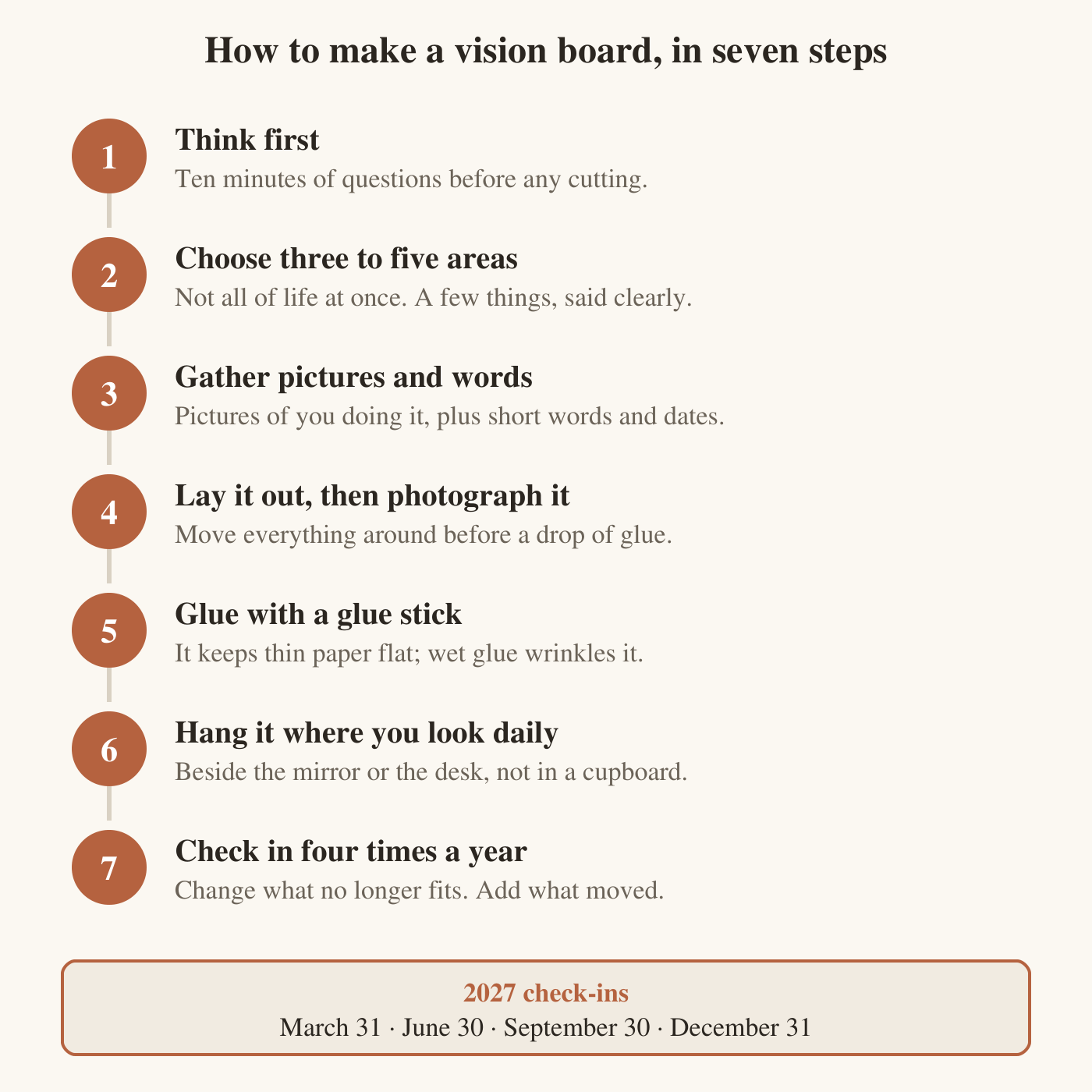
Here is the whole process on one page. Each step has its own section below.
What you need to make a vision board
- A board. Foam board or thick card. 11 x 14 inches is plenty for three areas of your life; 16 x 20 inches suits four or five. Bigger is not better: choose a board you can take in at a glance, with room for the pictures and words that matter most.
- Sharp scissors, and a craft knife and cutting mat if you have them, for clean edges and inside corners.
- A glue stick or double-sided tape. Wet glue soaks thin paper and makes it ripple.
- Pictures and words. Old magazines, your own printed photos, postcards, a vision board clip art book, or a mix.
- A pen and a few blank labels for goals only you can write.
- Your phone, to photograph the layout before you glue.
Step 1: Think before you cut
The single most useful thing you can do is spend ten minutes with a pen before you touch the scissors. Try these questions:
- What do I want 2027 to feel like, in three words?
- What would make me proud by December 31, 2027?
- Which part of my life needs the most care this year?
- What will I stop doing to make room for all of this?
- What does an ordinary Tuesday look like at the end of 2027?
The last one is the most useful. Big moments are easy to picture and rarely change much. An ordinary Tuesday, the time you wake up, who you have coffee with, what you are working on, tells you what the year is really about.
Step 2: Choose three to five areas, not ten
Look at your answers and circle the parts of life they keep returning to: home, work, money, health, rest, the people you love, travel, learning, small joys, a milestone. Then choose three to five. A board that tries to say everything says nothing; you stop seeing it within a week. If you are not sure which areas matter most this year, a wheel of life assessment is a quick way to see where you are.
Step 3: What to put on a vision board
This is where most boards go wrong, and it is mostly about the pictures you choose.
- Choose pictures of doing, not owning. A pair of hands kneading bread says more than a perfect kitchen. Someone lacing running shoes says more than a trophy.
- Prefer pictures you could step into. Shots from your own point of view, a figure seen from behind or far off, hands at work. It is easier to see yourself in a picture when no stranger's face is looking back at you.
- Pick one anchor. One large picture that holds the feeling of the whole year. Everything else on the board sits around it.
- Use short words, not paragraphs. A word of the year (Brave, Simplify, Trust), two or three short phrases, and your goals written in your own hand. Verbs beat slogans.
- Add dates. "By June 2027" next to a goal turns a wish into something you can check.
- Include one real photo. Yourself, your street, your people. It makes the board yours, not a mood board.
A useful test for any picture: if it showed up on your phone in July, would you know why it is on your board? If not, leave it out.
Step 4: Lay it out before you glue
Put the anchor down first, near the middle. Give each of your areas its own small cluster around it: one or two pictures, an object, a few words. Put your goals and their dates where your eye lands after the anchor. Leave gaps. How many pieces fit depends on their size - a 16 x 20 board takes several picture clusters, words and date labels before it crowds. Most people cut far more than they use, and that is fine.
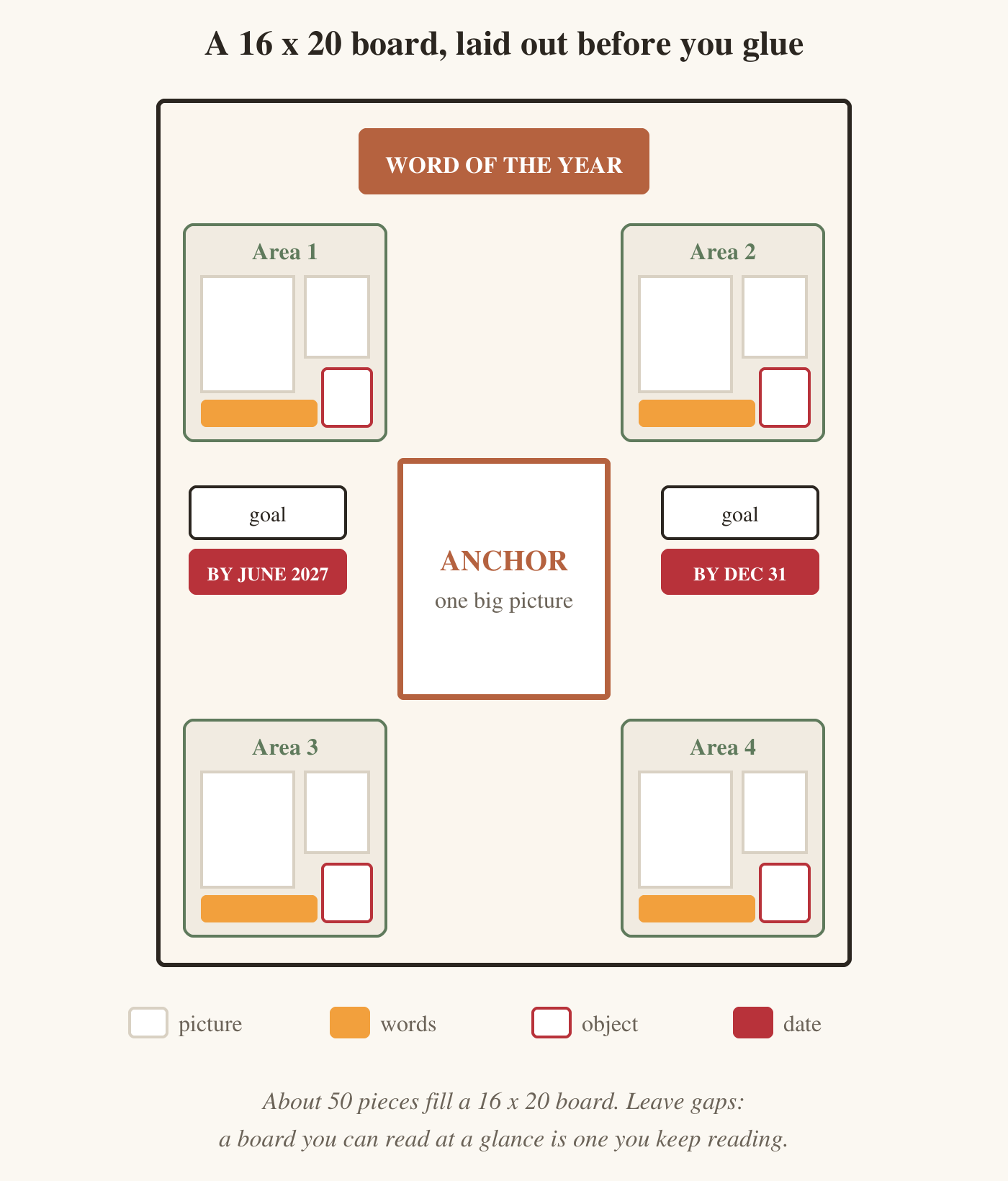
Now move things around for a few minutes. When it feels right, take a photo. You will be glad of it when a piece slides while you glue, and in December when you look back at how the year began.
Step 5: Glue it, then hang it where you look every day
Glue from the middle out, so the anchor is fixed first. Press each piece flat with the side of your hand. Then hang the board somewhere you pass every day: beside the mirror, above the desk, inside the wardrobe door you open each morning. A board in a cupboard is a scrapbook.
The 2027 twist: give the board four dates
The step almost everyone skips is coming back. Put four dates in your phone now: March 31, June 30, September 30 and December 31, 2027. On each one, stand in front of the board and ask three questions. What moved forward? What will I add, change or let go? What is my next step before the next check-in? Then choose one small action and write down when you will do it: even if the board has barely changed, the next step can.
Change the board when your answers change. Swap a picture, add a date, take down a goal that no longer fits. A board that changes with you is a board you are still using. And if you like a date to aim for, National Vision Board Day falls on the second Saturday of January, which in 2027 is January 9.
If a goal on the board feels too big to start, it helps to break it down into steps before the first check-in.
Vision board party ideas
Making boards together is half the fun. A few ideas that keep a vision board party relaxed:
- Start with the questions, not the scissors. Hand everyone the five questions above with a cup of tea and give it fifteen minutes.
- One supply table. Boards, scissors, glue sticks, pens, and plenty of pictures. Ask each guest to bring a few of her own photos.
- No judging. Nobody explains her board unless she wants to.
- Invite everyone to photograph her own finished board. If everyone agrees, swap the photos again before the March 31 check-in, as a reminder.
Where the pictures come from
Every step above works with magazines. But anyone who has made a board from them knows the problem from that January Sunday: the picture you want is printed behind the picture you also want, many of the pages are adverts, and you end up building the board from what was left over.
That is the problem we set out to solve with our 2027 Vision Board Clip Art Book for Women. It has 630 pieces to cut out across ten life areas, including 140 photo-style images, 220 themed words and phrases, and a 2027 kit with a calendar, date stamps, a ticket and a boarding pass. The cut sheets carry patterned paper or a pale Photo Mat design on the reverse - never another picture you might want to keep - and those reverse sides work as backgrounds too. It also has planning pages that follow the same method as this guide: eight questions to answer before you cut, a page to plan the board, and four dated check-ins through to December 31.
If you want a page for every week of the year as well, the board pairs naturally with a planner: our 2027 goal planner was made to sit beside it.
Frequently asked questions
How big should a vision board be?
Big enough for three to five areas and small enough to read at a glance. 11 x 14 inches works for three areas, and 16 x 20 inches for four or five. How many pieces fit depends on their size; leave enough space to see each area clearly.
When should I make my 2027 vision board?
Any time you have two quiet hours. Late December and the first weeks of January are popular, and National Vision Board Day is Saturday, January 9, 2027, but a board made in February works just as well.
Does a vision board actually work?
A vision board cannot make anything happen on its own. What it can do is keep your goals in front of you. Pairing the pictures with written goals, dates and regular check-ins, as in the steps above, is what turns it from a picture of a wish into a plan you look at every day.